
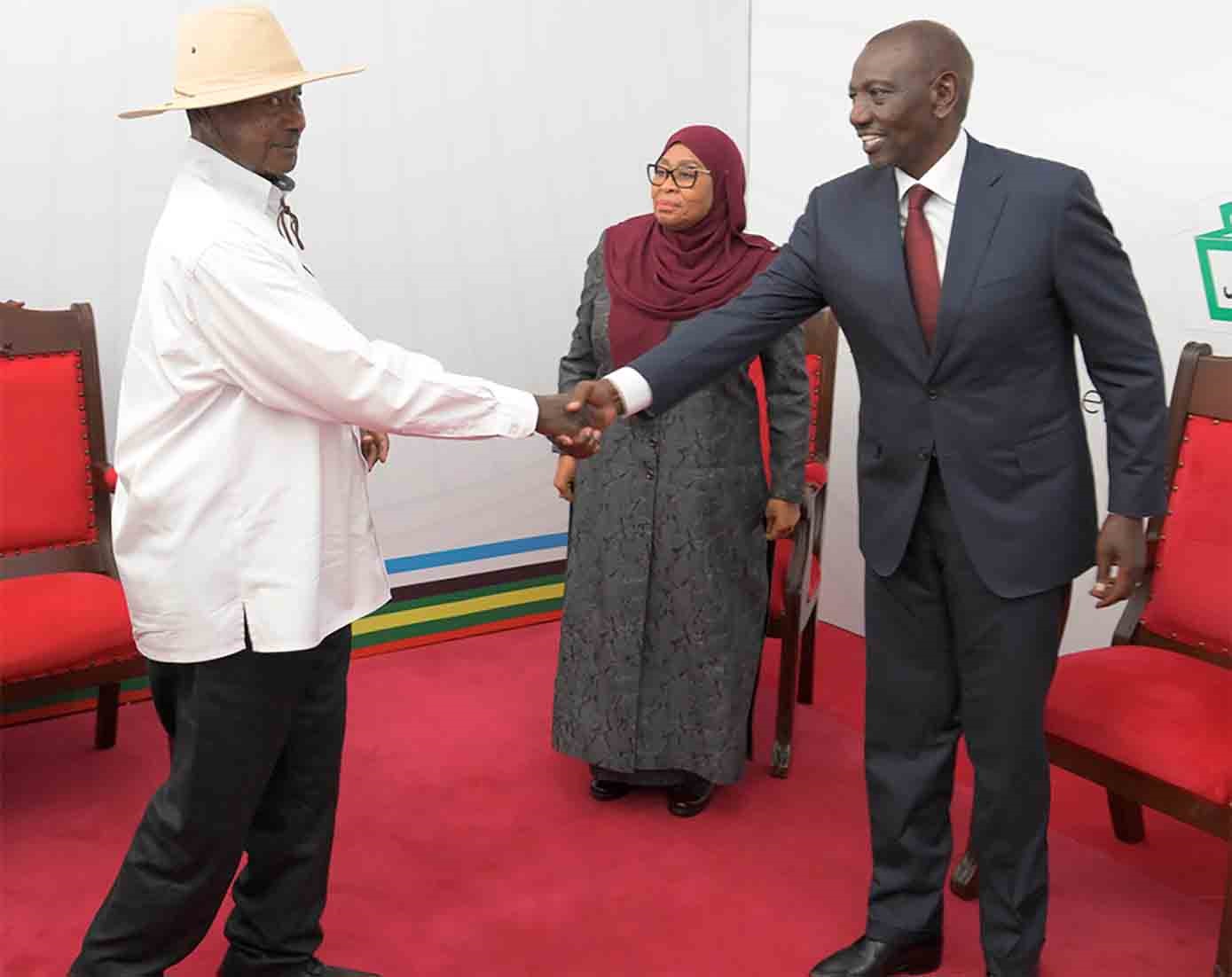
The 3 EAC heads of State (L-R) Presidents Museveni, Suluhu and William Ruto
HABARI DAILY I Kampala, Uganda I President Yoweri Museveni has urged African leaders to accelerate regional integration as a key step toward unlocking the continent’s vast economic potential, currently estimated at about $3.6 trillion.
Speaking after assuming the rotating chairmanship of the East African Community during a summit in Arusha, northern Tanzania, Museveni warned that failure to unite economically and politically could derail Africa’s long struggle for prosperity.
Using a traditional Ugandan concept known as “okukonesa,” Museveni likened the danger to undercooking food by failing to apply enough heat for the required time, leaving it spoiled and difficult to salvage.
“In our language we call it okukonesa — when food is not cooked enough because the fire was not sustained,” he said. “Africa must avoid that mistake in its revolution for freedom and development.”
Museveni cautioned that unless African nations deepen cooperation, the continent risks replacing the ideals of unity with division.
“Instead of Uhuru na Umoja — freedom and unity — we risk ending up with Uhuru na Uhasama, freedom and discord,” he said.
Tracing Africa’s historical trajectory, Museveni said the continent’s vulnerability began centuries ago when European explorers and traders arrived with advanced technologies and maritime power.
He cited the arrival of Portuguese explorer Vasco da Gama on the East African coast in 1498 as a turning point that eventually opened the door to centuries of slave trading and colonial rule.
By the start of the 20th century, almost the entire continent had been colonized, with the notable exception of Ethiopia, which successfully resisted European domination after defeating Italy during the Battle of Adwa in 1896.
Despite that history, Museveni noted that African resistance movements and intellectual leaders later mobilized the struggle for independence. He highlighted the influence of Pan-African thinkers such as W. E. B. Du Bois and Marcus Garvey, as well as liberation movements like the African National Congress.
By 1963, dozens of African nations had gained independence amid a powerful global anti-colonial wave.
Museveni said the continent’s next major task is economic transformation, which he argued requires the creation of larger markets capable of supporting industries and attracting investors.
“The more buyers you have, the more prosperous you become,” he said, stressing that deeper economic integration in East Africa and across the continent is essential.
He pointed to major economies such as the United States, China and India as examples of how large domestic markets can fuel industrial growth and innovation.
While Africa’s collective economy is estimated at $3.6 trillion, Museveni said this remains far smaller than those global giants, underscoring the need to expand trade through initiatives like the African Continental Free Trade Area.
Beyond economic cooperation, he also emphasized the importance of political integration within regional blocs, arguing that stronger federations would enhance Africa’s strategic security.
“Strategic security can only come from political integration,” Museveni said, adding that unified states would be better able to defend themselves across land, air, sea and even space.
He praised historic Pan-African leaders including Julius Nyerere, Kwame Nkrumah and Ahmed Sékou Touré for championing African unity.
Museveni concluded by urging young Africans to revive the ideals of solidarity and cooperation championed by earlier generations.
Recalling a conversation he once had with Nyerere in Arusha, Museveni said the region’s shared cultural heritage — including the widespread use of Swahili language — should inspire deeper unity.
“What God has put together, man should not separate,” he said, urging leaders and citizens alike to recommit to the vision of a united and prosperous Africa.







About the Author