
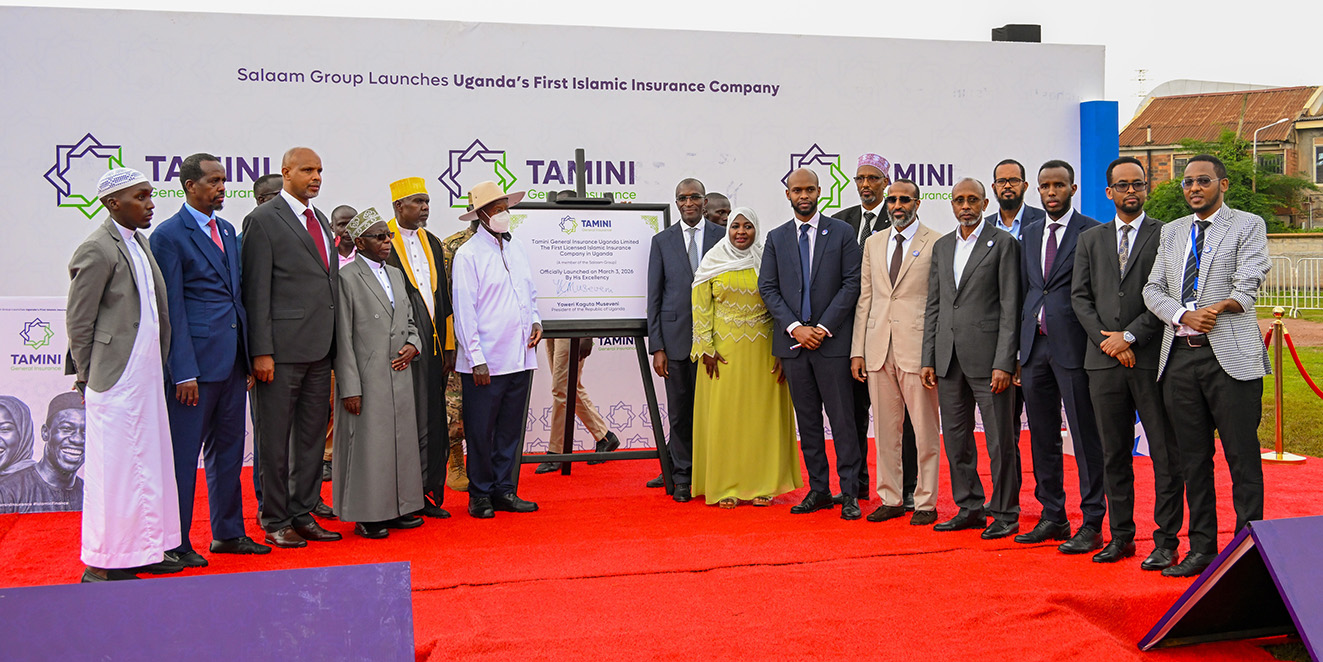
Museveni in a group photo with beneficiaries after launching the first Islamic insurance firm
HABARI DAILY I Kampala, Uganda I Hardworking Ugandan women have been commended for their central role in driving household incomes and strengthening the national economy.
The commendation was sounded by President Yoweri Museveni, who pledged increased government support to uplift Muslim families as he launched the country’s first Islamic insurance firm.
Speaking at Millennium Park in Lugogo, Kampala, during an Iftar dinner organised by the Senior Presidential Advisor on Political Affairs and Head of the NRM National Chairman’s Office, Hajjat Hadijah Namyalo, the President applauded women for their resilience and active participation in wealth creation initiatives. The event marked the official launch of Tamini General Insurance, Uganda’s first Sharia-compliant insurance provider.
Museveni pledged to increase government funding directed at supporting Muslim women and their families from Shs2 billion to Shs20 billion, underscoring his administration’s commitment to inclusive economic empowerment.
“Women are working hard in markets, in agriculture and in small enterprises. Their efforts are transforming homes and contributing to national development,” Museveni said. “We must support them with affordable financial services so that they can expand their activities and eliminate poverty.”
Tamini General Insurance is a conglomerate of Salaam Group and is designed to offer Sharia-compliant insurance services based on mutually beneficial terms, with joint guarantees between insurers and the insured. The firm completes what the President described as a “comprehensive financial cycle” by pairing Islamic financing with insurance coverage.
“Salaam Bank and Tamini, you are welcome to Uganda. Uganda is a growing market with over 45 million people. The population will reach 100 million by 2050. You are in Uganda at the right time,” Museveni said, rallying the Muslim community to invest in commercially viable ventures rather than focusing on consumptive spending.
He emphasized that insurance is critical for sustainable enterprise. “Insurance is about preparing so that in case anything goes wrong, you have backup. When you borrow, you invest but what if things do not go as planned? I thank Tamini Insurance for completing the cycle,” he noted.
The President also highlighted government interest-free wealth creation initiatives such as the Parish Development Model (PDM), explaining that the six per cent annual charge attached to PDM funds is intended solely to control inflation and maintain the stability of the revolving fund. He urged the Muslim community, especially women, to take full advantage of such programs.
“We should work to eliminate poverty by getting everyone out of poverty. PDM will help to ensure the remaining 30 percent of Ugandans also gets out of poverty,” he said.
In a move aimed at strengthening women’s inclusion, Museveni directed PDM management committees to adopt a matrilineal approach in selecting beneficiaries. He explained that tracing kinship through the female line would ensure broader family inclusion, particularly in polygamous households where some women-led families might otherwise be excluded under a strictly patrilineal system.
Mr. Mohamed Bahdon, Group CEO of Tamini Insurance, outlined the firm’s three operational pillars: ethical investment, transparent oversight, and collective participation. He said the Sharia-based insurance model would expand financial inclusion and align with Uganda’s Vision 2040 development aspirations.
“A farmer who accesses Halal financing from Salaam Bank to grow his crop can now insure that crop through Tamini,” Bahdon said. “This will result in Uganda’s economic transformation from a consuming nation into a producing nation.”
The Chief Executive Officer of the Insurance Regulatory Authority, Ibrahim Kaddunabbi Lubega, revealed that Uganda’s insurance sector has grown to over Shs2 trillion in gross written premiums. He expressed optimism that the introduction of Sharia-compliant insurance would further boost the industry’s expansion.
Globally, Sharia-based insurance—also known as Takaful—is valued at approximately USD 36.6 billion and is projected to surpass USD 75 billion by 2033. Kaddunabbi said Uganda’s adoption of the model presents immense growth opportunities for the country’s financial services sector.
Hajjat Namyalo noted that Tamini General Insurance would particularly focus on the informal sector, including market vendors and communities in disaster-prone areas—segments where women dominate economic activity but often lack insurance coverage.
Meanwhile, Sheikh Muhammad Yunus Kamoga of the Tabliq Muslim sect thanked President Museveni for fostering unity among Muslims and promoting equal opportunities for all religions. He praised the establishment of Muslim education and financial institutions and requested presidential pardon for two prominent Muslims currently under detention.
As Uganda embraces Islamic finance and insurance, Museveni’s message remained clear: empowering hardworking women—especially through inclusive financial systems—remains central to the country’s journey toward broad-based prosperity and poverty eradication.







About the Author