
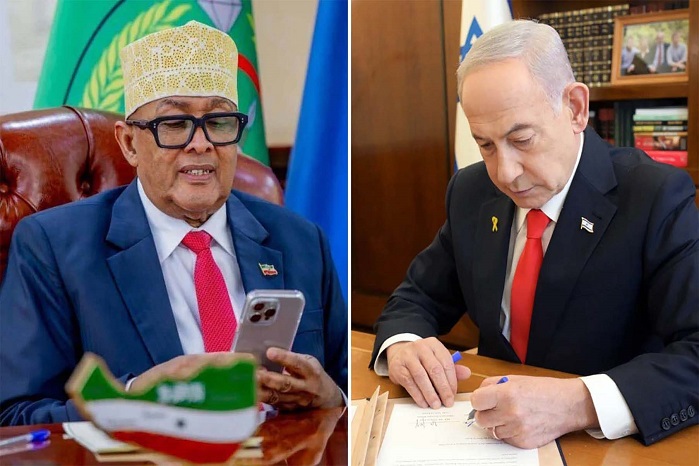
Natenyahu (R) on Friday recognised Somaliland as an independent state, and its President, Abdirahman Mohamed Abdallah (L) as its sovereign leader
HABARI DAILY I Kampala, Uganda I The Uganda Government is facing a delicate diplomatic dilemma following Israel’s announcement that it has recognised Somaliland as an independent and sovereign state, a move that cuts against Kampala’s long-held position on territorial integrity in Africa and risks straining regional relations in the Horn of Africa.
Uganda has consistently rejected the independence of Somaliland, insisting instead on the reunification of the breakaway region with Somalia. President Yoweri Museveni has been unequivocal on the matter, arguing that secession weakens African states and undermines long-term security.
“We don’t support secession because strategically, it is wrong,” Museveni has said, warning that fragmenting states only creates new vulnerabilities.
In September 2023, Museveni went a step further by agreeing to act as a “unification facilitator” between Somalia and Somaliland after receiving a special envoy from Hargeisa. At the time, State House said the President believed reunification could help stabilise the Horn of Africa and strengthen collective efforts against transnational threats such as the al-Shabaab insurgency, which has continued to menace Somalia and the wider region.
Israel’s declaration, announced on Friday by Prime Minister Benjamin Netanyahu, has complicated that position. Netanyahu said Israel had “officially recognised the Republic of Somaliland as an independent and sovereign state,” describing the move as historic and consistent with Israel’s drive to expand diplomatic ties beyond the Middle East.
He said a joint declaration had been signed with Somaliland’s leadership “in the spirit of the Abraham Accords,” the US-brokered normalisation framework launched under former US President Donald Trump.
The announcement is expected to provoke a strong reaction from Somalia’s federal government in Mogadishu, which considers Somaliland an integral part of its sovereign territory and has long lobbied against any international recognition of the region. Somaliland declared independence from Somalia in 1991 following the collapse of the central government and has since maintained its own administration, currency and security forces, but has remained diplomatically isolated.
Uganda’s stance mirrors that of the African Union, which has repeatedly rejected recognition of Somaliland and upheld the principle of the inviolability of colonial borders inherited at independence. AU member states fear that endorsing Somaliland’s independence could embolden other separatist movements across the continent, from the Sahel to the Great Lakes region.
At the same time, Kampala must balance its principled position with its broader foreign policy interests. Uganda enjoys warm relations with Israel, particularly in security cooperation, agriculture and technology.
Israel’s stated intention to deepen ties with Somaliland in areas such as health, farming and economic development underscores the strategic calculations now reshaping the Horn of Africa, a region that sits astride critical Red Sea and Gulf of Aden shipping lanes.
Netanyahu congratulated Somaliland President Abdirahman Mohamed Abdallah for what he called his commitment to stability and peace and invited him to visit Israel, while also praising Israel’s foreign and security establishments for the breakthrough.
For Uganda, the episode underscores the tension between solidarity with African Union norms and the reality of shifting global alliances. As Museveni has argued, unity remains central to Africa’s strength.
How Kampala navigates Israel’s move—without alienating Somalia, undermining AU consensus or straining key partnerships—will test its diplomatic agility in an increasingly fragmented international order..







About the Author