
Museveni, Ruto To Launch SGR Extension To Malaba Border As East Africa Strengthens Railway Transport

The Kenyan SGR is already operational
HABARI DAILY I Kampala, Uganda I Presidents Yoweri Museveni of Uganda and William Ruto of Kenya are set to meet on March 20, 2026 in Kisumu to officially launch the construction of the Standard Gauge Railway (SGR) extension from Naivasha toward the Ugandan border, marking a major milestone in regional infrastructure development.
The high-level ceremony will signal the beginning of a multi-billion-dollar railway project designed to connect Kenya’s existing Nairobi–Naivasha SGR line to Malaba at the Uganda border and eventually extend the modern railway to Kampala.
Kenya’s Standard Gauge Railway currently runs from the Indian Ocean port city of Mombasa to Naivasha in central Kenya. The absence of an extension beyond Naivasha has long complicated Uganda’s plans to construct its own SGR network, leaving the landlocked country reliant on costly road transport for cargo moving to and from the sea.
Officials from Uganda’s Ministry of Works and Transport say the extension is expected to transform freight movement between the two countries and reduce the heavy costs associated with road transportation.
The Kenyan section of the project, stretching from Naivasha to Malaba, is expected to cost more than $5.5 billion, while the Ugandan segment from Malaba to Kampala is estimated at about $3 billion.
Uganda has already begun preliminary work on its section of the railway after contracting Turkish construction firm Yapi Merkezi to undertake the project. The company has started geotechnical surveys and infrastructure mapping along the proposed 273-kilometre route linking Malaba to Kampala.
In January this year, officials from the Islamic Development Bank held discussions with Ugandan authorities regarding a potential contribution of €405 million to support the railway project.
The railway line is expected to significantly improve transport efficiency between Uganda and Kenya while strengthening trade across the East African region.
According to a statement from the Kenyan government, once the line is completed, travel time between Kampala and Nairobi could drop from about 14 hours to roughly four hours, while freight transport costs are expected to fall by nearly 35 percent.
“The Nairobi–Kampala rail link is projected to be completed by 2028, forming a crucial part of the East African regional transport network. The line is also expected to be extended in the future to Rwanda and the Democratic Republic of Congo to facilitate wider cross-border trade,” the statement reads.
The project follows a bilateral agreement signed in March 2025 in which Uganda and Kenya committed to harmonising railway technical standards to ensure seamless connectivity between their transport systems.
Speaking recently in Osukuru, Tororo District during the groundbreaking ceremony for the Devki Mega Steel Project alongside President Museveni, President Ruto described the SGR extension as a joint venture between the two countries aimed at deepening regional integration.
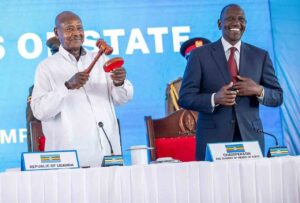
President Museveni interacting with his Kenyan counterpart, President William Ruto recently
“In early 2026, we will be launching the extension of the SGR from Naivasha to Kampala to connect with the Malaba-Kampala line and later to the DRC,” Ruto said.
Transport experts say the railway will bring extensive economic benefits to Uganda and the wider region.
According to Bageya Waiswa, the Permanent Secretary at the Ministry of Works and Transport, the Uganda SGR network will eventually have the capacity to move between 20 and 30 million tonnes of cargo annually.
“It will reduce road damage, lower emissions and cut the cost of doing business. In effect, the SGR will position Uganda as the trade and logistics hub of East and Central Africa,” Waiswa said during the Inaugural National Content Symposium for the Development of the SGR held at Speke Resort Munyonyo.
He added that efficient railway transport would spur industrialisation by making it easier for manufacturers to operate inland while also enabling farmers to access regional and international markets at lower transport costs.
Economists have also pointed out that shifting bulk cargo from roads to rail will reduce road maintenance costs and ease congestion caused by heavy trucks.
Charles Ocici, director general of Enterprise Uganda, said the SGR could significantly lower the cost of doing business.
“The transport costs have been a major factor when it comes to the cost of doing business in Uganda. Once the SGR connects Uganda directly to Mombasa port, it will reduce commodity prices and make trade more efficient,” Ocici said.
He also noted that the railway construction itself will generate economic opportunities for Ugandan businesses through the supply of construction materials and services.
Beyond freight transport, officials believe the modern railway will also improve passenger travel, reduce road accidents and create jobs for thousands of people during construction and operation.
As the region prepares for the March 20 launch, policymakers say the SGR project represents not just a transport upgrade but a strategic investment aimed at strengthening economic integration within the East African Community and unlocking trade across the wider Great Lakes region.
About the Author