
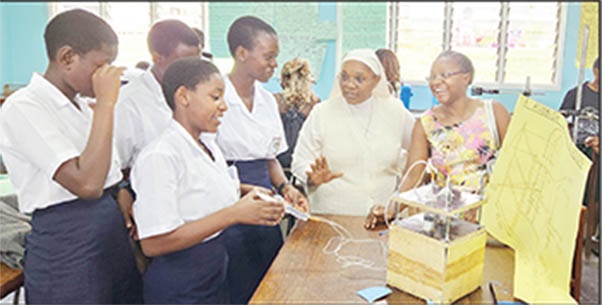
Senior Five students at Mt St Mary’s College Namagunga showing Sr Regina Nabawanuka (centre) and another guest a prototype rubbish compressor
HABARI DAILY I Kampala, Uganda I Uganda’s competence-based curriculum is increasingly proving its value in nurturing creativity, critical thinking and practical problem-solving skills among learners, as demonstrated by students of Mt St Mary’s College Namagunga during their annual education fair.
The exhibition, held under the theme Innovation for Impact: Science, Technology, Engineering, Arts and Mathematics as an Engine for Sustainable Economic Transformation, showcased a wide range of student-led innovations designed to tackle real-life community challenges. From smart agriculture concepts to affordable health solutions, the projects reflected a shift from theoretical learning to hands-on application.
Education experts say this transformation is at the heart of Uganda’s competence-based curriculum, which emphasizes skills acquisition, creativity and innovation over rote memorisation.
Speaking at the event, the school headmistress, Sr Regina Nabawanuka, noted that the goal of the fair is to inspire learners to think beyond the classroom. “We want our students to create solutions that have a real impact in society, not just display academic concepts,” she said, adding that each project must address a specific community problem.
One of the standout innovations was a prototype rubbish compressor designed by Senior Five students, illustrating how interdisciplinary learning is shaping modern problem-solving approaches. The project integrates physics, engineering and environmental awareness.
According to student innovator Mary Kyompaire, the machine operates on Pascal’s principle, where pressure applied to a confined fluid is transmitted equally. Using water-filled syringes acting as pistons, the device transfers pressure to compress waste into compact blocks.
“We use water as the fluid. When pressure is applied through the syringes, it is distributed evenly, allowing the compression plate to reduce the volume of rubbish,” she explained.
Her teammate, Emmanuella Ssanyu, said the idea was inspired by a common community challenge where garbage spills from trucks during transportation, causing environmental pollution. The prototype was built using locally available materials, including metal rods, wooden plates and plastic tubing—demonstrating resourcefulness and practical application of classroom knowledge.
However, the students cited limited funding as a barrier to scaling up the innovation, calling on stakeholders to support young innovators.
Another project that captured attention was an eco-friendly roofing solution developed by Senior Two students using recycled plastics. Led by Zoe Rowena Tuyizere, the team sought to address both plastic waste and housing challenges in vulnerable communities.
“Plastic is strong, waterproof and durable. By using it for roofing, we can provide affordable shelter while reducing environmental pollution,” she said.
The group used plastic bottles and polythene to construct the roofing structure, while leftover materials were melted using a solar-powered parabolic mirror they designed—ensuring an environmentally friendly process. Additional features, such as mud and grass layers, were incorporated to regulate indoor temperature and light.
Fellow students Precious Nandutu and Ann Louise Matte explained that the design balances durability, affordability and environmental sustainability.
The innovations on display highlight how Uganda’s competence-based curriculum is equipping learners with the ability to identify problems, think critically and develop practical solutions. As schools continue to embrace this approach, educators believe it will play a crucial role in shaping a generation capable of driving sustainable development and economic transformation.







About the Author