Dan Nokrach Odongo
HABARI DAILY I Kampala, Uganda I The Uganda National Examinations Board (UNEB) has released the results of the 2025 Primary Leaving Examinations (PLE), revealing a modest improvement in overall performance, a rise in candidature.
According to UNEB, 91,990 candidates passed in Division One, representing 11.39 percent of those who sat the examination. This is an increase of 7,689 candidates compared to 2024.
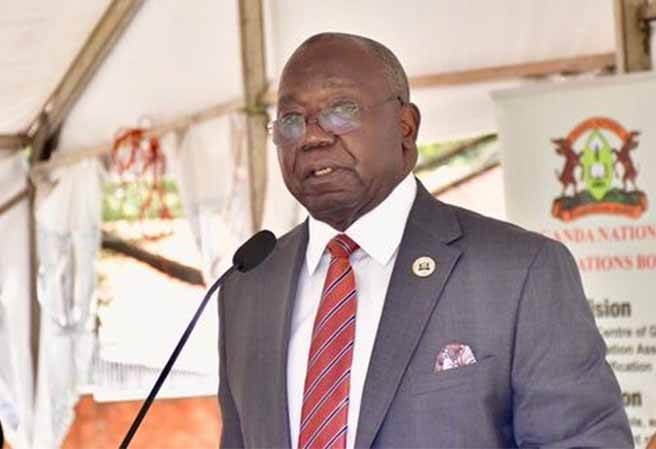
“More candidates passed in Division One in 2025 than in 2024,” Odongo said. “In terms of numbers, more candidates—7,503—passed the 2025 PLE compared to last year.” Dan Nokrach Odongo, the Uganda National Examinations Board (UNEB) Executive Director and Secretary to the Board.
He added that the largest proportion of candidates—48.1 percent—passed in Division Two, while 20.47 percent were in Division Three. Candidates in Division Four accounted for 10.49 percent, while 9.55 percent were ungraded.
Presenting the results earlier today, Odongo said that the examinations were successfully conducted despite logistical and environmental challenges in several parts of the country.
“We thank God that despite the bad weather and damaged roads and bridges in parts of the country, heroic efforts by the Local Governments and UNEB monitors ensured that the conduct of the examination in those areas was successfully completed,” Odongo said.
He noted that a total of 817,883 candidates registered for the 2025 PLE, an increase of 20,439 candidates (2.6 percent) compared to 2024. Of these, 807,313 candidates sat the examination, while 10,570 were absent, maintaining an absentee rate of 1.3 percent, the same as the previous year.
Odongo noted that the steady absentee rate reflects improvements in examination administration and candidate retention. “The percentage of absentee candidates in 2025 remained the same as that of 2024, but lower than the previous years,” he said.
More Girls Complete Primary
Gender analysis shows that girls accounted for 52.4 percent of the registered candidates, compared to 47.6 percent boys, continuing a trend observed over the last several years.
“This indicates that more girls than boys completed the Primary Education cycle,” Odongo said, adding that the trend has remained consistent in recent examinations.
Of the total candidates, 63.8 percent were Universal Primary Education (UPE) beneficiaries, while 36.2 percent came from non-UPE schools, reflecting continued reliance on the public education system.
English Improves, SST Declines
At subject level, UNEB’s analysis shows that English was the best performed subject, with 91.9 percent of candidates scoring Grade 8 or better, an improvement from 2024.
“Compared to 2024, English showed an improvement,” Odongo said. However, Social Studies with Religious Education (SST) recorded a notable decline. Only 86.7 percent of candidates attained Grade 8 or better, down from 91.9 percent in 2024.
“Social Studies with Religious Education was worst done,” Odongo noted, attributing the decline partly to teaching methods that have not adapted to the competency-based curriculum.
“Teachers, especially of Social Studies and Religious Education, appear not to be adjusting their teaching methods in this direction,” he said.
Ability level declines
An item response analysis conducted by UNEB shows that less than 20 percent of candidates demonstrated higher ability levels in any of the four subjects examined—English, Mathematics, Integrated Science, and SST.
“Like in 2024, less than 20 percent of the candidates exhibited higher ability levels in any of the subjects,” Odongo said.
About two-thirds of candidates fell within the medium ability category, meaning they could recall facts and apply them in familiar situations but struggled to transfer knowledge to new contexts.
“This explains why candidates had difficulty in answering questions that required application of knowledge, particularly in relation to their communities and the country,” Odongo explained.
Boys perform better than girls
Overall, boys performed slightly better than girls, particularly at the higher divisions. Boys recorded a lower failure rate and a higher proportion in Divisions One and Two.
“The table shows that, in terms of percentages, males performed better than the females and recorded a lower failure rate,” Odongo said.
However, girls continued to outperform boys in English, maintaining a long-standing trend.
Special Groups perform better
UNEB also reported results for special candidate groups, including prison inmates and learners with special needs.
At Luzira Upper Prison School, four candidates obtained Division One, while at Mbarara Main Prison, seven candidates passed in Division One.
“The number of Special Needs candidates continues to increase annually due to the awareness that has been created in the schools by UNEB and the Ministry of Education and Sports,” Odongo said.
Examination Malpractice rise
Odongo raised concern over increasingly brazen cases of examination malpractice, involving bribery and intimidation of invigilators.
“Examination malpractice has now taken a brazen form where scouts and invigilators are bribed or threatened with physical harm by school directors and headteachers,” he said.
UNEB has withheld results from affected centres pending investigations, particularly in districts such as Kampala, Mukono, Kisoro, Namutumba, Kassanda, Buyende and Kaliro.
“In accordance with the UNEB Act, the Board will withhold the results of the affected candidates pending completion of investigations,” Odongo said, assuring that all affected candidates would be accorded a fair hearing.
In her remarks, Mrs Janet Museveni, the minister of Education and Sports, hailed all the participants in the examinations cycle, adding that continuous assessment is the way to go if Uganda’s education sector is to improve.
The results will be available through school centres, UNEB offices, and via SMS on MTN and Airtel networks.







About the Author