
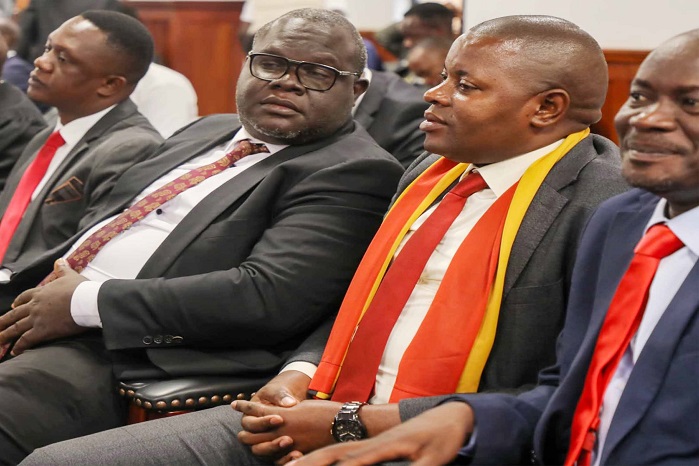
A cross section of lawyers listening to the petition at the Supreme Court
HABARI DAILY I Kampala, Uganda I The Supreme Court has rejected an application by former presidential candidate Robert Kasibante seeking to adjourn proceedings in his election petition, ruling that any delay would undermine the strict constitutional timelines governing presidential election disputes.
In a decision delivered in Kampala on Wednesday, January 28, the court held that granting the adjournment would be inconsistent with Article 104 of the Constitution, which requires presidential election petitions to be heard and determined expeditiously. The ruling means the court will proceed to hear the petition without the additional disclosures and forensic inspections sought by the petitioner.
Kasibante, who contested the January 15, 2026 presidential election on the National Peasants Party ticket, had asked the apex court to delay the hearing and compel the Electoral Commission to produce internal operational documents and submit its biometric voter verification machines to a forensic audit before the substantive hearing could begin.
In dismissing the application, the justices emphasised that presidential election petitions are subject to rigid timelines intended to safeguard political stability and certainty. They found that the requested adjournment and pre-hearing processes would risk derailing the constitutionally mandated schedule.
Kasibante filed his petition on January 17, within the ten-day period prescribed by law, challenging the outcome of the presidential election. His case raises questions about the conduct and independence of the Electoral Commission, including alleged failures in biometric voter verification and claims of non-compliance with electoral laws.
With the procedural application out of the way, the court is now expected to focus squarely on the substantive merits of the petition.
President Yoweri Kaguta Museveni, who was declared winner of the election, has already filed a response through his legal team from K&K Advocates, led by senior counsels Usaama Sebuufu, Anthony Bazira and Edwin Karugire. In the response, the President denies all allegations of electoral malpractice and argues that the petition is legally defective and unsupported by evidence.
Museveni maintains that the election was conducted in full compliance with the Constitution, the Electoral Commission Act and the Presidential Elections Act. He has asked the court to dismiss the petition with costs.
Kasibante’s petition accuses Museveni, the Electoral Commission and the Attorney General—named as the first, second and third respondents respectively—of presiding over an election marred by widespread irregularities. These include allegations of violence, voter bribery, intimidation, abuse of state resources and systemic non-compliance with electoral laws.
According to the petition, the Electoral Commission declared Museveni the winner with 7,946,772 votes. Opposition leader Robert Kyagulanyi Ssentamu was announced runner-up with 2,741,238 votes. Nathan Nandala Mafabi garnered 209,039 votes, Gen Gregory Mugisha Muntu polled 59,276 votes, Frank Buura received 45,959 votes, Mubarak Munyagwa secured 31,666 votes, while Kasibante himself obtained 33,440 votes.
The Supreme Court is expected to issue further directions on the conduct of the hearing, during which justices will receive detailed submissions from all parties. The court will then determine whether the 2026 presidential election results should be upheld or nullified, in line with constitutional requirements.







About the Author