
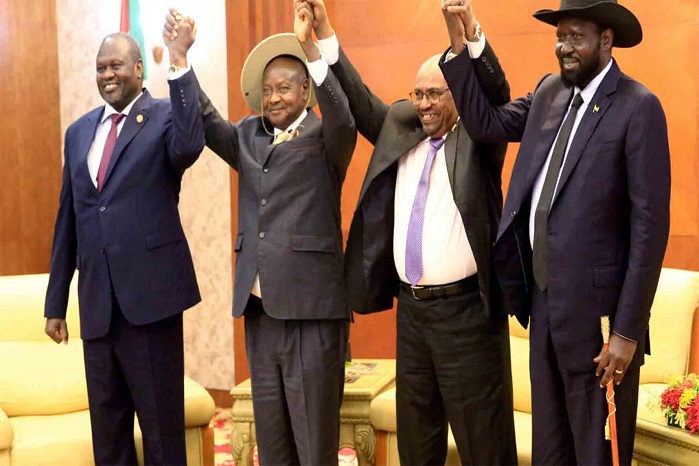
South Sudan’s President, Salva Kiir (R) shakes hands with regional leaders after the main rebel group headed by Dr Riek Machar (L) signed a final power-sharing deal. On Monday, 22 September 2025, Dr Riek Machar, and the co-accused appeared before a televised special court established by the government to answer to charges of treason
HABARI DAILY I Kampala, Uganda I A sweeping wave of arrests targeting former ministers and senior officials has sent shockwaves through South Sudan, deepening political uncertainty and raising fresh questions about governance, accountability and internal power struggles within President Salva Kiir Mayardit’s administration.
At the centre of the unfolding drama is Dr Barnaba Bak Chol, the recently dismissed finance minister, who was arrested late Friday night while allegedly attempting to flee to Uganda. Security sources, quoted by South Sudan media outlet Radio Tamazuj, said Bak was intercepted around 8pm in the border town of Nimule as he tried to cross into Uganda using an unofficial route on a boda boda motorcycle.
Footage circulating widely on social media shows the 43-year-old former minister with apparent bloodstains on his clothes, following what witnesses described as a pursuit by security operatives. In one video clip, Bak is heard pleading with officers not to film him after being captured near the Elegu–Nimule border crossing. Photos from the scene appear to show a large, undisclosed sum of US dollars allegedly seized during the arrest. By press time, the government had not issued a formal statement explaining the circumstances or charges.
Sackings aired on national radio
Many sackings of public officials in Government are just announced on public radio. Similar to that scenario, Bak’s arrest came just four days after President Kiir fired him in a presidential decree broadcast on South Sudan Broadcasting Corporation, abruptly ending a tenure that had lasted slightly over three months. He formally handed over office to his successor, Salvatore Garang Mabiordit, on Thursday, a day before his reported detention.
The dramatic turn of events directly contradicts Bak’s own public assurances earlier in the week. On Tuesday, amid growing speculation on social media, he issued a statement denying that he had been arrested by the National Security Service (NSS).
“I want to reassure everyone that I’m safe, well, and continuing with my normal activities,” Bak said. “The reports circulating on social media claiming that I have been arrested are completely false. I remain at peace and in good health.”
In the same statement, he expressed gratitude to President Kiir for the opportunity to serve, describing his role as finance minister as a “profound honour,” and thanked colleagues, development partners and citizens for their support. He reaffirmed his commitment to “peace, stability, and prosperity” in South Sudan.
However, Friday’s developments suggest that tensions had escalated rapidly behind the scenes.
Bak, a professor at the University of Juba, previously served as finance minister from August 2023 until March 2024 before being reappointed on November 4. His sudden dismissal on Monday was not accompanied by any official explanation, but it came amid mounting economic pressure, growing scrutiny of financial institutions, and deepening public frustration over the country’s persistent fiscal woes.
Widespread crackdown
His detention appears to be part of a broader crackdown sweeping across the finance and security sectors. Earlier this week, former central bank governor Moses Makur Deng Manguak was placed under house arrest in Juba. On Thursday, former finance minister Dr Marial Dongrin Ater was arrested in Rumbek and flown to the capital under heavy security.
In parallel, Maj Gen Manasseh Machar Bol, a senior security official formerly stationed at the Ministry of Petroleum, was also taken into custody. On Friday, Deng Lual Wol, the former undersecretary at the Ministry of Petroleum, was reportedly detained after reporting to the NSS for questioning.
The motives behind the sudden spate of arrests remain unclear, fuelling speculation about internal power struggles, corruption probes, or efforts by the presidency to reassert control over key state institutions.
South Sudan has long grappled with entrenched corruption, weak accountability frameworks and chronic mismanagement of public resources. Billions of dollars in oil revenues have flowed through state coffers since independence, yet basic services remain severely underfunded, and much of the population continues to face extreme poverty.
Economic degeneration
The current crackdown comes at a time of intensifying economic strain. The country is battling currency instability, soaring inflation and declining oil revenues, further complicated by disruptions in regional oil export routes. These pressures have heightened scrutiny of public finance management and increased demands for transparency.
For many observers, the arrests signal a potentially significant shift in President Kiir’s approach to governance, though questions persist about whether the actions will lead to genuine reforms or merely deepen political uncertainty.
As the government remains silent on the reasons behind the detentions, South Sudanese citizens and international partners alike are watching closely, seeking clarity on whether this dramatic sweep will usher in accountability—or further unsettle an already fragile nation.
General elections are due to be held in South Sudan on 22 December 2026, the first since independence







About the Author