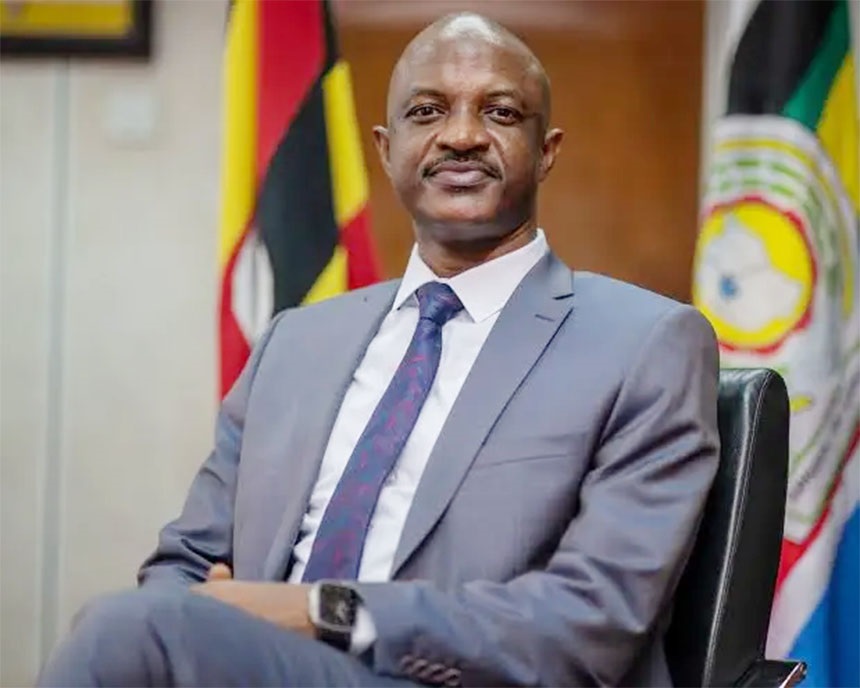
Ramathan Ggoobi, the PSST
HABARI DAILY I Kampala, Uganda I As many Ugandans as ever before are set to use savings as a safety net during emergencies, to implement investments in education or property, and contribute to long-term financial goals like retirement.
According to Uganda’s development aspiration “Vision 2040,” the country aspires to transform its society from a peasant to a modern and prosperous middle-income country by 2040, with per capita income of $9, 567. Uganda’s current savings-to-GDP rate stands at 20.39%, according to NSSF.
Economists have pointed out that in order to attain the vision, savings as a percentage of GDP should be over 35%.
Ramathan Ggoobi, the Permanent Secretary at the ministry of finance said that the nation’s financial institutions should aid in the doubling of the national savings rate to 40% of GDP in the medium term.
“Uganda’s financial sector must double the national savings rate to 40% of GDP within 15 years, to unlock the $500 billion economy,” he said.
He emphasized the government’s appreciation for companies that offer savings solutions and investment group businesses, urging them to expand their services to meet the national target.
Researchers Vivian Nagawa, Francis Wasswa and Edward Bbaale, said that while achieving sustainable economic growth is one of the fundamental targets of most economies, over the years, domestic savings have been believed to be among the most influential determinants of economic growth.
“A nation’s domestic savings play a very imperative role in attaining rapid and sustainable economic growth, that is higher savings provide funds needed for investment, thereby prompting an expansion in production and employment eventually leading to economic growth and development,” they said in a research paper titled: Determinants of gross domestic savings in Uganda.
They further add that limited amounts of savings make sub-Saharan African countries exceedingly dependent on foreign help in form of aid and loans.
“To attenuate the vulnerability and defenselessness of an economy to external political and economic shocks, the nation ought to attempt to finance its investment needs using internally generated resources.”
How will it happen?
Whether it’s setting aside a few coins in a piggy bank or automating deposits into a savings account, individual savers are encouraged to prioritize saving for a more secure and prosperous future.
Many people have fronted the piggy bank, which is a common symbol of saving. This tool has historical roots dating back to ancient times.
In Austria for instance, the official mascot of saving, “Sparefroh” (Happy Saver), became more popular than the country’s president during the 1970s.
NSSF Counsels
According to the National Social Security Fund (NSSF), Uganda’s financial ecosystem offers a variety of saving tools that cater to low and middle-income earners.
“These include mobile money platforms like MTN Mobile Money and Airtel Money, which allow users to save, send, and withdraw money at their convenience,” it says, adding that community-based models such as Village Savings and Loan Associations (VSLAs) and Savings and Credit Cooperative Organizations (SACCOs) offer peer support, small loans, and a sense of collective accountability.
NSSF further notes that formal banking institutions provide savings accounts with flexible plans and low minimum balances.
For those with more financial knowledge, unit trusts, government bonds, and Treasury Bills offer investment options with varying risk and return profiles.
“These tools provide savers with the opportunity to grow their wealth while minimizing risk through diversification. Fixed deposit accounts, available in banks and microfinance institutions, also offer a safe way to earn interest over a set period, encouraging longer-term saving.”
Vibrant Regulation
Behind Uganda’s growing savings infrastructure is a robust regulatory foundation laid by the Uganda Retirement Benefits Regulatory Authority Act, 2011.
This law, enforced by the Uganda Retirement Benefits Regulatory Authority (URBRA), introduced reforms to make retirement saving more accessible and flexible.
One such reform is the legalization of voluntary retirement benefits schemes, which enable individuals — including informal sector workers — to save small amounts, even as low as Shs 2,000 per day.
The law also provides for the portability of benefits, ensuring that savings are not lost when one changes jobs or schemes. Furthermore, trustees can tailor benefits to the needs of savers, including income drawdowns and medical cover, making retirement schemes more relevant to Ugandans.







About the Author