
HABARI DAILY I Kampala, Uganda I Uganda’s long-awaited oil production milestone has drawn closer after the country surpassed the minimum number of wells required to commence commercial production. Officials have confirmed that 187 wells have so far been drilled under the Tilenga project — exceeding the 170 wells needed for Uganda to achieve first oil, which is scheduled for July 2026.
The announcement was made by Ernest Rubondo, executive director of the Petroleum Authority of Uganda (PAU), following a two-day supervisory visit to oil project sites in Buliisa district, north and south of the River Nile.
“In terms of drilling, we have now exceeded the required number of wells necessary for first oil,” Rubondo told journalists at the end of the inspection. “All key players are working together to ensure that first oil is achieved as planned by July 2026.”
The Tilenga project, operated by TotalEnergies EP Uganda, plans to drill a total of 420 wells across 29 well pads. At peak output, the project is expected to produce up to 190,000 barrels of oil per day, positioning Uganda among Africa’s emerging oil producers.
Rubondo’s inspection tour included visits to Jobi-Rii 4, 5 and 10 well pads, where he reported positive progress. The drilling milestone is particularly significant because it confirms Uganda has already met and surpassed the threshold required to technically initiate oil production once surface facilities and export infrastructure are fully completed.
Critical Infrastructure Advancing
Beyond drilling, officials say progress on associated infrastructure is equally encouraging. At the Horizontal Directional Drilling (HDD) crossing point — where flowlines pass beneath the River Nile — restoration works are underway following the successful installation of underground pipelines.
These flowlines will transport crude oil from well pads to the Central Processing Facility (CPF) in Buliisa district. Rubondo emphasized that restoration efforts at the crossing site reflect a commitment to environmental protection while advancing underground infrastructure.
At the Tilenga Industrial Area, several critical components of the CPF have already been completed. These include crude oil storage tanks, water treatment systems, pig launchers and receivers, and the central control building. Supporting infrastructure such as the drilling support base, construction camps, a 4,000-person accommodation facility, the water abstraction point and the Kasamene-2 well pad are either completed or nearing completion.
According to PAU, overall progress on the Tilenga project now stands at over 63 percent, with steady advancements in civil works, mechanical installations, infield flowlines and pipeline preparations.
Parallel Progress at Kingfisher
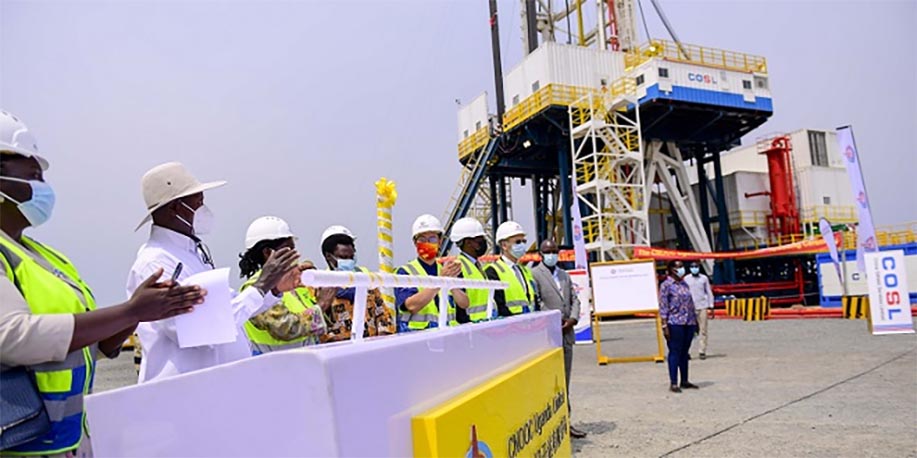
Uganda’s second upstream development, the Kingfisher Project operated by CNOOC Uganda Limited, is also ahead of schedule in terms of drilling. The project has drilled 21 wells so far, surpassing the 19 wells required for first oil.
In total, 31 wells are planned across four well pads at Kingfisher, located in Kikuube district. The project currently stands at 76 percent completion, further strengthening confidence that Uganda’s oil ambitions are on track.
Pipeline Nearing Completion
Meanwhile, the East African Crude Oil Pipeline (EACOP) — which will transport Uganda’s crude oil to the Tanzanian port of Tanga for export — has reached 80 percent completion. All 296 kilometres of pipeline designated for the Uganda section had been delivered by January 20, 2026, with more than 200 kilometres already welded within the country.
Rubondo also revealed that preparations are underway to bring in additional foreign technical experts as Uganda approaches the final and most critical phases before first oil. Furthermore, an investor has been identified for the proposed Kabaale-Hoima oil refinery, a project aimed at boosting domestic refining capacity.
With 187 wells already drilled — comfortably above the minimum requirement — Uganda’s oil sector appears technically ready for production. What remains is the final integration of surface facilities, pipeline systems and export infrastructure.
If timelines hold, July 2026 could mark the moment Uganda joins the ranks of oil-producing nations, backed by a well count that has already surpassed expectations.
When it comes toroject Readiness, including upstream and midstream infrastructure, is reported between 75% and 90% in early 2026, ensuring the July 2026 target remains on track.
The government has confirmed that the Kabaale International Airport in Hoima is nearing completion to support the oil and gas sector’s logistical needs.







About the Author