
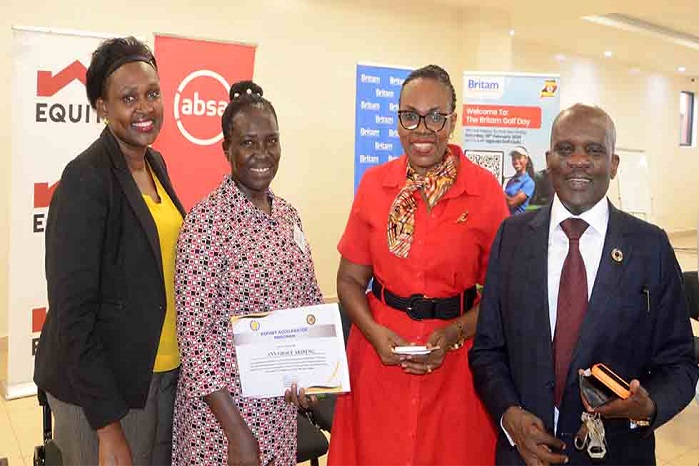
Charles Ocici (R), the Director General of Enterprise Uganda, and Rose Mutyabule (3rd L), Enterprise Uganda’s Director for Partnerships, awarding one of the graduates from the training at their headquarters in Butabika
HABARI DAILY I Kampala, Uganda I Uganda is steadily positioning itself to break into regional and international trade with renewed confidence, driven by a new wave of export-ready entrepreneurs, strategic training programmes, and growing institutional support.
At the heart of this momentum is a cohort of 90 entrepreneurs who recently completed an intensive export readiness programme under Enterprise Uganda. The three-day Export Accelerator Programme is equipping businesses with the practical tools needed to access markets under the African Continental Free Trade Area and beyond.
One of the key reasons Uganda is now better prepared to compete globally is the deliberate focus on building strong business foundations. Speaking at the closing ceremony at the Enterprise Uganda Business Training Hub in Butabika, Director General Charles Ocici emphasized that exporting goes beyond simply selling products abroad.
Upholding the vision
“You should learn how to build a brand that crosses borders and goes to the next generation,” Ocici said, underscoring the need for sustainability, structure, and long-term vision in business operations.
He noted that many Ugandan enterprises have historically struggled not due to lack of opportunity, but because of gaps in management, planning, and execution. By addressing these weaknesses, the programme is helping entrepreneurs become more competitive and resilient.
Another major factor driving Uganda’s export readiness is increased awareness and understanding of the export ecosystem. According to Rose Mary Mutyabule, Director for Partnerships and Business Advisory Services at Enterprise Uganda, the training exposes entrepreneurs to all aspects of exporting.
“After the intense three-day clinic where we expose them to all aspects of exporting—from documentation and compliance to understanding international markets and logistics, we think they are ready to conquer the export world,” she explained.
This comprehensive approach ensures that businesses are not only ambitious but also technically prepared to meet international standards. The involvement of key stakeholders such as financial institutions, insurers, and quality assurance bodies like the Uganda National Bureau of Standards (UNBS) further strengthens this readiness.
Risk management crucial
Mutyabule noted that exporting requires careful planning and risk management, and the programme ensures entrepreneurs understand the full value chain. “Exporting is complex, and we wanted them to understand the risks and how to mitigate them,” she said.
Uganda’s readiness is also being reinforced by a strong emphasis on value addition. Many of the trained entrepreneurs are engaged in processing and improving raw materials, which enhances product quality and competitiveness in foreign markets. This not only boosts export earnings but also creates jobs and strengthens supply chains across the economy.
“In terms of jobs and export revenue, we are looking at exponential growth. Each exporter creates a multiplier effect,” Mutyabule added.
The programme has also facilitated networking and partnerships, enabling entrepreneurs to connect with suppliers, financiers, and potential buyers. Several participants have already secured deals, highlighting the immediate impact of the initiative.
National priorities
Crucially, government support under Uganda’s development framework continues to play a vital role. By aligning the programme with national priorities, authorities are fostering an environment where the private sector can drive export-led growth.
With continued mentorship and follow-up support planned, the newly trained entrepreneurs are expected to translate their knowledge into tangible export ventures.
As Uganda seeks to expand its footprint in regional and global markets, the combination of skilled entrepreneurs, institutional backing, and growing market access positions the country to unlock its full export potential and compete on the global stage.







About the Author