
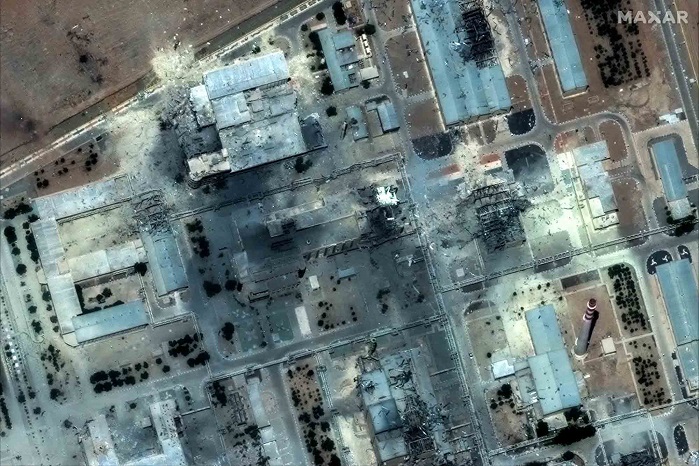
Burnt out structures showing part of Iran’s destroyed nuclear arsenal that were hit bu the US last year
HABARI DAILY I Kampala, Uganda I A convergence of diplomatic deadlines, military planning, political maneuvering, and escalating rhetoric is fueling growing speculation that the United States could launch military strikes against Iran in less than a week, as President Donald Trump tightens pressure on Tehran to accept a new nuclear deal.
At the center of the unfolding crisis is Iran’s Supreme Leader, Ayatollah Ali Khamenei, who is reportedly preparing for worst-case scenarios as Washington sets a 10- to 15-day window for renewed negotiations. Trump’s top Middle East envoys, special representative Steve Witkoff and senior adviser Jared Kushner, are scheduled to meet Iranian representatives in Geneva on Thursday in what could be the last diplomatic effort to avert confrontation.
However, Trump has openly warned that military action remains firmly on the table. Speaking at the inaugural meeting of his Board of Peace, the president said the United States could bomb Iran if a deal is not reached within 10 days — a statement widely interpreted as a direct ultimatum.
Senior Iranian officials appear braced for escalation. Ali Larijani, a top national security adviser to Khamenei, told members of the media that Tehran has strengthened its defenses and prepared for conflict over the past several months. “We are not looking for war, and we won’t start it. But if they force it on us, we will respond,” he said, projecting readiness for confrontation.
Behind the scenes, discussions in the Oval Office have reportedly focused not just on limited strikes, but on broader military options aimed at crippling Iran’s strategic infrastructure. A regional official familiar with the talks said the tactic of issuing short deadlines could push Iran out of negotiations, paving the way for decisive US military action.
Khamenei’s preparations underscore the seriousness of the moment. According to the New York Times, the Iranian leader has established a four-deep line of succession for key military and government posts — a move seen as an extraordinary signal that Tehran is bracing for potentially devastating attacks on its leadership and institutions.
Further intensifying the sense of urgency, US Secretary of State Marco Rubio was seen leaving President Trump’s governors’ dinner twice over the weekend to hold urgent discussions, including with CIA Director John Ratcliffe. The unusual movements have added to speculation that operational decisions may be imminent.
Domestic political pressures are also mounting. In Congress, bipartisan lawmakers Thomas Massie and Ro Khanna are preparing to introduce a War Powers Resolution, seeking to block military action without explicit congressional authorization. They argue that recent US military operations risk bypassing constitutional limits.
Yet influential voices in Washington are pushing in the opposite direction. Senator Lindsey Graham, following meetings with Israeli Prime Minister Benjamin Netanyahu, has emerged as a vocal proponent of decisive military action. “The consequences of letting evil go unchecked are far worse than the risks of confrontation,” Graham said, signaling strong support for striking Iran’s nuclear and military facilities.
Inside Iran, rising public unrest adds another volatile layer. Protests have intensified since the New Year, prompting the regime to restrict internet and telephone services. Despite these measures, activists have continued sharing information via Starlink, amplifying international attention and emboldening Trump’s public messaging in support of what he calls Iran’s “push for freedom.”
Trump has dramatically escalated his rhetoric, warning Tehran against repression and signaling US backing for protest movements. “Iran is looking at FREEDOM, perhaps like never before,” he wrote on Truth Social, adding that the United States “stands ready to help.”
The State Department has reinforced this hardline posture, reminding Iran of previous US actions, including last year’s devastating “Operation Midnight Hammer,” when American and Israeli forces struck Iran’s three largest nuclear facilities using B-2 stealth bombers and 30,000-pound bunker-buster bombs.
With diplomatic efforts hanging by a thread, military assets positioned, and political tensions boiling on both sides, all signs now point toward a decisive moment. Whether Geneva delivers a breakthrough or becomes the final stop before war, the next few days could reshape the Middle East — and global security — for years to come.







About the Author