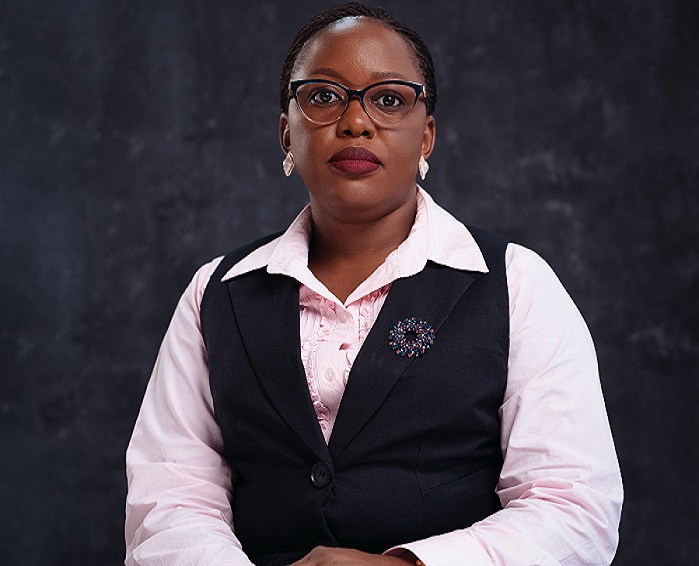


By Vanessa Kyalimpa Mutesi
HABARI DAILY I Kampala, Uganda I Every International Women’s Day, we speak confidently about women’s empowerment, celebrating resilience, progress, and recommitting to equality. Yet for many Ugandan women and girls, empowerment remains fragile because justice is unreliable.
This year’s national theme, “Scaling up investments to accelerate access to justice for all women and girls”, is not aspirational. It is an acknowledgment of failure: our justice systems, as currently resourced and structured, do not serve women equally. Without deliberate investment, equality remains rhetorical.
Justice is where inequality stops being theoretical and becomes personal. It is the woman who loses her land after displacement caused by floods along the Nile or by government development projects and cannot enforce her rights.
It is the girl who drops out of school because reporting abuse feels more dangerous than silence. It is the survivor who waits years for a case to be heard, only to withdraw because the financial, emotional, and social costs are too high.
Ugandan women and girls make up over half of the population. Yet gender‑based violence remains widespread: in 2024, the Uganda Police Force recorded about 14,000 cases of domestic violence and over 12,000 defilement cases, reflecting the persistent scale of violence against women and girls.
Delays in handling these cases, particularly defilement and aggravated defilement, continue to weaken accountability. When justice is slow, costly, or intimidating, the law ceases to protect, it becomes another obstacle.
As someone working at the intersection of climate action, development, and social systems, I’ve learned that justice is the invisible infrastructure behind every development outcome we care about. When justice fails, progress elsewhere becomes unstable.
Justice Was Never Neutral
Justice systems are often described as neutral. They are not. They reflect power, resources, and social norms. Legal processes favor those who can afford lawyers, transport, and time away from work. For rural women, young women, older women, and women with disabilities, these costs are prohibitive. Legal awareness remains uneven, witness protection weak, and stigma deeply entrenched.
This is not accidental. Systems reproduce the priorities of those who fund and design them. When justice is underfunded, delay becomes normalized. When delay is normalized, impunity grows.
Access to justice must therefore be treated as a governance issue, not a side concern. When women cannot enforce rights to land, inheritance, or protection from violence, inequality is reproduced across generations.
Why Investment Matters More Than Rhetoric
Uganda does not lack laws; it lacks sufficient investment to make them work. Courts need personnel. Survivors need legal aid and psychosocial support. Communities need functional mechanisms that resolve disputes quickly and fairly.
Scaling up investment also means investing upstream. Prevention is cheaper than prosecution. Legal literacy is cheaper than litigation. Economic security is cheaper than crisis response.
From a climate perspective, this matters profoundly. Prolonged droughts in the Karamoja and cattle corridor regions, recurrent floods in low‑lying eastern and western districts, and landslides on the slopes of Mount Elgon and the Rwenzori Mountains are intensifying competition over land and natural resources.
Women, who are often primary users but secondary rights holders, bear the greatest risk when weak justice systems turn climate stress into gendered injustice. Climate action without justice simply redistributes vulnerability.
Economic Empowerment Without Justice Is Fragile
Uganda has invested in women’s economic empowerment, from credit schemes to vocational training and enterprise development programs. These efforts matter but are incomplete without enforceable rights.
A woman can receive training, credit, or a grant and still lose everything if her land is taken, her contract unenforceable, or violence unpunished. Justice is what turns opportunity into security.
When women cannot claim or protect assets, the broader economy also suffers. Families lose stability. Communities lose contributors. Development loses impact.
Actionable Steps
To make empowerment meaningful, we must expand legal aid and gender-sensitive court services, particularly in rural areas.
We should also strengthen land rights enforcement and dispute resolution for women affected by climate displacement or development projects, as well as invest in legal literacy campaigns and community-based dispute resolution.
We should also integrate gender and climate considerations into governance, policy, and program design.
These measures are not “extra.” They are essential infrastructure for justice, development, and resilience.
Beyond Symbolism
International Women’s Day should do more than inspiring many, but should also unsettle them. The topical questions at this point are: Are we funding justice with the same seriousness as roads, energy, or schools? Are women shaping justice systems or merely surviving them? Are we willing to confront cultural practices that contradict constitutional rights? Justice delayed remains justice denied.
Voice alone is not power. Women can speak loudly and still be ignored if institutions are weak. Justice converts voice into consequence.
On this International Women’s Day, Uganda has an opportunity to move beyond symbolic empowerment. Investing in access to justice is not radical, it is responsible governance.
Because when justice works, everything else begins to hold. When justice fails women, equality becomes a lie.







The writer is a Climate Implementation Strategist and Policy and Development Communicator
About the Author