

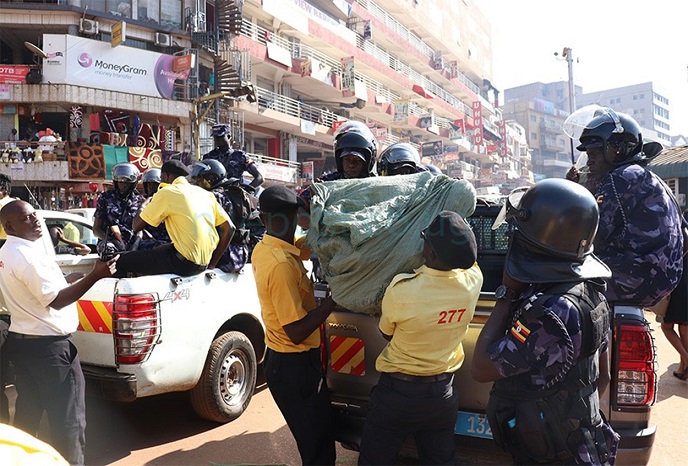
The big eviction
HABARI DAILY I Kampala, Uganda I Kampala is once again at a crossroads. As dawn broke on Friday, Kampala Capital City Authority (KCCA) enforcement teams, backed by police, demolished dozens of illegal roadside kiosks and makeshift structures, escalating a citywide crackdown aimed at restoring order in Uganda’s fast-growing capital.
The overnight operation followed the expiry of a two-week ultimatum issued to street vendors, boda boda cyclists and informal taxi drivers accused of obstructing walkways, road reserves and drainage channels. By morning, several major streets in the central business district (CBD) had been cleared, marking one of the most decisive enforcement drives in recent years.
For city authorities, the message is blunt: uncontrolled street vending and unregulated boda boda operations have become a ticking time bomb — threatening public safety, urban mobility, sanitation, and the long-term viability of Kampala as a modern city.
KCCA Executive Director Hajjat Sharifah Buzeki defended the operation, describing it as necessary to protect pedestrians, improve sanitation and restore order. “This exercise is about restoring order, protecting pedestrians and ensuring that drainage channels are not blocked. We cannot allow the city to descend into chaos,” she said.
Her words reflect a growing consensus among city planners, traders’ associations and residents that the status quo is unsustainable. Across Kampala, vendors sprawl across pavements, traffic islands and road reserves, spreading their merchandise on tarpaulins and sacks.
Fresh produce, clothes and household items are sold directly from the ground, often inches from speeding vehicles. Boda boda cyclists camp at illegal stages, blocking shop entrances and intersections, while informal taxis pick up and drop off passengers anywhere, worsening congestion.
The result is a city choking under its own disorder.
A threat to life and safety
Pedestrian safety is one of the most pressing concerns. With walkways narrowed or entirely blocked by stalls and parked motorcycles, pedestrians are routinely forced onto busy roads, where they must compete with cars, buses and trucks. This dangerous mix has contributed to a steady rise in road accidents, many involving boda bodas.
City officials argue that street vending and boda boda congestion have effectively turned Kampala into a high-risk environment for anyone on foot. Mothers with children, the elderly, people with disabilities and office workers are all exposed daily to life-threatening situations simply because sidewalks no longer exist in many areas.
“This is not just about business,” one KCCA official said. “It is about saving lives.”
The boda boda sector, which employs tens of thousands of young men, has become both an economic lifeline and a public menace. While motorcycles provide quick transport, their unregulated operation — coupled with illegal stages, reckless riding and disregard for traffic rules — has turned them into a leading cause of accidents, injuries and deaths in the city. When combined with chaotic street vending, the danger multiplies.
Flooding, filth and public health risks
Beyond safety, the proliferation of illegal stalls has worsened flooding during heavy rains. Drainage channels are routinely blocked by merchandise, plastic waste and temporary structures, preventing water from flowing freely. Each rainy season, central Kampala experiences flash floods that disrupt business, damage property and paralyse traffic.
Health officials also warn that roadside vending creates severe sanitation risks. Food is often sold from the ground without access to clean water, toilets or waste disposal. This raises the risk of food contamination, outbreaks of cholera, typhoid and other preventable diseases — dangers that are magnified in densely populated urban settings.
KCCA says designated markets offer safer, more hygienic environments, complete with proper drainage, waste management and sanitation facilities. Yet many of these markets remain underutilised.
Markets with empty stalls
According to KCCA, the authority manages 17 public markets and oversees 69 private ones, with at least 2,520 vacant stalls in public markets and another 1,980 spaces in private facilities. Yet, despite this availability, thousands of traders continue to operate illegally on the streets.
At Usafi Market, which can accommodate 3,000 vendors, only about 1,600 are currently registered. Busega Market, spanning nearly three acres, has around 500 empty stalls, while Kamwokya Market has more than 250 spaces available for immediate allocation.
Market vendors are increasingly frustrated. Those who pay rent, utilities and taxes inside formal markets say they are being undercut by street traders who benefit from heavy foot traffic without incurring formal business costs.
“We want more traders to come and join us,” said Nalwanga Lwanga, a vendor at Busega Market. “We cannot let the President who built this market down. There is space here. People should not remain on the streets when stalls are available.”
Sekiranda Kizito echoed the same sentiment, urging street vendors to occupy the vacant spaces. “Busega is a big market. The majority of people trading on the streets are welcome because the spaces are here,” he said.
Their calls are reinforced by the Kampala City Traders Association (KACITA), whose Chief Executive Officer, Abel Mwesigye, has long advocated for strict enforcement of trade regulations.
“As KACITA, we’ve always supported the relocation of street vendors to designated places,” Mwesigye said. “This is not about persecuting anyone. It is about creating a fair and organised business environment.”
Mwesigye also criticised the unchecked spread of boda bodas and informal taxis. “We want taxis allocated to taxi parks and boda bodas confined to designated stages, not camping in front of our shops,” he said, arguing that disorder hurts both businesses and customers.
Why enforcement is inevitable
For years, KCCA has issued warnings, conducted sensitisation campaigns and offered alternative trading spaces, yet compliance has remained low. Many vendors argue that formal markets attract fewer customers, reducing daily income. But city leaders insist that long-term urban order must take precedence over short-term convenience.
State Minister for Kampala Kabuye Kyofatogabye has been categorical: enforcement will continue, and arrests will be made where necessary. “Starting at midnight, vendors found trading illegally on walkways, drainage channels or green spaces will have their items impounded and be arrested,” he said, stressing that the two-week grace period was sufficient.
Police spokesperson Kituuma Rusoke confirmed that law enforcement agencies are fully prepared to support KCCA. “This is about restoring order. We are not eliminating livelihoods but safeguarding them through organisation,” he said.
City planners warn that if left unchecked, street vending and boda boda congestion will derail Kampala’s development. The city’s population is projected to double in the next two decades, and without strict regulation, infrastructure will collapse under the pressure.
The bigger urban picture
Kampala’s struggle mirrors that of many African cities grappling with rapid urbanisation, youth unemployment and informal economies. Street vending and boda bodas provide livelihoods for thousands who might otherwise be jobless. But without order, these same activities can undermine the city’s functionality, safety and attractiveness for investment.
KCCA insists that its strategy is not to criminalise poverty but to formalise it — to transform informal survivalist activities into organised, sustainable enterprises. Markets, officials argue, are business incubation centres that offer traders stability, security and growth potential.
The authority has also engaged neighbouring municipalities to expand relocation options and is exploring digital vending platforms to widen market access. New market construction plans are underway to meet future demand.
A defining moment for Kampala
The current crackdown represents a defining moment. Either Kampala enforces order now, or it risks becoming ungovernable. Street vending and boda boda operations, if left uncontrolled, will continue to claim lives, choke mobility, worsen flooding and erode public health.
This is why city leaders describe them as a ticking time bomb.
For vendors and riders, the challenge is to adapt — to transition into organised systems that protect their livelihoods while preserving public order. For authorities, the test lies in consistent, fair enforcement that avoids corruption and political interference.







About the Author