
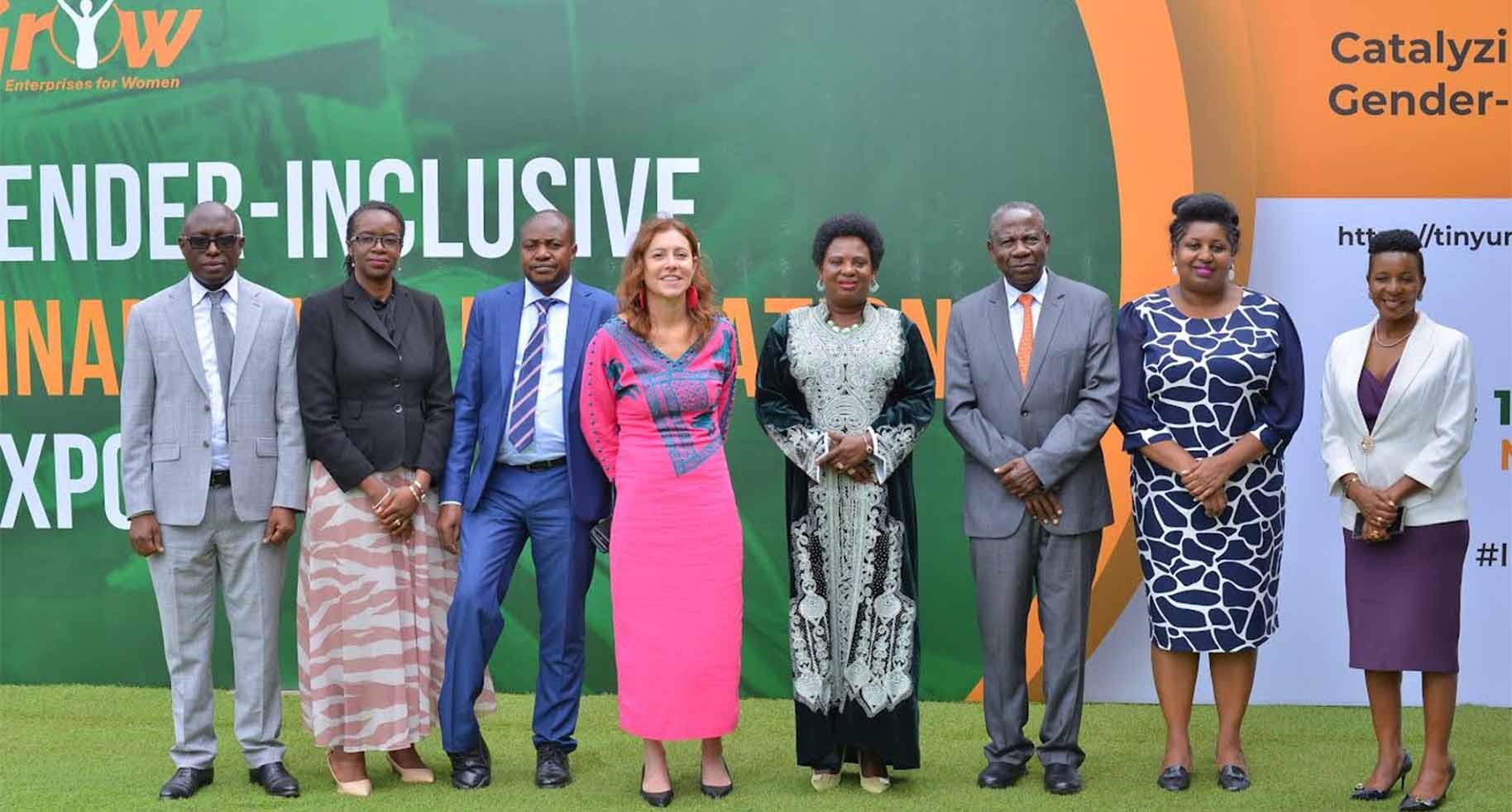
World Bank and Government officials from line ministries that run the GROW Project pose for a photo
HABARI DAILY I Kampala, Uganda I Women entrepreneurs across Uganda have accessed about Shs 73.3 billion in affordable credit during the first year of implementation of the Generating Growth Opportunities and Productivity for Women Enterprises (GROW) Project.
GROW is a 5-year World Bank funded initiative, through which it allocated $217m funding to women entrepreneurship, with implementing partners including the Ministry of Gender and the Private Sector Foundation Uganda (PSFU).
According to the recently released performance report, the funds were disbursed between 1 July 2024 and 30 June 2025 through six participating financial institutions which incude Equity Bank, Finance Trust Bank, Pearl Bank (formerly PostBank), Stanbic Bank, dfcu Bank and Centenary Bank.
The report further says that the cumulative value of loans extended to women-owned enterprises reached sh73,344,593,450, exceeding the amount initially disbursed to participating banks due to loan repayments that were re-lent to new borrowers
“This first year demonstrates that significant amounts of capital are now reaching women entrepreneurs who have historically been excluded from affordable finance,” said Dr Ruth Aisha Biyinzika Kasolo, the GROW Project Coordinator at PSFU.
She added that over Shs 73 billion has already been put directly into women’s businesses, and this is only the beginning.”
Government approved Shs 120 billion for disbursement to the six participating financial institutions over a two-year period. By the end of the first year, Shs 69.2 billion had been released to the banks under the GROW line of credit, enabling them to lend to women entrepreneurs across the country
“The money is not sitting in banks; it is circulating in women-led enterprises,” Dr Kasolo said, adding that what is particularly encouraging is that repayments are coming back on time, allowing us to reflow funds to reach even more women.
The report shows that loan repayments totaling Shs 21.7 billion had already been made by beneficiaries by the end of June 2025. These repayments represent 29.61 percent of the total amount lent out, significantly boosting the overall volume of money accessed by clients
“This reflow of over Shs 21 billion tells us that women are not only accessing the money, but they are using it productively and paying it back,” Dr Kasolo noted. “It strengthens the sustainability of the facility and increases the pool of funds available to other borrowers.”
A total of 2,958 loans were issued during the year, cutting across three funding levels. The largest number of borrowers accessed loans ranging from sh4m to sh20m, which accounted for 2,120 loans, or 71.7 percent of all lending
Small loans impactful
“These smaller loans are critical,” Dr Kasolo said. “They enable micro enterprises to stabilize, expand operations, and transition into small businesses.”
Loans between Shs 20 million and Shs 40 million accounted for Shs 13.6 billion, while the largest share of money—Shs 38.9 billion, representing 53.1 percent of total lending—went to enterprises accessing loans between Shs 40 million and Shs 200 million.
“This distribution shows that women are confidently taking on larger loans to scale their businesses,” Dr Kasolo said, addi g that more than half of the total money disbursed went to women-owned enterprises that are ready to operate at a higher level.
Among the participating banks, Centenary Bank disbursed Shs 24.8 billion, Stanbic Bank Shs 16.3 billion, Pearl Bank Shs 15.7 billion, DFCU Bank Shs 11.5 billion, Finance Trust Bank Shs 3.7 billion, and Equity Bank Uganda Shs 3.7 billion to women borrowers during the period under review
“Each of these institutions has played a role in ensuring the money reaches women in different regions and sectors,” Dr Kasolo said.
She added that what matters most is that the funds are now embedded in productive economic activity.
She added that the loans reached women entrepreneurs in 113 districts, including eight cities, reflecting a wide national footprint. However, the report also highlights that 26 districts had no beneficiaries, pointing to areas requiring intensified outreach in the next phase
“The figures help us identify where money has flowed and where it has not,” Dr Kasolo explained. “This data is essential for guiding future allocations and ensuring equitable access.”
By sector, the largest share of loan amounts went to Trade and Commerce, which absorbed 39.5 percent of total lending, followed by Agriculture and Agribusiness at 22.2 percent
“These sectors are absorbing substantial capital because they employ many women and have strong growth potential,” Dr Kasolo said. “The money is enabling women to invest in stock, equipment, processing, and market expansion.”







About the Author