

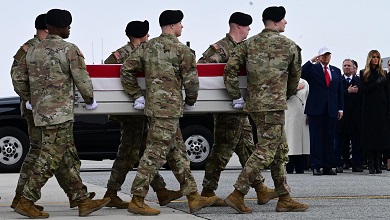
HABARI DAILY I Kampala, Uganda I President Donald Trump must be having sleepless nights over the rising number of deaths among the US servicemen as America’s military campaign against Iran continues to exact a growing human cost, with the Pentagon confirming that 17 U.S. service members have now been killed and more than 420 wounded since the conflict erupted on February 28, 2026.
The mounting casualties come as the war enters another dangerous phase, with neither Washington nor Tehran showing any sign of backing down. Instead, both sides have intensified military operations, raising fears that the conflict could become a prolonged regional war with devastating consequences for troops and civilians alike.
The latest figures released by the U.S. military underscore the increasing risks facing American personnel deployed across the Middle East. Although the United States has not launched a full-scale ground invasion of Iran, its military bases spread across Gulf nations remain within range of Iranian missiles and drones, exposing thousands of troops to continuous attacks.
Waves of ballistic missiles
The conflict began after coordinated U.S. and Israeli strikes targeted military installations inside Iran. Tehran responded by unleashing waves of ballistic missiles and armed drones against American military facilities across Saudi Arabia, Jordan, Iraq, Kuwait and other strategic locations in the region.
The casualty breakdown paints a grim picture of how dangerous the conflict has become.
Six American soldiers were killed during the opening days of the war when Iranian drones struck an undefended civilian port in Kuwait where U.S. military personnel were operating. The attack exposed the vulnerability of logistics and support facilities that were not designed to withstand direct military assaults.
Another soldier succumbed to injuries sustained during Iran’s March 1 missile attack on Prince Sultan Air Base in Saudi Arabia, dying more than a week after being critically wounded.
Jordan also became one of the conflict’s deadly flashpoints after an Iranian barrage of ballistic missiles and drones killed two American soldiers identified as 1st Lt. Tyler James Feehan and Pvt. Isabella Gonzales.
Aircraft crashes blamed
Not all the deaths have resulted directly from enemy fire. Six service members lost their lives in March when an Air Force KC-135 aerial refueling aircraft crashed in friendly Iraqi airspace while supporting combat operations. The accident highlighted the enormous logistical pressures being placed on military personnel conducting around-the-clock missions throughout the region.
The Navy also suffered another loss when a helicopter pilot died following an emergency landing in the Arabian Sea on July 1.
In northern Iraq, another service member was killed while attempting to safely destroy a downed Iranian attack drone during an explosive ordnance disposal operation, illustrating the dangers troops face even after attacks have ended.
Beyond the fatalities, the Pentagon says more than 420 American personnel have been wounded since the war began. Many suffered injuries from missile blasts, drone explosions and flying debris during repeated attacks on military installations.
The conflict has expanded beyond military bases into critical civilian infrastructure across the Gulf region.
Fresh Iranian strikes have reportedly ignited fires at a desalination plant and power stations in Kuwait, causing significant damage to facilities vital for electricity generation and water supply. Other attacks targeted areas in Bahrain and Jordan following what marked the tenth consecutive night of American bombing campaigns inside Iran.
Strait of Hormuz epitheater
Iran’s Revolutionary Guard also reported “massive fires” aboard two oil tankers that allegedly took what it described as an unsafe route through the strategically important Strait of Hormuz, one of the world’s busiest oil shipping lanes. Any prolonged disruption to maritime traffic through the narrow waterway could have significant implications for global energy markets.
Despite ten consecutive days of sustained American air strikes targeting Iranian missile infrastructure, command centres and drone launch facilities, military analysts say the campaign has yet to produce a decisive breakthrough.
The United States continues launching daily waves of attacks aimed at weakening Iran’s ability to threaten regional shipping routes and American military installations. However, Iranian forces have maintained their capacity to launch retaliatory missile and drone attacks, keeping pressure on U.S. forces stationed across the Middle East.
The prolonged campaign is also generating political debate in Washington.
Political challenge for Trump
Questions are increasingly being raised on Capitol Hill over whether President Trump is receiving an accurate assessment of the battlefield from Pentagon officials. Critics point out that while the administration has repeatedly argued Iran’s military capabilities have been significantly degraded, the continued missile attacks suggest Tehran retains substantial offensive capacity.
The growing casualty figures also present a political challenge for Trump, who campaigned on promises to avoid what he frequently described as America’s “forever wars” in the Middle East.
While military planners continue evaluating options for increasing pressure on Iran, reports indicate that deploying large numbers of American ground troops has effectively been ruled out by the White House.
Nevertheless, with no ceasefire negotiations in sight and no indication that either side intends to reduce military operations, the conflict appears poised to continue. As the war enters yet another day of relentless air strikes and retaliatory attacks, the rising toll of dead and wounded American service members serves as a stark reminder that even without a ground invasion, modern warfare can exact an increasingly heavy price on the men and women in uniform.







About the Author