
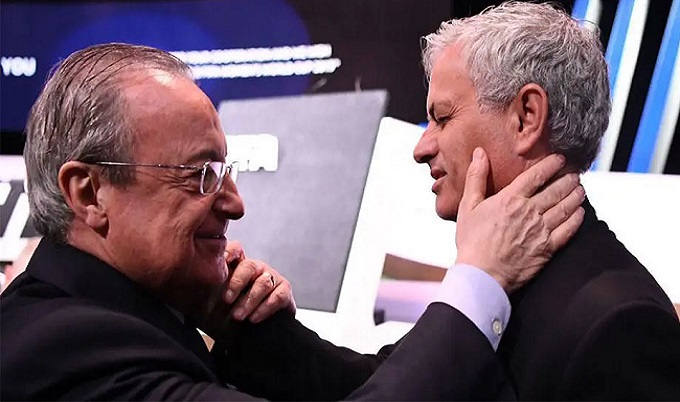
Jose Mourinho with Real Madrid president Florentino Perez
HABARI DAILY I Kampala, Uganda I Portuguese manager Jose Mourinho is increasingly being viewed as the ideal figure to stabilize Real Madrid after a chaotic and trophyless campaign that exposed deep fractures within the club’s dressing room and raised serious concerns about the direction of the project under club president Florentino Perez.
With morale reportedly at rock bottom, tensions growing among star players and the team enduring a second consecutive season without a major trophy, Mourinho’s name has re-emerged at the Santiago Bernabéu as the man capable of restoring discipline, authority and a winning mentality.
For Perez, Mourinho represents far more than a tactical coach. He is viewed as a commanding personality capable of taking control of a fractured dressing room dominated by egos, superstar politics and off-field distractions.
Reports from Spain indicate that Madrid’s squad has suffered internal divisions, with disagreements among players and growing concerns over the chemistry between key figures such as Vinicius Junior and Kylian Mbappe. The relationship between the two attacking stars has failed to deliver the devastating partnership many expected, despite the club assembling one of the most talented squads in Europe.
The instability has reportedly contributed to the dismissals or exits of several coaches, including Xabi Alonso, as Madrid struggled to impose consistency both domestically and in Europe.
In the midst of that turbulence, Mourinho is seen as one of the few managers in world football with the stature and personality to immediately command respect from the dressing room.
During his first spell at Real Madrid between 2010 and 2013, Mourinho transformed a side that had been psychologically dominated by Pep Guardiola’s Barcelona. Under Mourinho, Madrid developed a fierce competitive identity and eventually won the 2011-12 La Liga title with a record-breaking 100 points and 121 goals — achievements that remain historic in Spanish football.
Club officials believe that ability to engineer rapid cultural change is precisely what Madrid needs again.
The appeal of Mourinho lies heavily in his reputation for discipline. Throughout his managerial career, he has insisted that no player is bigger than the team, often confronting superstar personalities directly when standards slip.
For a Madrid squad accused of lacking intensity, focus and accountability, Mourinho’s iron-fisted approach is viewed as a potential solution to restore order.
Tactically, Mourinho is also considered a strong fit for the current state of the squad. While Madrid possess enormous attacking talent, critics argue the team has become defensively vulnerable and structurally imbalanced.
Mourinho’s pragmatic philosophy — built on defensive organization, compact systems and devastating counter-attacks — is seen as a way of bringing stability back to a side that has struggled in major knockout matches, particularly in the UEFA Champions League.
Supporters of his return point to his ability to maximize difficult player combinations. At Inter Milan, Mourinho famously convinced striker Samuel Eto’o to play in a wider role as the club won the historic Treble in 2010.
At Madrid, he successfully managed the dynamic between Cristiano Ronaldo and Karim Benzema, ensuring the partnership remained productive despite occasional tensions.
Another major factor behind Mourinho’s growing appeal is his reported desire to influence transfer strategy. Sources indicate he has already identified weaknesses in Madrid’s squad and wants specific reinforcements, including Rodri of Manchester City, to improve balance in midfield.
During his previous Madrid spell, Mourinho strongly advocated for signings such as Luka Modric, Sami Khedira and Mesut Ozil — players who later became central figures in one of the club’s most successful eras.
However, Mourinho’s possible return has also divided supporters.
Critics point to the decline of his recent managerial spells, noting that he has not won a league title in more than a decade and has left several clubs amid dressing room conflicts and public disputes with players.
His turbulent periods at Tottenham Hotspur and Manchester United raised questions about whether his confrontational methods still work in the modern game.
There are also concerns that Madrid’s fragile dressing room could deteriorate further if Mourinho fails to balance authority with empathy and communication.
Yet despite those concerns, Perez appears convinced that Madrid requires drastic action after two disappointing seasons. The club’s leadership reportedly believes the squad has become too comfortable and lacks the ruthless mentality traditionally associated with Real Madrid’s greatest eras.
For many within the club, Mourinho’s return would represent an attempt to restore that edge.
Whether it becomes a renaissance or another controversial chapter in Madrid’s history may ultimately depend on whether Mourinho himself has evolved from the manager who left the Bernabéu amid conflict more than a decade ago.