

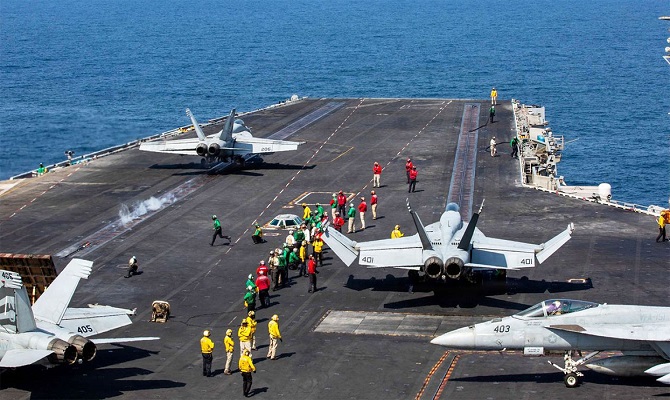
War planes preparing to launch from the flight deck of Nimitz-class aircraft carrier USS Abraham Lincoln in support of Operation Epic Fury at the beginning of the first wave of attacks in February 2026
HABARI DAILY I Kampala, Uganda I As military preparations intensify and diplomatic efforts appear to stall, signs are emerging that the United States and Israel could resume large-scale military operations against Iran within days.
This is amidst mounting tensions in the Middle East and growing indications of intensified military planning in Washington and Tel Aviv.
Media reports indicate that the United States and Israel are currently “engaged in intense preparations — the largest since the cease-fire took effect — for the possible resumption of attacks against Iran as early as next week.”
The developments come only two days after US President Donald Trump returned from a high-profile state visit to China, where the escalating Iran crisis reportedly dominated discussions with Chinese President Xi Jinping.
Although both leaders publicly displayed goodwill during the Beijing meetings, no agreement was announced regarding the Iran conflict, and no joint communique was released — a sign analysts interpret as evidence that diplomatic efforts failed to produce a breakthrough.
Despite weeks of devastating attacks that reportedly killed more than 3,000 Iranians and destroyed about 81,000 civilian structures, Washington is said to believe that its strategic objectives remain unmet.
According to military sources, the United States has failed to topple the Iranian government, cripple Iran’s military capabilities or secure control over the strategically vital Strait of Hormuz, through which a significant share of global oil supplies passes.
In another indication of possible military escalation, Trump is expected to convene his top national security officials in the White House Situation Room on Tuesday to discuss restarting combat operations.
The planned meeting follows a high-level strategy session held Saturday at Trump’s golf club in Virginia. The gathering was attended by Vice President JD Vance, Secretary of State Marco Rubio, CIA Director John Ratcliffe and Middle East envoy Steve Witkoff.
The rhetoric from Trump has also intensified dramatically in recent days.
Following a phone conversation with Israeli Prime Minister Benjamin Netanyahu on Sunday evening, Trump posted a warning on Truth Social directed at Tehran.
“For Iran, the Clock is Ticking, and they better get moving, FAST, or there won’t be anything left of them,” Trump wrote.
The message was followed by an AI-generated image showing a map of the Middle East covered with the American flag and red arrows pointing toward Iran from multiple directions — imagery widely interpreted as hinting at a possible US-led invasion.
In another controversial social media post, Trump shared an image of himself pressing a red button on a command console while mushroom-cloud explosions appeared on an overhead screen, fueling speculation that nuclear options are also being considered.
According to media reports, Pentagon officials are evaluating several military scenarios, including the deployment of US ground troops inside Iran. Such an operation, analysts warn, would carry enormous risks, including significant American casualties and the possibility of triggering a broader regional war.
Pressure for a tougher military response is also growing within influential sections of the US political and media establishment.
In an opinion article published Sunday in The Wall Street Journal titled “How to Finish the Job in Iran,” former US Navy official Seth Cropsey urged Trump to pursue “catastrophic force” against Iran.
Cropsey argued that Washington should prepare “a multistage operation, including boots on the ground,” aimed at reopening the Strait of Hormuz and accelerating “the collapse of the Iranian state.”
He warned that prolonged instability in the Gulf could push global oil prices to around $150 per barrel, intensifying inflation and disrupting supply chains worldwide.
The increasingly aggressive language from both Washington and Tel Aviv has heightened fears that the fragile cease-fire could collapse within days, plunging the Middle East into a far wider and potentially catastrophic conflict.







About the Author