

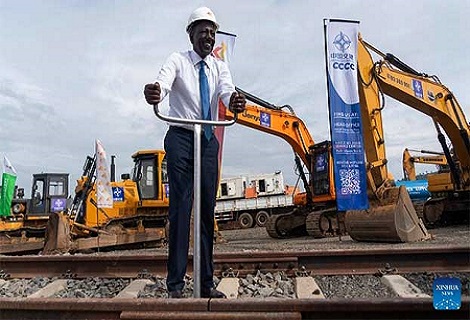
Kenyan President, William Ruto breaking ground for the launch of SGR Naivasha Malaba route this week
HABARI DAILY I Kampala, Uganda I The commencement of construction of the Standard Gauge Railway (SGR) section linking Naivasha to the Malaba border is expected to significantly transform Uganda’s transport and logistics sector by providing a faster, cheaper and more efficient route for cargo moving to and from the Port of Mombasa.
The multi-billion-dollar railway project, which Kenyan authorities officially launched this week, marks a major milestone in the long-awaited regional railway network that is expected to improve trade across East Africa and strengthen Uganda’s position as one of the region’s largest transit economies.
Once completed, the railway will connect Naivasha in Kenya’s Rift Valley to Malaba on the Kenya-Uganda border, creating a continuous standard gauge line from the Port of Mombasa through Nairobi and onward to Uganda’s main entry point for imports.
The project is being undertaken by the Kenya Railways Corporation, which says the line forms part of a broader regional transport corridor intended to ease the movement of goods across East Africa.
Year’s of planning fruitful
According to Kenya Railways Managing Director Philip Mainga, construction of the new railway section has officially commenced after years of planning and financing negotiations.
The Naivasha-Malaba railway is expected to extend approximately 262 kilometres and will complete the missing link between Naivasha and the Ugandan border.
Officials said the project has been divided into several construction phases to enable faster implementation while ensuring financing remains manageable.
The railway is expected to substantially reduce cargo transport costs by shifting thousands of containers from road transport to rail.
For Uganda, whose imports and exports rely heavily on Kenya’s Port of Mombasa, the new railway promises a major improvement in the efficiency of moving goods into the country.
Currently, much of Uganda’s imported cargo is transported by trucks travelling from Mombasa through Nairobi and onward to Malaba before crossing into Uganda.
The heavy dependence on road transport has resulted in congestion, high transport costs, road accidents and accelerated deterioration of highways due to the large number of heavy trucks.
The extension of the Standard Gauge Railway to Malaba is expected to address many of these challenges by allowing freight trains to transport much larger cargo volumes more quickly and at lower cost.
Businesses in Uganda are expected to benefit from reduced freight charges, shorter delivery times and more reliable transport schedules.
Road congestion to be history
Importers who currently experience delays caused by road congestion could see cargo arriving faster, enabling companies to reduce storage costs and improve inventory management.
The railway is also expected to enhance Uganda’s export competitiveness by lowering the cost of transporting agricultural produce, manufactured goods and minerals to international markets through the Port of Mombasa.
Lower logistics costs could make Ugandan products more competitive within regional and global markets while encouraging greater cross-border trade.
The project is also expected to improve the efficiency of Uganda’s growing logistics industry.
Many freight forwarding companies currently rely almost exclusively on trucking services between Mombasa and Kampala.
With the railway reaching Malaba, logistics companies will have greater flexibility to combine rail and road transport, creating more efficient multimodal transport systems.
Cargo arriving by rail at Malaba could then be distributed by road to Kampala, western Uganda, northern Uganda and neighbouring countries such as Rwanda, eastern Democratic Republic of Congo and South Sudan.
Regional distribution hub
The railway therefore has the potential to reinforce Uganda’s role as a regional distribution hub.
Reduced truck traffic on the Northern Corridor is also expected to bring wider economic and environmental benefits.
Fewer heavy trucks on the highways could lower road maintenance costs, reduce traffic congestion and improve road safety along one of East Africa’s busiest transport corridors.
Businesses transporting fuel, construction materials, machinery and consumer goods are likely to be among the biggest beneficiaries of the improved railway connection.
The Standard Gauge Railway project also aligns with regional efforts to improve transport infrastructure under the Northern Corridor Integration Projects, which seek to facilitate trade among East African Community member states.
Improved railway connectivity is expected to complement ongoing investments in roads, border facilities and customs modernisation.
Kenyan officials have described the project as an important investment that will stimulate economic growth while strengthening trade links between Kenya and its landlocked neighbours.
The financing arrangements demonstrate continued international confidence in the regional railway project.
The Kenyan government announced that the construction contract has been awarded to the China Road and Bridge Corporation (CRBC), one of the companies that previously constructed other sections of Kenya’s Standard Gauge Railway.
Chinese funding procured
According to the project announcement, funding has been secured through cooperation between the governments of Kenya and China.
The project is expected to create employment opportunities during construction while generating long-term economic benefits through increased trade and improved logistics.
For Uganda, however, the full benefits of the project will ultimately depend on the development of its own Standard Gauge Railway network from Malaba into the interior.
Successive Ugandan governments have identified the Kampala-Malaba Standard Gauge Railway as a strategic infrastructure priority that will eventually connect Kampala to the Kenyan border and later extend to other parts of the country.
Once Uganda completes its section, freight trains will be able to move cargo seamlessly between Mombasa and Kampala, dramatically reducing transport times compared to current road-based logistics.
The launch of the Naivasha-Malaba railway therefore represents more than another Kenyan infrastructure project. It marks a critical step toward creating an integrated regional railway system that could reshape trade across East Africa.
For Uganda, whose economy depends heavily on efficient access to international seaports, the railway offers the prospect of lower transport costs, faster cargo movement, improved regional competitiveness and stronger economic integration with neighbouring countries.
If matched by complementary investments on the Ugandan side, the new Standard Gauge Railway could become one of the most significant transport developments affecting Uganda’s logistics sector in decades.