
President Museveni’s National Address on 4th July 2026
HABARI DAILY I Kampala, Uganda I President Yoweri Museveni has accused opposition figure Dr. Kizza Besigye of undermining Uganda’s legal system by refusing to stand trial.
“How can a great human rights advocate not respect Ugandan courts,” asked the President, as he defended the government’s approach to justice and security.
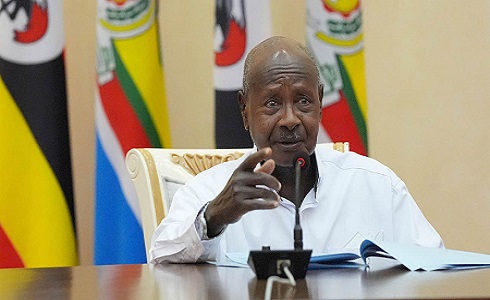
In his national address on July 4, 2026, President Yoweri Kaguta Museveni argued that respect for the rule of law requires accused persons to face the courts rather than resist legal proceedings. He singled out Dr. Besigye, saying the veteran opposition politician had deliberately frustrated the judicial process since his arrest in November 2024.
“To show the impunity, take the case of Besigye,” Museveni said. “He was arrested on the 17th of November, 2024. All this time, however, he has been refusing trial, misusing the legal system.”
The President questioned what he described as a contradiction between Dr. Besigye’s long-standing advocacy for democracy and human rights and his alleged refusal to participate in court proceedings.
“Why would this great democrat and human rights fighter spend so many calories on refusing to come to trial where he has got opportunity to prove his innocence and expose the undemocratic behaviour of the dictatorship of Museveni and his family?” Museveni asked.
He argued that Uganda’s courts provide an appropriate forum for determining guilt or innocence and said refusing to appear before them weakens confidence in the country’s legal institutions. According to Museveni, if an accused person believes the charges are politically motivated, the courtroom offers the best opportunity to challenge the prosecution’s case.
The President also criticized what he described as weaknesses within Uganda’s justice system, arguing that authorities had allowed accused persons to evade accountability for too long.
“Second question: why should the legal system for so long allow an accused person to just refuse to be tried?” he asked.
Museveni linked this perceived failure to broader challenges within the justice sector, arguing that delayed or stalled prosecutions contribute to public frustration and, in some cases, encourage mob justice.
“This allowing of impunity to continue for so long is responsible for the culture of mob-justice,” he said. “The population suspects that the Police and the Judiciary may not hold the criminal accountable. Hence, the mob-justice, which is unfortunate.”
The President placed his criticism of Dr. Besigye within a wider defence of recent security operations, insisting they were intended to strengthen, rather than weaken, the rule of law. He rejected claims that Uganda was returning to the abuses of previous eras.
“Therefore, what the security forces have been doing recently is not a regression in the fight for freedom but a consolidation of our long fight for the principles of Patriotism, Pan-Africanism, Social-economic transformation and Democracy,” Museveni said.
He dismissed assertions that the country was sliding backwards on human rights, arguing that today’s legal system is fundamentally different from the periods before the National Resistance Movement came to power.
“Those who have been putting forward the slogan: ‘Bizeemu’—meaning ‘the bad things of the past have come-back’—are wrong,” he said. “Ebyariwo (The past happenings), meant that anybody arrested would not go to court but would end-up as a dead body in Namanve forest, the River Nile or Kaaya’s farm.”
Instead, Museveni pointed to Dr. Besigye’s court appearances as evidence that judicial processes remain available.
“On the contrary, here you see Besigye creating scenes in the courts of law,” the President said, adding that those seeking the truth should “wait for the trials of the accused People.”
Throughout his address, Museveni emphasized what he described as his government’s commitment to accountability, arguing that no individual should be above the law, including members of the security forces. He cited an incident involving the death of a Ugandan known as Zebra in Kawempe, saying he personally organized compensation for the family after the death occurred following contact with security personnel.
“I cannot allow impunity in our system even on the side of the security forces,” Museveni said.
The President maintained that Uganda’s security agencies had stepped in because other state institutions had failed to deal effectively with corruption, crime and persistent violations of the law.
“It is, therefore, the impunity promoters that have been inviting the security forces to finally do something,” he said. “It is the security forces that die to keep peace in Uganda and in our turbulent Region.”
Museveni also defended restrictions on bail in certain cases, saying some suspects should remain in custody where they could interfere with witnesses.
“The arrested opposition law-breakers may not get bail because they threaten the security of the witnesses,” he said.
He concluded that the government’s objective is to ensure full accountability for all Ugandans, regardless of political affiliation.
“It is, therefore, in order for us to insist on full accountability and no impunity for our words or our actions,” Museveni said. “I hope these comments have illuminated what the gaps were and why the limited, supportive actions of the security forces to the real rule of law in the Country.”
For Museveni, the central issue is not merely the prosecution of one opposition leader but what he described as respect for Uganda’s legal institutions. By questioning why a prominent advocate of democracy would refuse to submit to the courts, the President argued that genuine commitment to the rule of law requires confidence in judicial processes and a willingness to allow the courts to determine the outcome of criminal cases.







About the Author