
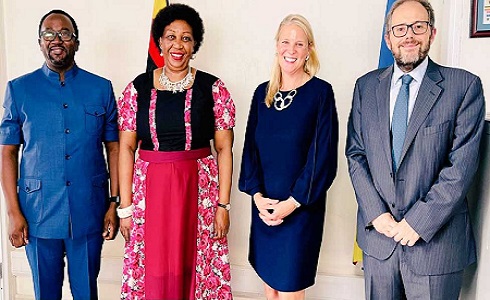
The UHRC Chairperson, Mariam Wangadya (2nd Left), Commissioner Crispin Kaheru (Left) pause for photos after a meeting with the British High Commissioner recently
HABARI DAILY I Kampala, Uganda I A deepening leadership crisis has engulfed the Uganda Human Rights Commission (UHRC), with bitter disagreements over finances, governance and management spilling into the public domain and exposing widening divisions between the commission’s chairperson and fellow commissioners.
At the centre of the dispute is UHRC Chairperson Mariam Wangadya, who has been accused by some commissioners of sidelining colleagues from key financial decisions, disregarding established governance structures and exercising excessive control over the institution’s resources.
The accusations emerged through petitions submitted to the Inspectorate of Government (IG), Parliament and other oversight bodies, triggering investigations into the operations of one of Uganda’s most important constitutional institutions.
According to the petitions, the commissioners contend that Wangadya has increasingly centralized decision-making, particularly regarding the commission’s finances, procurement processes and administrative affairs.
The complainants allege that commissioners have been excluded from participating in major financial decisions despite being members of the commission’s governing body.
They also claim that the chairperson has exercised powers that should ordinarily be shared collectively, creating an environment where accountability and transparency have been undermined.
The dispute has now evolved into an open power struggle, with both sides accusing each other of misconduct and abuse of office.
Governance concerns
One of the central issues raised by the commissioners concerns the governance structure of the commission and how decisions are made.
The petitioners argue that the UHRC Act envisages collective leadership, where commissioners jointly oversee the institution’s strategic direction and financial management.
Instead, they allege that major decisions have increasingly been taken without adequate consultation, leaving commissioners feeling marginalized.
The petitions reportedly question whether proper procedures were followed in approving budgets, expenditure and procurement activities.
They further argue that governance systems designed to ensure transparency have weakened as authority became concentrated in the office of the chairperson.
The commissioners maintain that such an approach undermines both institutional independence and public confidence in the commission.
Financial disagreements
The conflict is also rooted in disagreements over the management of the commission’s financial resources.
According to the petitions, commissioners accuse the chairperson of making financial decisions without obtaining the necessary approvals from the commission.
Some of the concerns reportedly relate to travel expenditures, procurement decisions and the allocation of institutional resources.
The complainants argue that these actions have denied commissioners their oversight role and weakened financial accountability within the institution.
The petitions also allege that internal governance mechanisms have not functioned effectively, prompting commissioners to seek intervention from external oversight bodies.
These allegations have become a major focus of the investigations now underway.
Petition triggers investigations
The complaints prompted the Inspectorate of Government to begin reviewing allegations relating to the commission’s operations.
Parliament has also been drawn into the matter through its oversight role over constitutional bodies.
The investigations are expected to examine governance procedures, financial management practices and whether the commission has complied with relevant laws and regulations.
The petitions reportedly contain allegations of abuse of office, financial mismanagement and violations of established administrative procedures.
The outcome of the investigations could significantly influence the future leadership of the commission and determine whether reforms are required to restore confidence in the institution.
Wangadya fights back
Chairperson Mariam Wangadya has strongly rejected the allegations against her, dismissing them as false, malicious and politically motivated.
She insists that she has managed the commission in accordance with the law and that all major financial decisions have followed established government procedures.
According to Wangadya, the accusations are part of a coordinated campaign intended to discredit her leadership rather than genuine concerns about governance.
She argues that the commission has continued to execute its constitutional mandate despite internal disagreements.
Wangadya further maintains that some of the issues raised by the commissioners stem from differences over management style rather than any wrongdoing.
She says the allegations have unfairly damaged both her personal reputation and the image of the Uganda Human Rights Commission.
Claims of a smear campaign
The chairperson believes the petitions form part of what she describes as an orchestrated smear campaign designed to force her out of office.
She argues that some individuals became hostile after she assumed office and have since attempted to undermine her authority through repeated complaints.
According to Wangadya, the timing and nature of the allegations suggest a deliberate effort to weaken her leadership.
She insists she has nothing to hide and welcomes any lawful investigation that establishes the truth.
“If I were doing anything wrong, I would be a very weak woman today,” she reportedly says, expressing confidence that the investigations will vindicate her.
Appeal to President Museveni
As the conflict intensified, Wangadya appealed to President Yoweri Museveni to intervene and protect the commission from what she considers attempts to destabilize it.
She argues that constitutional commissions require institutional independence to perform their duties effectively and should not become arenas for prolonged internal power struggles.
According to her, restoring stability within the commission is essential if it is to continue protecting and promoting human rights across Uganda.
She also expressed concern that continued public infighting risks eroding public confidence in an institution whose credibility depends heavily on perceptions of impartiality and integrity.
Institution caught in internal conflict
The unfolding dispute has placed the Uganda Human Rights Commission under unprecedented public scrutiny.
Established under the Constitution to investigate human rights violations, monitor compliance with human rights standards and educate the public, the commission plays a critical oversight role in Uganda’s governance framework.
However, observers note that prolonged internal divisions could weaken its effectiveness, delay important decisions and distract it from its constitutional responsibilities.
The conflict has also raised broader questions about governance within independent constitutional bodies and whether existing accountability mechanisms are sufficient to resolve leadership disputes before they escalate into public confrontations.
As investigations by the Inspectorate of Government and other oversight institutions continue, attention will remain focused on whether the allegations of financial mismanagement and governance failures can be substantiated.
Equally important will be determining whether the commission can rebuild trust among its own leadership and restore confidence in an institution mandated to safeguard the rights of all Ugandans.
For now, the battle between the chairperson and fellow commissioners has exposed deep fractures within the Uganda Human Rights Commission, turning what began as an internal disagreement over money and governance into one of the most significant leadership crises the institution has faced in recent years.