
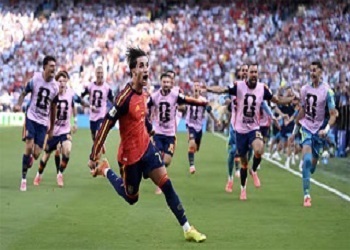
Ferran Torres took the winning shot
HABARI DAILY I Kampala, Uganda I Spain are the new kings of world football after defeating defending champions Argentina 1-0 after extra time in a gripping 2026 FIFA World Cup final at New York New Jersey Stadium, securing their second men’s World Cup title with a defensive masterclass that defined the tournament.
Ferran Torres emerged as the national hero, scoring the decisive goal in the 106th minute after Argentina had been reduced to 10 men following the dismissal of midfielder Enzo Fernández. The victory denied Argentina a second consecutive World Cup crown and potentially marked the end of Lionel Messi’s glittering international career on a heartbreaking note.
The final, played before a capacity crowd, was a tense tactical battle that remained scoreless throughout normal time. However, Spain were the dominant side from start to finish, controlling possession, creating the better opportunities and, remarkably, preventing Argentina from registering a single shot on target.
The triumph capped an extraordinary campaign for Spain, who completed the tournament unbeaten while conceding just one goal in the entire competition. Their defensive solidity became the hallmark of their success, with opponents consistently finding it impossible to break through the disciplined Spanish backline.
Despite the scoreline remaining level for 90 minutes, Spain looked the more likely winners throughout the second half.
The European champions repeatedly tested Argentina goalkeeper Emiliano Martínez, who produced a string of spectacular saves to keep his side alive. Martínez, already regarded as one of the world’s finest goalkeepers, set a new record for the most saves in a World Cup final as he frustrated Spain’s relentless attacks.
Wave after wave of Spanish pressure saw young stars Nico Williams and Lamine Yamal stretch Argentina’s defence, while Mikel Merino and Ferran Torres constantly found dangerous pockets of space.
Argentina, meanwhile, struggled to establish any rhythm going forward as Spain’s suffocating defensive system denied Lionel Messi and his teammates any meaningful opportunities.
One of Argentina’s rare attacking moments came when Messi combined with a teammate before a dangerous pass into the penalty area was deflected away just before an Argentine attacker could apply the finishing touch.
Later, Messi attempted one of his few shots of the match, only to find Mikel Merino bravely throwing himself in front of the effort. The Spanish midfielder absorbed the powerful strike directly on his forehead and remained on the ground for several minutes before eventually being substituted for a medical assessment.
The match took a dramatic turn late in the second half when Enzo Fernández received his second yellow card after a rash challenge, reducing Argentina to 10 men.
The dismissal significantly shifted the balance of the contest, leaving Argentina to defend desperately as Spain sought the breakthrough.
With a numerical advantage, Spain intensified their attacks, forcing Argentina coach Lionel Scaloni to abandon any attacking ambitions. In a clear sign that Argentina were aiming to survive until penalties, Scaloni withdrew forward Julián Álvarez and introduced centre-back Marcos Senesi, switching from a back four to a back five in an attempt to repel the Spanish onslaught.
Spain thought they had finally broken the deadlock in the 96th minute when Nico Williams poked home from close range after confusion inside Argentina’s penalty area.
However, celebrations were cut short after the referees ruled that Mikel Merino had committed a foul in the build-up by stepping on the foot of an Argentine defender. The decision added another controversial officiating moment to a tournament that had already generated considerable debate over refereeing decisions.
Undeterred, Spain continued pressing forward.
Martínez once again came to Argentina’s rescue with a remarkable fingertip save to deny Nico Williams’ powerful header during extra time, prompting jubilant celebrations from Argentine supporters who realised just how close their team had come to defeat.
Yet there was only so much even the inspirational goalkeeper could do.
Moments after the teams resumed play following a brief hydration break in extra time, Spain finally found the breakthrough they had deserved.
A beautifully lofted pass beyond Argentina’s defence located Nico Williams, who calmly knocked the ball back into the centre of the area. Ferran Torres timed his run perfectly before drilling an unstoppable finish beyond Martínez in the 106th minute to send Spanish fans into wild celebrations.
The goal was the culmination of Spain’s relentless dominance, having spent much of the second half peppering Argentina’s goal with attacks.
With only 10 men and little attacking threat, Argentina struggled to mount a meaningful response during the closing stages. Spain calmly managed possession while continuing to threaten on the counterattack, ensuring there would be no dramatic comeback from the South Americans.
When the final whistle sounded, Spanish players and supporters erupted in celebration, knowing they had completed one of the most dominant World Cup campaigns in modern history.
Their triumph not only delivered a second FIFA World Cup title but also underlined the emergence of a new generation led by stars such as Yamal, Williams, Merino and Torres.
For Argentina, the defeat ended hopes of becoming the first nation in more than six decades to successfully defend the World Cup. It also cast uncertainty over the international future of Messi, whose extraordinary career may have concluded with a courageous but ultimately unsuccessful final appearance on football’s biggest stage.
Spain’s victory will be remembered not simply because they lifted the trophy, but because they did so through disciplined defending, tactical superiority and unwavering consistency. By conceding only one goal throughout the tournament and shutting out the reigning champions in the final, Spain produced one of the greatest defensive performances ever seen at a FIFA World Cup.