
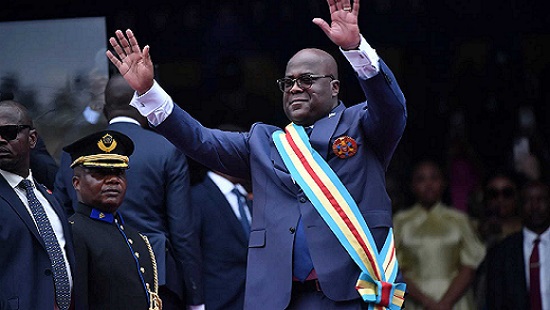
President Félix Tshisekedi
HABARI DAILY I Kampala, Uganda I Democratic Republic of Congo (DRC) President Félix Tshisekedi has signed a controversial referendum law that could pave the way for changes to the country’s Constitution, intensifying fears among opposition leaders that the President could use the process to extend his stay in power beyond the constitutionally permitted two terms.
Tshisekedi signed the legislation on Monday, November 9, 2026, following a lengthy legislative and judicial process involving Parliament and the Constitutional Court. The presidential approval was officially announced on Congolese state television late on Tuesday, November 10.
The new law establishes the legal procedures and institutional framework for organising national referendums, providing for existing constitutional provisions to be amended or an entirely new Constitution to be drafted and submitted to citizens for approval.
Although the government has defended the legislation as necessary to address constitutional and governance challenges, its enactment has generated political controversy because of the possibility that it could reopen debate over presidential term limits.
Tshisekedi is currently serving his second five-year presidential term, which is scheduled to end in 2028. Under the country’s 2006 Constitution, the President is limited to two terms, a provision that opposition groups consider a fundamental safeguard against the concentration of executive power.
Critics fear that the referendum framework could provide an alternative route to changing constitutional provisions that Parliament cannot amend through the ordinary constitutional revision process.
The controversy has therefore placed the DRC on the brink of another major political confrontation, with opposition figures accusing the President’s administration of laying the groundwork for a constitutional manoeuvre to secure a third term.
How the contested law passed
The legislation underwent several stages before receiving presidential approval.
The bill establishing a framework for national referendums was first submitted to Parliament in March 2026 before receiving initial approval from the Senate on June 16.
However, the proposed legislation subsequently faced scrutiny from the Constitutional Court, which examined whether its provisions were consistent with the country’s Constitution.
In July 2026, the court ruled that the proposed law was constitutional, although judges raised observations concerning certain provisions.
Following the ruling, Tshisekedi requested Parliament to reconsider the sections that had attracted the court’s observations before the legislation could proceed to final approval.
Lawmakers subsequently revised 13 articles to address the concerns raised during the judicial review.
The National Assembly overwhelmingly approved the revised legislation on October 23, 2026, with 346 legislators voting in favour, none opposing it and one abstaining.
The Senate followed on October 31, granting unanimous approval, with all 78 senators present voting in support of the revised bill.
With both parliamentary chambers having approved the final text, the legislation was forwarded to Tshisekedi for presidential assent.
He signed it into law on November 9, completing the legislative process that had begun in March.
However, no date has been announced for the organisation of an actual national referendum.
Article 220 at the centre of third-term controversy
At the heart of the controversy is Article 70 of the 2006 Constitution, which limits the President to two five-year terms.
The provision is reinforced by Article 220, which explicitly protects the two-term presidential limit from being changed through ordinary parliamentary constitutional revisions.
Opposition leaders argue that the new referendum law could provide Tshisekedi with an opportunity to circumvent these constitutional safeguards by submitting an entirely new Constitution to a popular vote.
Under this scenario, provisions governing the number and duration of presidential terms could potentially be reconsidered through a referendum rather than the conventional parliamentary amendment process.
The opposition fears that such a process could reset the constitutional framework and potentially allow Tshisekedi to seek another mandate when his current term expires in 2028.
The controversy has intensified because Tshisekedi has previously questioned the suitability of the existing Constitution.
During a press conference in Kinshasa on May 6, 2026, he described the 2006 Constitution as outdated and indicated that he would accept a third mandate if the Congolese people demanded it through a referendum.
Although he has denied actively campaigning for a third term, his remarks have continued to fuel suspicion among political opponents.
Opposition figures argue that the referendum legislation should not be viewed as an ordinary administrative measure but as a potential instrument for changing the country’s political succession arrangements.
Government cites security challenges
The government, however, has defended the need for constitutional changes, arguing that the existing framework contains provisions that complicate the organisation of referendums during periods of national security emergencies.
According to the government’s position, the legislation is necessary to address constitutional clauses that prohibit holding referendums during a state of siege or an active war.
The argument comes against the backdrop of continuing fighting between government forces and M23 rebels in eastern DRC, particularly in North and South Kivu provinces.
The conflict has created uncertainty about the country’s political and electoral calendar, with significant territories remaining under rebel control.
In May 2026, Tshisekedi warned that the presidential elections scheduled for late 2028 might not take place as planned if the government failed to regain control of territories occupied by rebels in the eastern provinces.
The security situation has therefore become an important part of the government’s justification for reconsidering aspects of the constitutional framework.
However, critics maintain that security concerns should not be used to weaken constitutional safeguards or create opportunities for extending presidential tenure.
Opposition reports constitutional coup
The signing has triggered renewed criticism from opposition figures, who accuse Tshisekedi of using institutional processes to prepare the ground for prolonging his presidency.
Among those opposing the initiative are Moïse Katumbi, Delly Sesanga and Claudel Lubaya, alongside the Coalition Article 64.
They have condemned the process as a potential constitutional coup, arguing that the referendum law could undermine the principles governing democratic succession and presidential term limits.
The opposition has also raised concerns about the political environment in which constitutional changes are being pursued, particularly given the ongoing insecurity in eastern DRC.
Protests have been reported in Kinshasa, Bukavu and other cities, reflecting growing resistance to any attempt to alter the constitutional arrangements governing presidential tenure.
For the opposition, the central concern is not simply whether the country needs constitutional reforms, but whether those reforms could be manipulated to benefit the incumbent President.
The signing of the law now places the DRC in a politically sensitive period as the country approaches the final years of Tshisekedi’s second term.
Although the legislation does not itself grant him a third mandate, its provisions have opened a new debate over whether the Constitution could be replaced or altered through a referendum.







About the Author