
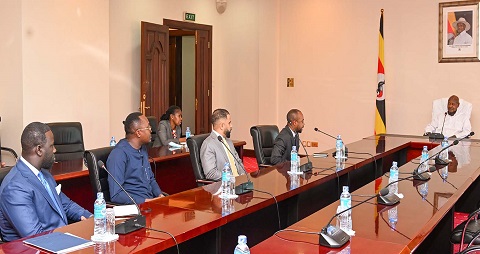
The Tanzanian delatation in talks with President Museveni at State House, Entebbe on Monday, August 24, 2026
HABARI DAILY I Kampala, Uganda I President Yoweri Museveni on Monday, August 24, 2026, met with a Tanzanian delegation led by Mr. Abdulhalim Hafidh Ameir, son of Tanzanian President Samia Suluhu Hassan, at State House, Entebbe.
The delegation also included George Nkya, Amal Garang, and Mundhir Mohammed Nassor.
The meeting focused on matters of mutual interest between Uganda and Tanzania, including areas of cooperation aimed at strengthening bilateral relations and regional development.
The President welcomed the delegation and held discussions with them on the issues presented.
Uganda and Tanzania are steadily transforming their longstanding relationship into a strategic partnership anchored on energy, trade, infrastructure and regional security, with major joint projects increasingly linking the two economies and strengthening East African integration.
At the centre of this growing cooperation is the energy sector, where the two countries have developed infrastructure that goes beyond national borders. The 1,443-kilometre East African Crude Oil Pipeline (EACOP), stretching from Uganda’s oil fields in Hoima to Tanzania’s Port of Tanga, is the most prominent example. The pipeline is expected to create a major economic corridor connecting Uganda’s petroleum resources to international markets through Tanzania.
The partnership is now expanding beyond crude oil transportation. In August 2026, President Yoweri Museveni and his Tanzanian counterpart, Samia Suluhu Hassan, signed a memorandum of understanding to develop the Tanga Regional Energy Hub. The project brings together the Uganda National Oil Company, Tanzania Petroleum Development Corporation and Vitol Bahrain E.C., with plans covering bulk storage, refining, logistics and petroleum infrastructure.
The proposed energy hub is expected to attract investments exceeding $20 billion, potentially creating new industries, jobs and business opportunities on both sides of the border. The two countries are also pursuing plans for a natural gas pipeline from Tanzania to Uganda and a bidirectional pipeline for refined petroleum products.
Trade is another pillar of the relationship. Bilateral trade has risen to about $2.23 billion, reflecting the growing movement of goods between the two countries. Uganda exports products including coated flat-rolled iron, rubber tyres, electricity, sugar and other agro-processed goods, while Tanzania supplies Uganda with commodities such as gold, rice and groundnuts.
Despite the growth, Uganda continues to run a trade deficit with Tanzania. Both governments, however, are seeking to expand trade and address barriers that have historically restricted the movement of goods.
Among the challenges have been non-tariff barriers, including restrictions affecting Ugandan sugar and multiple taxes imposed on dairy and industrial products. Presidents Museveni and Samia have directed their officials, through the Joint Permanent Commission, to take immediate action to remove such restrictions and facilitate smoother cross-border commerce.
Transport cooperation is equally important. Uganda relies on Tanzanian ports, particularly Dar es Salaam and Tanga, to access international markets, while the two countries continue to strengthen road, railway and maritime connections that can lower the cost and time of moving cargo.
Beyond commerce, Uganda and Tanzania cooperate on regional peace and security through the East African Community and other regional frameworks. Their collaboration includes defence initiatives, civil-military cooperation and efforts to maintain peace and stability in the region.
The deepening relationship therefore represents more than a series of individual agreements. From oil pipelines and energy hubs to trade corridors and security cooperation, Uganda and Tanzania are building an increasingly integrated economic and strategic partnership capable of benefiting both countries while advancing the wider East African integration agenda.







About the Author