
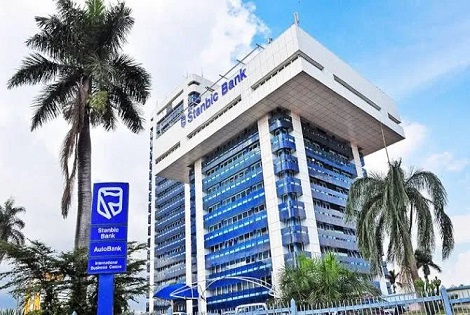
An Aerial view of Stanbic Bank Uganda headquarters currently
HABARI DAILY I Kampala, Uganda I Kampala Road was a very different place in the early 1990s. Tarmac stretched through a city still bearing the scars of war, while modest single-storey buildings housed video libraries, black-and-white photography studios, hair salons and dairy shops.
On the stretch where Mapeera House and Kampala Boulevard Building now dominate the skyline, two buildings still carried the physical wounds of the 1979 war that toppled Idi Amin. Their walls had been blown away, leaving gaping openings through which people could simply walk.
Elsewhere, Nkrumah and Nasser roads were struggling to attract business, while the journey from Kampala to Lugazi, just 45 kilometres away, could take three hours because of potholes rather than traffic.
This was the Uganda into which Stanbic Bank entered in 1991/92 — an economy emerging from years of political instability, economic mismanagement and destruction, and one in which confidence was in short supply.
Yet three-and-a-half decades later, the institution that arrived through Standard Bank Group’s acquisition of Grindlays Bank of East Africa has not merely survived the country’s transformation. It has grown with it, beaten off competition and established itself as Uganda’s largest financial institution.
Its story is therefore inseparable from the country’s economic recovery.
Betting on a difficult Uganda
In the early 1990s, Uganda’s prospects were far from certain.
Factories in once-thriving industrial centres such as Jinja and Mbale had closed. Production of coffee, one of the country’s traditional foreign-exchange earners, had fallen sharply. In the north, armed conflict continued, while the country was grappling with devastating levels of poverty and the HIV/AIDS epidemic.
The banking industry itself was facing a crisis. Five indigenous financial institutions would eventually collapse, while some international banks were closing branches outside Kampala and retreating to the capital.
Michael Wakabi, then a young journalist, remembers the atmosphere.
“We started to see international banks closing branches in major towns and concentrating in Kampala,” he says. “Some of these towns were former industrial towns that lost factories during Amin’s time and were now in bad shape.”
For ordinary Ugandans, the future was difficult to imagine.
“People had lost hope, and saw no need of long-term planning,” Wakabi recalls. “My father worked at Kakira Sugar Works, and I would see company trucks taking home three or five bodies of workers who had died of HIV/AIDS. The rebels were active in the north and, travelling there was dangerous.”
It was precisely at this moment that Standard Bank Group chose to deepen its presence in Uganda.
Rather than seeing a broken economy as a reason to stay away, the South African banking giant saw a country with enormous room for recovery and growth.
“Unless you were a long-term thinker, you would not invest in Uganda at that time,” Wakabi says. “Many companies saw no future here. But Stanbic knew things would settle and that Uganda needed financial services to recover and grow.”
The decision reflected Standard Bank Group’s long history on the African continent, where the institution had repeatedly expanded into markets on the basis of long-term potential rather than immediate certainty.
As Estranelle Lubbe, Head of Heritage Governance at Standard Bank Group, puts it, the Ugandan investment fitted that tradition.
“When you study the Group’s history, you find a recurring willingness to think beyond current conditions and focus on long-term potential,” Lubbe says. “Uganda represented exactly that kind of opportunity. The institution saw a country rebuilding itself and believed it could contribute to that journey.”
From niche bank to national powerhouse
The first decade was about establishing a foundation.
Between 1991 and 2000, the institution was overseen by a succession of Standard Bank Group executives, including AB Myers, Dave Edgar, John Murray, John Miller and Anthony Klensmitch.
But the biggest transformation came with the Government’s decision in 2002 to privatise Uganda Commercial Bank (UCB).
The sale generated enormous public interest and fundamentally changed the banking landscape. For Stanbic, it was an opportunity to move from being viewed largely as a niche institution operating on the legacy of Grindlays to becoming a bank with a truly national footprint.
The acquisition and subsequent merger placed Stanbic at the centre of Uganda’s economic expansion. Kitili Mbathi, who became the bank’s first African chief executive in 2001, steered it through the critical acquisition and integration process. He was followed by Philip Odera, who led the institution from 2007 to 2014.
Then came a succession of leaders who increasingly reflected the changing character of both the bank and the country.
Patrick Mweheire became the first Ugandan to lead Stanbic Bank Uganda. He was followed by Anne Juuko, the bank’s first female chief executive, and Samuel Mwogeza, who served in an interim capacity before the appointment of Mumba Kenneth Kalifungwa in 2025.
The leadership changes reflected an institution progressively becoming more Ugandan while retaining the financial muscle, regional reach and international expertise of Standard Bank Group.
Growing with Uganda
Stanbic’s ability to remain relevant as Uganda changed has arguably been one of its biggest advantages in a fiercely competitive banking industry.
The bank did not remain confined to traditional corporate banking. It expanded into retail banking, small and medium enterprises, agriculture, trade, infrastructure, energy and other productive sectors.
Today, it is one of the country’s leading financiers of agriculture, manufacturing, infrastructure, trade and energy.
The bank has also increasingly targeted groups that were historically excluded from formal finance, including women entrepreneurs, young people, farmers and rural communities.
It has provided unsecured, low-interest financing to savings organisations, helped informal businesses transition into formal enterprises and supported young Ugandans through entrepreneurship and innovation initiatives.
That approach has enabled Stanbic to compete not simply by selling financial products, but by embedding itself in the economic activities of its customers.
Former Stanbic Uganda Holdings chief executive and current Standard Bank Group Regional Chief Executive for Central and Southern Africa Francis Karuhanga believes this is what makes the institution’s story distinctive.
“What makes the story compelling is that it mirrors Uganda’s own development journey,” he says. “The bank grew because Uganda was growing. Every major phase in our evolution corresponded with a broader phase in the country’s economic progress. It has always been a shared story rather than two separate ones.”
A purpose beyond banking
The transformation also produced a philosophy that became central to Stanbic’s identity in Uganda: Uganda is Home. We Drive Her Growth.
For Mweheire, who played a major role in shaping the bank’s Ugandan identity, the statement was more than corporate branding.
“If Uganda is truly your home, then your relationship with the country cannot be transactional,” he says. “A home is somewhere you invest, a place whose success becomes intertwined with your own. The purpose challenged us to think beyond banking products and focus on how we could contribute to Uganda’s broader growth story.”
That philosophy has helped the bank navigate the country’s changing economic environment while competing against an increasingly sophisticated field of local and international banks.
Technology has further transformed the industry. Customers who once had to travel to branches can now access banking services through digital platforms, while businesses increasingly expect faster payments, financing and financial-management solutions.
Stanbic has had to evolve alongside those expectations. Its competitive advantage has increasingly rested on combining the scale of a major international banking group with local knowledge and a broad understanding of Uganda’s economy.
The next chapter
Today, Uganda is almost unrecognisable from the country Stanbic entered in 1991. The pothole-riddled roads and war-damaged buildings of that era have given way to a more urbanised economy, expanding infrastructure, growing private enterprise and increasingly sophisticated financial services.
But challenges remain. Uganda must still convert economic growth into broad-based prosperity, deepen industrialisation, expand energy production, strengthen regional trade and create opportunities for its rapidly growing young population.
Mark Ociiti Ongom, Chief Executive of Stanbic Uganda Holdings Limited, argues that the bank’s 35-year milestone should be viewed against that larger transformation.
“The real story isn’t that a bank has been operating in Uganda for 35 years,” he says. “The real story is that Uganda has undergone one of the most remarkable transformations on the continent during that period. Stanbic’s journey only becomes meaningful when viewed alongside the country’s journey. That is why the purpose continues to resonate.”
Kalifungwa similarly sees the anniversary as a reminder of the institution’s original bet on Uganda rather than simply a celebration of longevity.
“Thirty-five years ago, our predecessors made a choice that required confidence in Uganda’s future,” he says. “Looking back, that confidence was justified. Looking ahead, our responsibility is to continue earning the trust that has been built over three and a half decades and to remain a meaningful partner in Uganda’s next phase of growth.”
That original decision remains perhaps the most important part of Stanbic’s Ugandan story.
When the bank entered Uganda, the country offered few guarantees. Its economy was fragile, its infrastructure poor, its banking system troubled and its people emerging from years of uncertainty. Stanbic stayed.
It survived the banking crises, expanded beyond Kampala, absorbed Uganda Commercial Bank, invested in productive sectors, embraced digital transformation and built a succession of Ugandan leaders.
Thirty-five years later, it stands at the top of an industry that has become one of the country’s most competitive sectors.
Wakabi believes the bank’s success can ultimately be traced to the confidence it showed when confidence was scarce.
“The decision Standard Bank Group made to come to Uganda in 1991 showed that it was a long-term thinker,” he says. “I want to believe it still is. The new Government had laid out its reconstruction plan, and the bank bought into it. And here we are.”