
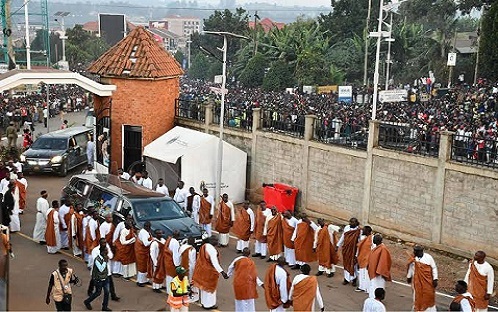
A cross section of Babiito, who received the body of the late Omukama Oyo Nyimba Kabamba Iguru Rukidi IV at Karuziika palace recently
The announcement of Prince Edward Rukidi Kijanangoma as the new King of Tooro has once again placed the Babiito royal clan at the centre of attention, raising an important question: who are the Babiito, and how do they determine who becomes Omukama?
Unlike a conventional political election, the choice of a Tooro king is governed by a traditional succession system in which the Babiito royal clan has the ultimate cultural authority over the throne.
Following the death of Omukama Oyo Nyimba Kabamba Iguru Rukidi IV on August 27, 2026, the Babiito moved quickly to activate this system. A 21-member Royal Succession Committee was constituted under Omusuuga Charles Kayondo Kamurasi, the head of the Babiito clan.
On September 9, the clan formally announced Prince Edward Rukidi Kijanangoma as the next Omukama at Karuziika Palace. Msgr Isaiah Mayombo read the announcement in the presence of Babiito elders and members of the succession committee.
Who are the Babiito?
The Babiito are the royal clan from which the kings of Tooro trace their lineage. Their history is closely connected to the ancient Bunyoro-Kitara traditions and the emergence of Tooro as an independent kingdom in western Uganda.
Tooro emerged as an independent kingdom in the early 19th Century under Prince Kaboyo Olimi I, who broke away from Bunyoro-Kitara and established a separate royal institution. The official Tooro Kingdom history places the emergence of the kingdom around 1822–1830, while tracing its deeper cultural traditions to the Babiito dynasty and the ancient Kitara civilisation.
The Babiito are therefore not simply another clan within Tooro. They constitute the royal lineage responsible for producing the Omukama.
The head of the clan is known as the Musuuga or Omujwera Musuuga. The office is particularly important during periods of transition because it takes charge of the cultural processes surrounding the death of a king, succession and enthronement.
Charles Kamurasi, the current Musuuga, has described himself as the person responsible for installing the king under the Tooro traditional system. He also played a central role when the three-year-old Oyo was enthroned in 1995.
There is no public election
The selection of a Tooro king is not conducted like a parliamentary or presidential election in which members of the public cast ballots.
The authority rests with the Babiito clan, which examines the royal lineage and applies established cultural traditions to identify a suitable successor.
That principle became particularly important after King Oyo’s death because questions emerged over whether he had left a biological son who could succeed him.
While some senior kingdom figures, including Prime Minister Calvin Armstrong Rwomiire, had indicated that Oyo left an heir, the Babiito leadership said it was not aware of a biological child whose identity had been formally established within the royal succession process. The issue made verification and consultation an important part of the transition.
The clan consequently established a 21-member committee of elders to identify the successor, formally announce the choice and prepare the traditional ceremonies.
How the decision was reached
The committee was not simply handed the name of a prince and instructed to endorse him. According to the resolution announced on September 9, the new king was selected after consultations, due diligence and consideration of the available royal lineage.
The committee said it had been elected by the General Meeting of the Ababiito clan to identify a suitable candidate for the throne. It then worked under the leadership of the Musuuga.
In its formal resolution, signed by 19 members, the committee said it had undertaken “due diligence, consultation and adequate consideration” before settling on Prince Edward Kijanangoma.
The process therefore combined the authority of the wider Babiito clan with the specialised work of the succession committee.
The final resolution identified Edward Rukidi Kijanangoma as the son of the late Prince Christopher Paul Kijanangoma and grandson of the late Omukama George David Rukidi III.
That lineage was significant because Tooro succession is fundamentally tied to the royal family rather than simply membership of the wider Babiito clan.
Why Edward Kijanangoma?
The decision placed Prince Edward within a direct royal line associated with previous Tooro monarchs. The succession committee’s responsibility was to determine the appropriate candidate following Oyo’s death, particularly after the question of a direct heir became contested.
The choice also reflects the historical practice of examining family connections when a reigning monarch does not leave an established successor. Earlier accounts of Tooro succession have shown that royal wills, family relationships and established lines of succession can become important in determining who is eligible for the throne.
Indeed, a will left by former King Rukidi III contained detailed provisions concerning succession within his family, illustrating how royal lineage and documentation can influence the process.
The Musuuga’s powerful role
At the centre of the entire process was Kamurasi. As Musuuga, he was not acting as a political candidate or government-appointed administrator. His authority derives from his position as head of the Babiito royal clan.
Following Oyo’s death, Kamurasi convened the Babiito meeting and presided over the traditional announcement of the king’s death. He subsequently headed the succession committee responsible for identifying the next monarch.
The committee itself brought together senior Babiito elders and other prominent members of the royal establishment, reflecting an attempt to give the process broad internal legitimacy.
From selection to enthronement
The selection of Edward Kijanangoma is not the end of the process. The Babiito resolution states that his enthronement will be conducted according to the traditions and customs of Tooro. The announcement at Karuziika Palace is therefore a formal declaration of the selected successor, while the actual enthronement involves further cultural procedures.
Karuziika Palace remains the official seat of the Tooro king, and traditional protocols place the Babiito and the Musuuga at the heart of the ceremonies surrounding the transition.
This is important because the Omukama is not merely a hereditary title. Within the restored Tooro Kingdom, the king serves as the cultural leader and unifying symbol of the Batooro.
A new chapter for Tooro
Prince Edward Kijanangoma now becomes the man at the centre of Tooro’s next chapter after almost 31 years of Oyo’s reign.
His selection demonstrates that, despite changes in Uganda’s political and constitutional landscape, the traditional institutions of Tooro retain their own internal procedures for determining cultural leadership.
For the Babiito, the decision was therefore less about a popular contest and more about ancestry, custom, consultation and responsibility.
The 21-member committee’s work, culminating in a resolution signed by 19 members and endorsed through the Babiito General Meeting, was intended to ensure that the succession was rooted in the clan’s traditional authority.
The next stage will be to translate that decision into the rituals of enthronement, formally installing Prince Edward Rukidi Kijanangoma as Omukama.
In doing so, the Babiito will once again perform the role they have occupied for generations: guarding the royal lineage, determining succession and handing the Tooro throne from one generation to the next.







About the Author