
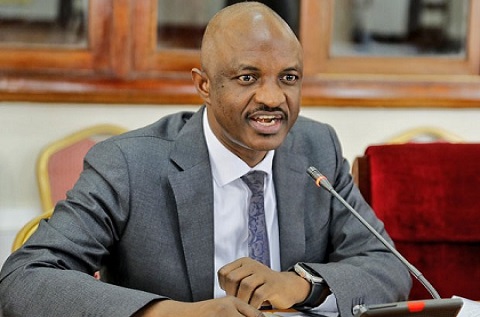
Ramathan Ggoobi
HABARI DAILY I Kampala, Uganda I The Government has cut the preliminary resource envelope for the 2027/28 financial year by Shs5.17 trillion as part of a broader effort to impose fiscal discipline, reduce reliance on borrowing and move Uganda towards greater domestic self-reliance.
The preliminary resource envelope has been set at Shs79.22 trillion, down from the Shs84.39 trillion budget for the current financial year, representing a 6.1 per cent reduction. The figure was communicated by Ramathan Ggoobi, the Ministry of Finance Permanent Secretary and Secretary to the Treasury, in the first Budget Call Circular issued to accounting officers and heads of public entities.
According to Ggoobi, the smaller envelope is intended to force government ministries, departments and agencies to work within realistic financial limits rather than continually expanding spending demands.
“The preliminary resource envelope underscores the need for stronger domestic revenue mobilisation, reduced reliance on borrowing, external financing, and allocative efficiency,” Ggoobi said.
The reduction is therefore part of an attempt to contain public borrowing. Instead of financing expanding government expenditure through additional debt, the Finance Ministry wants a larger proportion of the budget to be supported by domestic revenues.
This is significant because government is already managing substantial debt obligations. The Ministry of Finance said public debt stood at 54 per cent of GDP at the end of financial year 2025/26 and is expected to remain stable in the medium term.
The second reason is fiscal sustainability. Ggoobi has instructed accounting officers to live within the ceilings provided instead of simply carrying forward previous spending patterns.
Government agencies have also been warned against making commitments without approved budgets, accumulating domestic arrears, recruiting staff without wage allocations and starting projects before they are ready for implementation.
The tighter envelope is also intended to improve allocative efficiency by making ministries concentrate scarce resources on statutory obligations, essential public services and interventions capable of delivering measurable results.
The Government has consequently cautioned against spreading resources too thinly or merely reproducing historical allocations. The Presidential Advisory Committee on Budget has separately been tasked with testing proposed expenditures against strategic alignment, evidence of results, implementation readiness and value for money.
Under the preliminary framework, human capital development is allocated Shs12.7 trillion, followed by government and security at Shs9.9 trillion and integrated transport infrastructure and services at Shs7.9 trillion. Other priority areas include agro-industrialisation, private-sector development, regional development, manufacturing and science and technology.
The fourth motivation is domestic self-reliance. Finance officials want Uganda to mobilise more money locally by broadening the tax base, improving compliance, closing revenue leakages and increasing non-tax revenue.
Government is also looking beyond conventional borrowing for infrastructure financing, including foreign direct investment, private equity, joint ventures, infrastructure bonds, Islamic financing, climate financing and public-private partnerships. Pension and insurance funds have also been identified as potential sources of long-term capital.
Despite the smaller resource envelope, the Government expects economic growth to accelerate from a projected 7.6 per cent in 2026/27 to 9.1 per cent in 2027/28, partly on expectations of commercial oil and gas production and its wider effects on construction, manufacturing, services and exports.
The reduction therefore represents less a retreat from development spending than an attempt to make government expenditure more selective, with ministries expected to prioritise essential and high-impact programmes while relying increasingly on domestic revenue and private capital to finance Uganda’s development ambitions.







About the Author