

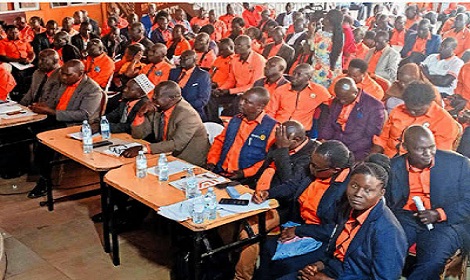
A cross section of Ugandan teacers
HABARI DAILY I Kampala, Uganda I The proposed shift to digital examination marking is set to disrupt one of Uganda’s long-standing examination traditions, with more than 15,000 teachers and other professionals hired annually by the Uganda National Examinations Board (UNEB) facing the prospect of losing the marking assignments that have provided them with additional income.
The reform, still at a preliminary study stage, would see UNEB phase out the manual system in which thousands of examiners gather at designated marking centres for weeks to read and score candidates’ scripts.
Instead, candidates’ examination scripts would be scanned and made available electronically for marking, potentially allowing examiners to score papers digitally without physically gathering at a marking centre.
The proposed change is part of a wider digital transformation at UNEB that has already eliminated some of the paperwork that once characterised national examinations.
For those who went through Primary Seven before electronic registration, the Form X system remains a familiar memory. The document was used to register candidates for the Primary Leaving Examinations (PLE), with pupils or their parents filling in candidates’ details in tiny boxes using a pencil.
The introduction of electronic registration eventually rendered Form X obsolete. UNEB officials now believe examination marking could be the next major stage in the board’s digital transformation.
The proposed reform, however, is likely to have significant consequences for thousands of teachers who depend on UNEB marking assignments for additional income each examination season.
15,000 markers at risk
UNEB hires more than 15,000 examination markers every year to handle scripts from PLE, Uganda Certificate of Education (UCE) and Uganda Advanced Certificate of Education (UACE).
The examiners, many of whom are teachers, are deployed to marking centres, where they can spend close to a month marking candidates’ scripts before results are released.
A UNEB source told Habari Daily that the board is considering replacing this system with digital marking because of the rising cost of handling examinations.
“Where UNEB markers would sit for a month to mark and score candidates before the release, the proposed system would see the students’ scripts scanned and scored immediately in minutes,” the source said.
The source, who asked not to be identified because he was not authorised to speak to the media, said the growing number of examiners required every year had become one of the reasons for considering the reform.
“I tell you, the cost of marking examinations is growing amidst other competing national priorities. This is why UNEB is proposing undertaking these other forms of marking scripts,” the source said.
The implications for teachers are potentially significant because marking has become an established annual source of supplementary income for thousands of educators.
But UNEB Executive Director Dan Odongo said the proposed system is not yet ready for implementation.
In an interview with The Weekend Vision, Odongo confirmed that electronic marking had been discussed internally as the board searches for ways to contain the increasing cost of managing national examinations.
“The main reason we are studying digital marking is to cut costs and manage our examinations well. We are still at the preliminary stages. Once we conclude this study, we will then take it to our governing board, before we present it to other authorities for approval,” he said.
This means that the 15,000 markers are not yet formally being replaced. Rather, UNEB is studying whether digital marking can become a viable alternative to the current system.
The cost of marking
The financial burden of the existing system is substantial. Odongo said each of the more than 15,000 examination markers receives Sh70,000 on average for transport.
They also receive Sh33,000 per day to cater for meals, with the money paid directly to the schools hosting the marking exercise.
Each marker is further given Sh35,000 as a stipend or out-of-pocket allowance while on duty.
The allowance caters for small personal necessities such as shoe polish, toothpaste, a toothbrush and petroleum jelly during the marking exercise.
Beyond these payments, UNEB also pays professional fees to examiners and provides health cover, although Odongo did not disclose the amount spent on professional fees.
The system also requires UNEB to hire schools, particularly within the Kampala Metropolitan Area, to serve as examination marking centres.
Primary and secondary schools are used for marking PLE, UCE and UACE scripts, creating additional logistical costs for the examination body.
Digital marking is therefore being considered not merely as a technological experiment but as an attempt to deal with the growing financial demands created by Uganda’s expanding examination population.
Candidates are rising sharply
The pressure on UNEB has increased dramatically as the number of candidates sitting the national examinations continues to grow.
Odongo said that before the Covid-19 pandemic, the annual increase in candidature was generally between 3% and 5%.
That pattern changed after the pandemic. Over the last three years, UNEB has recorded annual candidature increases of 10% and above across PLE, UCE and UACE.
The latest registration figures illustrate the scale of the growth. A total of 1,627,885 candidates have registered for the three end-of-cycle examinations this year, compared with 1,416,446 in 2025.
This represents an increase of 211,435 candidates, or 14.9%, in just one year. Female candidates account for 52% of the total, while males make up 48%.
The figures also show the continuing importance of government-funded education programmes, with 52% of the candidates benefiting from Universal Primary Education, Universal Secondary Education for O’level or Universal Post O’level Education and Training for A’level.
The sharpest growth has been recorded at UACE level. The number of candidates sitting A-level examinations has risen from 166,400 in 2025 to 203,875 this year, representing a 22.5% increase.
UCE candidature has risen from 432,163 to 503,214, a 16.4% increase. At PLE, the number of candidates has increased from 818,885 to 920,796, representing a 12.4% increase.
For UNEB, more candidates mean more scripts, more markers, more transportation and more marking centres.
Odongo has warned that if more than 200,000 additional candidates continue to register annually over the next three years, Uganda could have more than two million candidates sitting PLE, UCE and UACE.
That would require UNEB to potentially double the number of examiners merely to keep pace with the scripts.
It is this prospect that has strengthened the case for exploring digital marking.
Digital centre being built
UNEB has already begun preparing infrastructure that could support the transition. The board has built a digital centre in Ntinda, Kampala, which is intended to support online marking and other digital innovations.
Odongo said construction works at the centre are expected to be completed within two years. The board also intends to benchmark countries that have experimented with similar systems.
Kenya and Zimbabwe are among the countries being considered. Zimbabwe has already implemented a similar system, although Odongo said UNEB had been informed that the Zimbabwe School Examinations Council was considering abandoning it because of the costs involved.
“In our region, it’s only Zimbabwe that currently has a similar system. But as we were planning to send a team there for benchmarking, the Zimbabwe School Examinations Council, the equivalent of UNEB, told me that they were considering abandoning it because of the cost involved,” Odongo said.
Kenya also has a similar arrangement, although it is currently used in teacher education. UNEB will therefore have to determine whether the potential savings from digital marking would outweigh the cost of establishing and maintaining the technology.
Another question is where scripts would be scanned. Odongo said UNEB would study whether scanning should be done at individual schools, regional centres or after scripts have been transported to Kampala.
Teachers question Uganda’s readiness
The proposed reform has already generated mixed reactions from education stakeholders.
Prof Anthony Muwagga Mugagga, a lecturer of educational foundations and management at Makerere University, said electronic assessment and digital marking were positive ideas but argued that Uganda may not yet have the infrastructure required to implement them nationwide.
“E-assessment and digital marking are both good ideas. But as a country, we are not ready for these many reforms,” he said.
He said reliable electricity and internet connectivity would have to reach villages across the country if the system was to function effectively.
His concern highlights one of the central challenges facing UNEB: examination scripts originate from schools across Uganda, including areas where digital infrastructure remains uneven.
Ismail Kafeero, headteacher of Ttamu Muslim Secondary School in Mityana Municipality, raised another concern — examination security and the integrity of marking.
He questioned what could happen if teachers were allowed to mark scripts remotely. “Imagine how some teachers have attempted to cheat exams for their students and what will likely happen if the same teachers are entrusted to mark from home and scan the examination scripts. To me, many teachers are dishonest and these reforms would fail,” he said.
His concern points to the need for UNEB to establish strict controls over access to scripts, examiner identification, monitoring and storage of examination data.
Beyond saving money
Information technology specialist Silver Muhindo, however, believes Uganda should embrace both digital assessment and digital marking.
He argues that the technology could deliver benefits beyond simply reducing expenditure on examiners, transport and accommodation.
“If such can be done at universities, the highest knowledge centres in academia, then it can be done at the lower levels,” Muhindo said.
He said digital assessment could allow UNEB to generate questions automatically and provide candidates with examinations that are accessed through passwords.
The technology could also introduce automated examination timers, ensuring that candidates who arrive late cannot access the examination before the scheduled time and that the system automatically closes when the allotted time expires.
Muhindo also envisages a system capable of scoring candidates immediately after they complete computer-based assessments.
“The team should also make a system which scores you immediately when you are done attempting these questions. The government should invest now,” he said.
A new era for UNEB
For UNEB, the proposed transition is therefore about more than replacing pen-and-paper marking.
It represents the next stage in a digital journey that has already transformed candidate registration and the transmission of examination results.
But unlike electronic registration, which largely replaced a paper process without eliminating an annual workforce of thousands, digital marking could directly affect the livelihoods of more than 15,000 people who currently participate in the examination marking exercise.
For teachers, the issue is therefore not simply whether technology can mark scripts faster.
It is also whether the transition will remove an important source of supplementary income, and whether UNEB can develop alternative roles for examiners in a system increasingly dependent on technology.
For UNEB, the immediate challenge is to determine whether digital marking will actually deliver the savings it expects without compromising examination security, fairness and reliability.
The board insists the proposal remains at the study stage and must still go through its governing board and other authorities before implementation.
If eventually approved, however, the change could mark the end of an examination tradition in which thousands of Ugandan teachers temporarily leave their classrooms every year to gather at marking centres.