
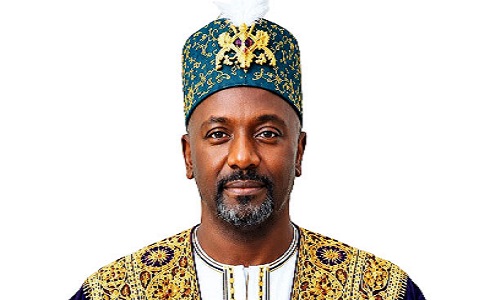
The new Omukama, Edward Rukidi Nyabongo I
HABARI DAILY I Kampala, Uganda I As Tooro prepares to welcome a new Omukama, Edward Rukidi Nyabongo I approaches his coronation not as the arrival of a man to power, but as the beginning of a life of service.
On September 29, he will formally assume the throne of the Toro Kingdom, succeeding the late Omukama Oyo Nyimba Kabamba Iguru Rukidi IV. For the new king, the moment carries the weight of family history, tradition and the expectations of a kingdom looking towards the future.
“I feel a deep sense of humility, gratitude and responsibility,” he says. “This is not a moment I approach with pride in myself, but with reverence for those who carried this heritage before me — beginning with my grandfather, His Highness Omukama Sir George Rukidi III, and my father, Prince Christopher Paul Kijanangoma.”
For Nyabongo, the coronation represents more than a ceremonial transition. It is the point at which a family legacy becomes a public responsibility.
“Personally, it is the point at which my family heritage becomes active service,” he says. “I have always regarded my lineage as a responsibility rather than a privilege, and September 29 is the day that responsibility formally begins.”
He describes himself as ready for the role, but immediately qualifies what readiness means to him.
“I feel ready, but also aware that readiness is something I must keep earning every day I sit on this throne.”
That philosophy was shaped long before the coronation. Nyabongo says his upbringing taught him that royal lineage was never supposed to be treated as an entitlement.
“I was raised with a strong awareness of where I come from — the son of Prince Christopher Paul Kijanangoma and grandson of Omukama Sir George Rukidi III — and with an equally strong insistence that heritage must be matched by discipline and hard work,” he says.
“My family never let me treat royal descent as an entitlement; it was presented to me as a duty to prepare for.”
Alongside his royal heritage, Nyabongo developed a professional identity far removed from the palace. He spent 24 years working in journalism and public communication, an experience he says fundamentally shaped the way he understands leadership.
“That work taught me to listen carefully, speak responsibly, and represent the concerns of ordinary people accurately,” he says.
The combination of heritage and professional experience, he believes, has given him a particular understanding of service.
“Between my family’s grounding in heritage and my professional grounding in public service through communication, I have been shaped to value humility, integrity and service above all else.”
These principles will form the foundation of his reign. At the centre of his vision is a Toro that remains deeply connected to its culture while embracing the possibilities of the modern world.
“My vision is for a united, culturally confident, forward-looking and people-centred kingdom — one firmly grounded in its traditions while embracing the opportunities of the modern world,” he says.
Young people occupy a particularly important place in that vision.
Nyabongo wants the kingdom to invest in education, mentorship, leadership development, skills training, entrepreneurship and innovation while ensuring that cultural identity remains central to the development of the next generation.
“I want to support education, mentorship, leadership development, skills training, entrepreneurship and innovation, alongside cultural awareness, so that they can confidently carry Toro’s heritage into the future rather than feeling they must choose between tradition and progress.”
For him, cultural confidence and economic participation should not be competing ambitions. “A confident young Mutoro should be at home speaking Rutoro and competing in the modern economy,” he says.
The new Omukama says his approach to leadership has been influenced most profoundly by his father, Prince Christopher Paul Kijanangoma.
“My father stands at the centre of that list,” he says. “Through him, I inherited not just a family name but an understanding that this throne exists to serve, not to be served.”
That lesson has become the principle he intends to carry into his reign. “The clearest lesson I carry from my family is one I hold as my guiding principle: Leadership is trust and trust must be honoured through service to the people.”
He adds: “Everything else — humility, wisdom, responsibility, respect for institutions and tradition — flows from that single idea.”
His first year on the throne, therefore, will focus on both preservation and renewal. “My priorities are clear and I intend to move on all of them from the outset,” he says.
They include preserving Toro’s cultural heritage, particularly the Rutoro language, customs and history; promoting unity and reconciliation; empowering young people through education and enterprise; honouring the wisdom of elders; strengthening communication between the kingdom and its people; and practising leadership grounded in humility and integrity.
He also intends to make the palace more accessible. “In the first year, I intend to be visible and accessible — using my background in communication — to open direct channels between the palace and our people, at home and in the diaspora, so that the kingdom hears its subjects and is seen to act on what it hears.”
For Nyabongo, staying connected to ordinary people is not simply a communications strategy. It is central to the kind of king he wants to be.
“Communication has been both my profession and, in many ways, my personal passion — 24 years in journalism and public engagement have shaped how I relate to people and ideas,” he says.
“I value time spent listening to and learning from communities, which keeps me connected to everyday realities rather than removed from them.”
He believes the kingdom has a particular asset that can be used for development: the trust and convening power associated with the institution.
“The kingdom carries a convening power that the Government and private actors do not always have — the trust of the people,” he says.
That trust, he argues, can help bring together different actors around education, youth empowerment, community wellbeing, environmental stewardship and tourism.
“I believe Toro should use that trust to champion education and youth empowerment, support initiatives that improve community wellbeing, and encourage responsible stewardship of our environment and natural heritage, which is closely tied to our tourism potential.”
On economic development, he sees the kingdom playing a connecting role rather than attempting to replace government or private institutions.
“The kingdom can be a bridge — connecting entrepreneurship, innovation and skills development among our youth with the resources and partners needed to turn ideas into livelihoods, while always working alongside government and development partners rather than in place of them.”
That collaborative approach will also guide his efforts to continue projects initiated during the reign of the late Omukama Oyo.
“Continuing my predecessor’s developmental work is a priority, not an afterthought,” Nyabongo says.
He plans to build on partnerships and goodwill already established, while strengthening engagement with government, development partners, the private sector and well-wishers in Uganda and abroad.
“My background in public communication will be valuable here — telling the story of these projects clearly and consistently, so that partners and citizens alike can see their impact and are motivated to continue investing in them, whether through direct funding, in-kind support, or volunteered expertise.”
But perhaps the most delicate task facing the new king will be healing divisions surrounding succession.
Nyabongo does not dismiss those divisions.
“I recognise this honestly: unity is not automatic; it must be built.” His response, he says, will be dialogue rather than confrontation.
“I intend to pursue it through genuine dialogue, mutual respect and co-operation with all those who hold a stake in the kingdom’s future, including those who may have differing views on succession.”
He says the throne must be understood as belonging to the entire kingdom.
“My approach will be to lead with humility rather than confrontation — listening to grievances, respecting the kingdom’s institutions and traditions and consistently demonstrating, through action, that the throne belongs to all the people of Toro, not to one faction or family line alone.”
For Nyabongo, resilience has been forged in the tension between two identities: that of a royal heir and that of a professional who spent more than two decades building a career outside the throne.
“Stepping into public life with the weight of a royal lineage — while having built an entirely separate career for over two decades — has required its own kind of resilience,” he says.
“Carrying both identities, and now bringing them together as I assume the throne, has taught me that leadership is not a single dramatic act but a long, patient accumulation of discipline, humility and consistency.”
That, ultimately, may be the clearest description of the reign he envisions.
“I have learned that resilience is less about avoiding difficulty and more about returning, again and again, to one’s guiding principles,” he says.
For him, those principles return to one central conviction: “Leadership is trust and trust must be honoured through service.”
As the crown passes to a new generation, Edward Rukidi Nyabongo I says his task is not simply to inherit Toro’s history, but to serve as its custodian while helping prepare the kingdom for its future.
“I have always regarded my lineage as a responsibility rather than a privilege,” he says.
And on the eve of his coronation, that responsibility is no longer something waiting in the distance. It is about to become his daily duty.