
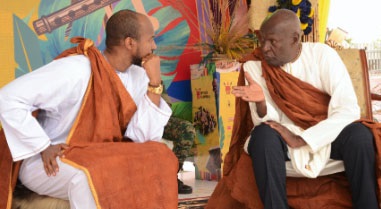
The late King Oyo listening to his uncle Charles Kamurasi during the 29th empango celebrations last year at Karuziika Palace in Fort Portal
HABARI DAILY I Kampala, Uganda I For much of its modern history, the royal families of Toro and Rwanda have been connected by friendship, marriage, exile and shared political upheavals. Long before the late Omukama Oyo Nyimba Kabamba Iguru Rukidi IV considered marrying a Rwandan princess, another member of his family had already forged a marital link with Rwanda’s royal house.
In 1963, Prince Stephen Karamagi, a half-brother of Oyo’s father, Prince Patrick Kaboyo, married Rwandan princess Margret Semugeshi in a ceremony at St John’s Cathedral in Fort Portal.
The wedding was attended by Rwanda’s King Kigeli V Ndahindurwa, who at the time was living in Uganda as a refugee.
Six decades later, the relationship between the two royal families nearly produced another marriage. In 2022, King Oyo proposed to a Rwandan princess closely connected to the family of Kabudadali, a Rwandan relative whom King Kigeli had cared for during his years in Uganda.
The princess accepted. But the marriage never happened. According to the account, a female relative of Oyo advised him against taking the Rwandan princess as his official wife, arguing that he should instead marry a Mutoro who could potentially give birth to a future king of Toro.
Oyo was reportedly deeply disappointed. He offered the Rwandan princess the possibility of becoming his second wife if he married a Mutoro as his official wife. She rejected the proposal. Despite the heartbreak, the two remained close friends until Oyo’s death.
History stretching back to Omukama Rukidi III
The story begins with Oyo’s grandfather, Omukama Sir George Rukidi III, who ruled Toro from 1928 until 1965.
George Rukidi III had two prominent family lines relevant to this story. His official wife, Kezia Byanjeru, was the mother of Prince Patrick Kaboyo and Princess Elizabeth Bagaya. His other wife, Evelyn Kahinju, also known as Omugo wa Harukoto, was the mother of Prince Stephen Karamagi.
The two princes were therefore half-brothers. While Kaboyo’s life would eventually lead him to the Toro throne and later into exile, Karamagi established his own connection with Rwanda when he married Princess Margret Semugeshi in 1963.
The wedding was an important royal gathering. Among those present was King Kigeli V Ndahindurwa, then a Rwandan monarch living in exile in Uganda.
Kigeli’s presence was not merely ceremonial. By that time, his own family had endured decades of upheaval, colonial intervention, exile and the abolition of Rwanda’s monarchy.
Rwandan monarchy’s troubled history
Kigeli was born into a royal family whose history had already been profoundly affected by Belgian colonial rule.
His father, King Yuhi Musinga, became Rwanda’s monarch in 1896. In 1931, Belgian authorities deposed him after he refused to convert to Roman Catholicism, among other disagreements with the colonial administration.
Musinga sought asylum in Moba, in the Belgian Congo, now the Democratic Republic of Congo. He died there on January 13, 1944, aged 60.
After his removal, his eldest son, Mutara III Rudahigwa, became king on November 16, 1931.
Rudahigwa initially accepted baptism and became the first Rwandan king to convert to Roman Catholicism. His relationship with colonial authorities later deteriorated, however, and he died on July 25, 1959, aged 48.
His death was followed three days later by the accession of his 23-year-old half-brother, Kigeli V Ndahindurwa.
The new king inherited a country entering one of the most turbulent periods in its history.
In 1959, violence erupted along ethnic and political lines, triggering a mass refugee movement. More than 300,000 Rwandans fled to neighbouring countries, including Uganda.
Kigeli himself eventually became a refugee.
Rwanda’s monarchy was abolished following the September 25, 1961 referendum, and Kigeli’s subsequent attempts to remain politically relevant were complicated by the changing political environment in the region.
Kigeli’s first Ugandan refuge
Uganda became an important part of Kigeli’s life. He was welcomed by Buganda’s King Edward Mutesa II, who accommodated him in a twin house at Blue Room in Kampala. Kigeli lived there with his aide, Michelle Kayihura, and other relatives and associates.
Among those around him were Gerald Rwigyemera, Emmy Rutayisire, Consolata Mukamusoni, Verediana Kicichondo and Nkurayize.
His stay in Uganda, however, was interrupted in 1964 when the government of Prime Minister Milton Obote ordered him to leave.
The eviction reportedly became dramatic when soldiers arrived at Blue Room with instructions to remove him. The wife of Nelson Sebugwawo attempted to resist the soldiers physically but was overpowered.
Kigeli was eventually taken to Uganda’s border with Kenya and subsequently sought asylum there.
It was against this backdrop that he attended the wedding of Prince Stephen Karamagi and Princess Margret Semugeshi in Fort Portal in 1963.
The marriage therefore represented more than a union between two individuals. It brought together two royal families whose histories were unfolding amid enormous political change in the Great Lakes region.
The return of royal connections
Kigeli’s relationship with Uganda would continue to evolve. After Idi Amin seized power in 1971, he welcomed Kigeli back to Uganda and provided him with a residence on Buganda Road in Kampala.
Prince Patrick Kaboyo also returned to Uganda around this period after his own experiences in exile. Princess Elizabeth Bagaya and Bishop Aberi Balya later appealed to Amin on Kaboyo’s behalf, and he was provided with a house in Boma, Fort Portal.
Kigeli’s family connections in Uganda also deepened. He learned that relatives Bulikoma and his wife, Mukandekyezi, were living in difficult circumstances in Nateete. Mukandekyezi was the younger sister of Kigeli’s mother, Bernadette Mukashema.
The couple had children, including Gloria, also known as Kabudadali. She later married Aliberi, whose father was Prince Etienne Rwigemera, a brother of Kigeli.
Kigeli took a particular interest in Kabudadali, eventually caring for her and enrolling her at school in Nakivubo.
Following the overthrow of Amin in 1979, Kigeli fled Uganda again, this time taking Kabudadali with him to Kenya. He later moved to the United States, while Kabudadali remained with relatives in Kenya.
The family story
Years later, these intertwined family histories would become significant in the life of Oyo. Prince Patrick Kaboyo married Best Kemigisa in 1987. About four years later, the couple had a son, Oyo.
In 1993, Kaboyo regained the Toro throne. He became Omukama once again, but his reign was brief. He died in 1995, when Oyo was only three years old, leaving his young son to inherit the throne.
By the time Oyo was born, Kabudadali was still living in Kenya. The connections between the Toro and Rwandan royal families, however, had not disappeared.
The proposal in 2022
In 2022, Oyo proposed to a Rwandan princess who was closely related to Kabudadali. The princess accepted. The relationship appeared to be moving towards marriage, with Oyo informally introducing his intended bride to a female relative. The plan, according to the account, was for the wedding to take place in 2024.
But that plan encountered opposition from within Oyo’s family.
The female relative reportedly admired the Rwandan princess but advised Oyo not to marry her as his official wife. Instead, she encouraged him to find a Mutoro, reasoning that a Mutoro wife might give birth to a future king of Toro.
The advice reportedly left Oyo disheartened. The Rwandan princess was also deeply disappointed. Oyo subsequently offered a compromise: she could become his second wife if he married a Mutoro as his official wife.
She declined. The relationship that had begun with a marriage proposal therefore never reached the altar.
Friendship survived the disappointment
Despite the failed marriage plans, the relationship between Oyo and the Rwandan princess did not end.
The two remained close friends. That friendship became particularly poignant when news of Oyo’s death reached her.
According to the account, she was devastated by the loss. She locked herself inside a house in Nakawa Division and spent two days mourning and weeping.
Eventually, she emerged, styled her long braids, dressed in jeans and went to the vigil at Oyo’s palace in Munyonyo, Makindye.
She also travelled to Fort Portal for his funeral. In the end, the story of Oyo and the Rwandan princess became one of a royal marriage that almost happened but was ultimately prevented by considerations surrounding succession, identity and the future of the Toro monarchy.
A lasting royal connection
The proposed marriage would have represented another chapter in a relationship between Toro and Rwanda that goes back generations.
Prince Stephen Karamagi’s 1963 marriage to Princess Margret Semugeshi had already linked the two royal families. King Kigeli’s attendance at that wedding underscored the close ties between the royal houses during a turbulent period in the region’s history.
More than half a century later, Oyo’s proposed marriage to another Rwandan princess offered the possibility of renewing that connection.
It was not to be. Yet the relationship left behind something that outlasted the marriage proposal itself: a friendship that survived disappointment and ultimately became part of the story of Oyo’s final years.