
Tundu Lissu
HABARI DAILY I Kampala, Uganda I Previously known as the region’s beacon of peace and stability, Tanzania has now become a country increasingly associated with political intolerance, shrinking democratic space and the persecution of opposition leaders, following the conviction and sentencing of its main opposition figure, Tundu Lissu, to four years in prison.
The 58-year-old leader of the opposition Chadema party was found guilty of inciting unrest in connection with his campaign against the disputed October 2025 general elections, despite being acquitted of the more serious charge of treason.
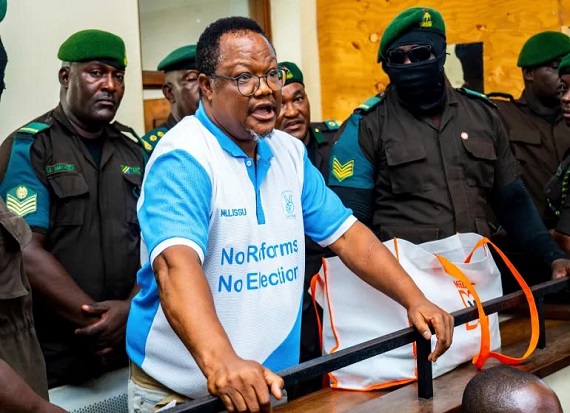
A three-judge panel of the High Court in Dar es Salaam ruled that prosecutors had failed to establish a crucial element of the treason charge but found that Lissu’s campaign slogan, “No Reforms, No Election”, amounted to incitement because it encouraged supporters to disrupt the electoral process.
The judges argued that by publicly disseminating the slogan, Lissu had encouraged the public to interfere with the 2025 elections.
“By uttering those words with the intention of disseminating them to the public, the accused incited the public to disrupt the 2025 elections,” the court ruled.
However, the verdict has triggered fresh concerns about the independence of Tanzania’s judiciary, freedom of expression and the government’s willingness to tolerate political criticism.
Lissu, who has been in detention since April 2025, rejected the conviction, arguing that the incitement charge was politically manufactured because he had initially been prosecuted for treason.
“The offence of incitement is one that you, honourable judges, have manufactured. You have created an offence that did not exist, and you have done so on political directives,” he told the court.
He maintained that his statements were part of a legitimate political campaign demanding electoral and constitutional reforms rather than an attempt to overthrow the government.
The opposition leader indicated that he intended to seek bail, arguing that incitement, unlike treason, was a bailable offence. He also has the right to appeal the conviction before the Court of Appeal, Tanzania’s highest court.
The slogan that landed Lissu in prison
At the centre of the prosecution was Lissu’s campaign slogan, “No Reforms, No Election”, which he adopted shortly after becoming Chadema’s national chairman in January 2025.
He was arrested in April, approximately six months before the general elections, after intensifying demands for fundamental changes to Tanzania’s electoral system.
His party argued that the country’s electoral framework was heavily tilted in favour of the ruling Chama Cha Mapinduzi (CCM), which has dominated national politics since independence.
Among Chadema’s principal demands were the independent appointment of electoral commissioners rather than their selection by the President, an end to police intimidation of opposition campaigns and the removal of government-appointed district chiefs from their roles as returning officers.
The party also demanded that its agents be allowed to observe vote counting without harassment and that presidential election results be open to challenge in court.
Lissu argued that these were legitimate democratic demands intended to create a level playing field for political parties.
Prosecutors, however, maintained that his statements, including those circulated online, were intended to mobilise citizens to disrupt the elections and threaten the government.
The court ultimately agreed that the slogan constituted incitement, even though it dismissed the treason charge, one of Tanzania’s most serious offences, which can attract the death penalty.
Election controversy deepens political crisis
Lissu’s conviction comes against the background of Tanzania’s controversial October 2025 general elections, in which President Samia Suluhu Hassan secured approximately 98% of the vote.
The result was dismissed by opposition groups as a mockery of democracy, particularly because two major challengers, including Lissu, were excluded from the presidential contest.
The elections were followed by widespread protests and a violent security crackdown.
An official inquiry reportedly established that at least 500 people died during the unrest, although opposition groups insist that the actual death toll was considerably higher.
They have demanded an independent investigation into the killings and the conduct of security agencies.
President Samia’s government has defended its handling of the unrest, denied accusations of systematically targeting political opponents and maintained that the election was free and transparent.
The President has also blamed foreigners for the violence, describing it as part of an alleged attempt to overthrow her government. She subsequently established another commission of inquiry to investigate those responsible.
Last week, Amnesty International accused the government of continuing its post-election crackdown and weaponising counterterrorism laws to silence critics and instil fear.
A history of persecution
Lissu’s confrontation with the Tanzanian establishment is not new. A lawyer by profession, he first entered Parliament in 2010 as the representative of a constituency in Singida, north-west of Dodoma.
He became one of the country’s most outspoken critics of the ruling CCM government, particularly during the presidency of the late John Magufuli.
In September 2017, he narrowly survived an assassination attempt when gunmen sprayed his vehicle with bullets outside his home in Dodoma. He sustained multiple gunshot wounds and underwent extensive medical treatment abroad.
The perpetrators have never been brought to justice, forcing him to spend several years outside Tanzania.
He returned in 2020 to challenge Magufuli in the presidential election, which he lost amid opposition allegations of widespread irregularities.
Following another period in exile, Lissu returned in 2023 after President Samia lifted restrictions on opposition political rallies.
His return was initially celebrated as evidence that Tanzania was opening up politically following years of restrictions under Magufuli, who died in office in 2021.
However, relations between the government and opposition deteriorated as the 2025 elections approached.
During his detention at Ukonga Prison in Dar es Salaam, Lissu reportedly went on hunger strike twice over restrictions on access to his lawyers and relatives. He also complained that prison guards listened to confidential consultations with his legal team, allegations denied by prison authorities.
Democracy faces a defining test
Lissu’s four-year sentence has become a defining moment for Tanzania’s democratic credentials.
For critics, the prosecution demonstrates how criminal laws can potentially be used to restrict legitimate political mobilisation and discourage demands for electoral accountability.
His conviction also raises questions about whether opposition politicians can freely challenge the government without risking prosecution.
Although Tanzania has long enjoyed a reputation for relative peace and stability, the post-election violence, exclusion of opposition candidates and imprisonment of its most prominent opposition leader have placed that reputation under unprecedented scrutiny.







About the Author