
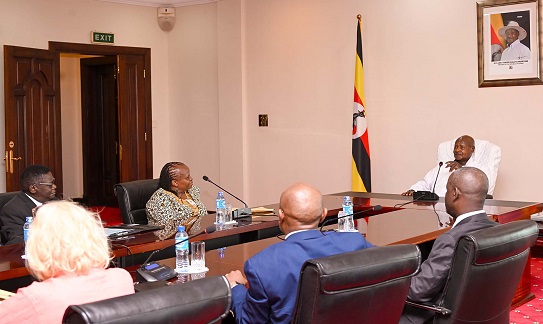
President Museveni meeting Rosette Muzigo Morrison, a candidate for the ICC Judicial Elections 2026. Also in the meeting are Deputy Speaker Tayebwa, Hon Ayebare, Hon Mao and Amb Blaac Mirjam. PPU Photo
HABARI DAILY I Kampala, Uganda I Uganda’s candidate for the International Criminal Court (ICC) judicial elections, Rosette Muzigo-Morrison, has received a significant endorsement from President Yoweri Museveni, strengthening the country’s campaign to secure a place on the international court’s bench for the 2027–2036 term.
Museveni met Muzigo-Morrison at State House, Entebbe, on November 23, 2026, in a meeting that focused on her candidature and Uganda’s representation in the forthcoming ICC judicial elections scheduled for December 1–17, 2026, in New York.
The meeting provides an important platform for Uganda to rally diplomatic and political support behind its candidate as States Parties prepare to elect judges who will serve a nine-year term at the international tribunal.
Muzigo-Morrison, an international criminal and human rights lawyer with more than 30 years of professional experience, paid a courtesy call on the President following Uganda’s formal presentation of her candidature in July 2026.
Museveni welcomed her and commended her extensive professional experience and contribution to the legal field, signalling the government’s support for her quest to join the ICC bench.
The meeting was attended by Deputy Speaker of Parliament Thomas Tayebwa, Justice and Constitutional Affairs Minister Norbert Mao, Foreign Affairs Minister Adonia Ayebare and Uganda’s Ambassador to Belgium, the Netherlands and Luxembourg, Mirjam Blaak Sow, among other officials.
Their participation underscored the involvement of Uganda’s political, legal and diplomatic leadership in supporting the candidature, which requires engagement with other ICC member states to secure votes.
Three decades of legal experience
Muzigo-Morrison’s candidacy is backed by a career spanning several international judicial and investigative institutions, including the ICC, the International Criminal Tribunal for Rwanda (ICTR), the Special Court for Sierra Leone and United Nations investigative bodies.
Her experience at the ICTR began in 1995, when she worked as an Investigator and Legal Officer, participating in the tribunal’s work relating to the 1994 genocide against the Tutsi in Rwanda.
Between 2000 and 2015, she served as the Registrar’s Representative, while also undertaking responsibilities as a Presiding Officer under Rule 33B between 2005 and 2015.
She additionally served as an Appeals Chamber Legal Officer from 2012 to 2015, giving her experience in different stages of international criminal proceedings.
Her work included supporting the establishment of the tribunal’s office in The Hague, Netherlands, an important component of its international operations.
At the Special Court for Sierra Leone, she served between 2006 and 2008 as Registrar’s Representative and Legal Officer/Coordinator, contributing to the institution’s work, including proceedings connected to the prosecution of former Liberian President Charles Taylor.
Her international experience also includes work within the ICC’s Office of the Prosecutor, where she served in the Legal Advisory Section and as an Operations Officer between 2016 and 2021.
In 2022, she was shortlisted for the position of ICC Registrar, the administrative head responsible for the court’s registry operations, further demonstrating her familiarity with the institution.
At the United Nations, she served as a sexual violence investigator with the Commission of Inquiry on Libya between 2011 and 2012, examining allegations of serious violations during the country’s conflict. She also worked as an expert on mission with the UN Office of the High Commissioner for Human Rights’ Office of the Inspector General.
Academic qualifications
Muzigo-Morrison’s professional background is complemented by academic qualifications in international law, peace studies and conflict resolution.
She holds a Bachelor of Laws degree and two master’s degrees, including a Master of Laws in International Human Rights Law and a Master of Arts in Peace Studies and Conflict Resolution from the University of Notre Dame in the United States, which she obtained in 1993.
The university’s Kroc Institute for International Peace Studies recognised her contribution to international peace and justice with its Distinguished Alumni Award in 2011.
She is also completing a PhD in International Human Rights Law.
Her professional qualifications include experience in both common law and civil law legal systems, an important consideration for an international court that handles cases involving different national legal traditions. She is a native English speaker and has intermediate French proficiency.
According to her nomination documents submitted to the Assembly of States Parties, Uganda nominated her under List B, which recognises candidates with expertise in relevant areas of international law, including international humanitarian law and international human rights law.
Diplomatic campaign
Uganda’s campaign to secure the ICC judicial position has involved engagement with continental and international institutions.
In July 2026, the country presented her candidature to the African Union Ministerial Committee on African Candidatures within the International System and subsequently promoted it through its engagement with the Assembly of States Parties.
The forthcoming elections will determine six judges for the ICC’s 18-member bench, with candidates competing for positions representing different geographical regions and professional qualifications.
Her candidature comes at a time when Uganda’s relationship with the ICC has attracted public debate among government officials, particularly regarding the country’s continued membership and cooperation with the court.







About the Author