
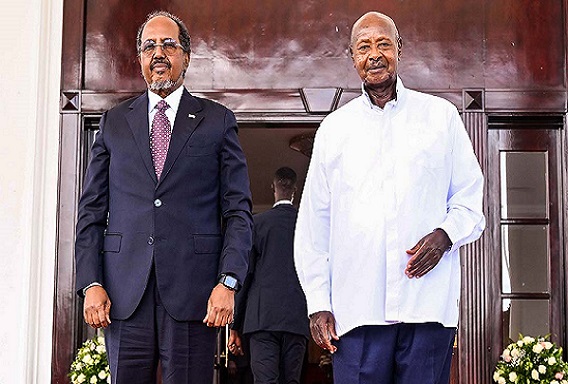
President Museveni poses for a photo with his Somalia counterpart President Hassan Sheikh Mohamud at State House Entebbe on Monday. President Mohamud is on an official working visit to Uganda. PPU Photo
HABARI DAILY I Kampala, Uganda I Uganda is seeking to strengthen its longstanding relationship with Somalia, even as the Uganda People’s Defence Force (UPDF) prepares to scale down its military presence in the Horn of Africa country, with President Yoweri Museveni and his Somali counterpart, Hassan Sheikh Mohamud, reaffirming their commitment to deeper cooperation during talks at State House Entebbe yesterday.
The meeting on November 23, 2026, focused on bilateral relations, regional security, democracy and ongoing efforts to restore peace in Somalia, where Uganda has played a leading role in international efforts to defeat al-Shabaab and rebuild state institutions.
Mohamud, who was in Uganda for a one-day working visit, briefed Museveni on progress in rebuilding Somalia, strengthening government institutions and advancing the country’s peace and stabilisation process.
He thanked Uganda for its longstanding support and contribution to Somalia’s security, commending Museveni’s leadership and commitment to regional stability.
The Somali leader expressed optimism that continued peacebuilding initiatives and institutional reforms would help his country overcome its challenges and realise its potential.
Museveni, in turn, shared lessons from Uganda’s political history, emphasising democracy, national unity, dialogue and peaceful political competition as important foundations for building stable and prosperous nations.
He called for stronger democratic institutions and inclusive governance, arguing that these are essential to sustainable peace and development.
The meeting is significant because it comes at a time when Uganda’s military engagement in Somalia is undergoing transition. Rather than signalling a breakdown in relations, the planned withdrawal and handover of UPDF responsibilities present an opportunity for the two governments to redefine their security partnership while expanding diplomatic, commercial and people-to-people ties.
Security beyond troop deployment
Uganda has been central to Somalia’s security efforts since March 2007, when the UPDF became the first foreign troop contingent deployed under the African Union mission. The operation subsequently evolved through AMISOM and ATMIS, and into the current African Union Support and Stabilisation Mission in Somalia (AUSSOM).
Ugandan troops have constituted the mission’s largest contingent, helping secure strategic installations in Mogadishu, confront al-Shabaab and support the development of Somali security institutions.
Their responsibilities have also included training Somali forces and gradually transferring security duties to national authorities.
The two countries have signed defence and implementation agreements to coordinate their cooperation. However, the mission has faced funding pressures, prompting plans for a phased reduction of foreign troops and the transfer of military bases and responsibilities to Somali forces.
The transition makes continued political and security coordination between Kampala and Mogadishu important, particularly as Somalia works to consolidate gains against al-Shabaab and establish its capacity to independently secure its territory.
Growing economic opportunities
Uganda’s relationship with Somalia, however, extends beyond military cooperation. Somali communities have lived in Uganda since the late nineteenth and early twentieth centuries, gradually establishing commercial networks, particularly in Kampala’s Kisenyi neighbourhood.
Political links also date back decades. In 1972, Somalia’s then-President Siad Barre supported Idi Amin during tensions between Uganda and Tanzania. Following Amin’s fall in 1979, Somali-Ugandans expanded their business interests in trade, real estate and services.
Today, the relationship is sustained by students, business communities and migrant workers. Thousands of Somali students attend Ugandan universities, while Somali entrepreneurs operate businesses across the country. Ugandans also live and work in Somalia, with some sending remittances home.
Diplomatic relations have become more structured over time. Uganda established a permanent diplomatic mission in Somalia in 2014 and the two countries signed a framework agreement in 2016. Cooperation has since advanced through a Joint Permanent Commission covering trade, defence, migration, education and investment.
Somalia’s admission to the East African Community has further widened opportunities for cooperation, giving the two countries a regional framework through which to expand trade, investment and access to markets.
The Entebbe meeting was attended by Foreign Affairs Minister Adonia Ayebare, Defence and Veteran Affairs Minister Kiryowa Kiwanuka, State Minister for Foreign Affairs in charge of Regional Affairs Haruna Kasolo, former Foreign Affairs Minister Sam Kutesa and UPDF Land Forces Commander Lt Gen Kayanja Muhanga, among other officials.
The two presidents reaffirmed their commitment to deepening bilateral cooperation, particularly in promoting regional peace, security and stability. For Kampala and Mogadishu, the message is that their partnership is broader than the deployment of troops: it rests on shared security interests, historical connections and growing economic possibilities.







About the Author