
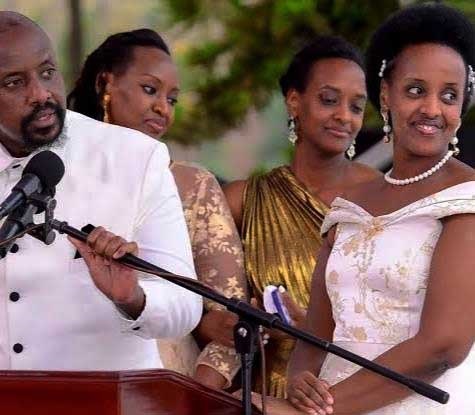
A cross section of Museveni’s children including Muhoozi Kainerugaba, Natasha Karugire, Patience Rwabwogo and Diana Museveni
HABARI DAILY I Kampala, Uganda I The President says his family should preserve inherited land as a single productive asset and share its earnings, warning that subdivision destroys family wealth and threatens national development.
President Yoweri Museveni has renewed his warning against fragmenting inherited family land, instructing his children to preserve the Rwakitura estate intact after his death and share the income generated from it rather than divide the property into individual plots.
The instruction, delivered during a thanksgiving ceremony for Chief Justice Flavian Zeija in Rukungiri District on Saturday, November 21, 2026, highlights the President’s longstanding position that family wealth should be preserved across generations through collective ownership and professional management.
Museveni invoked the example of his late father, Amos Kaguta, whose estate at Rwakitura, in Kiruhura District, has remained undivided among beneficiaries.
“My father Amos Kaguta died but if you come to Rwakitura, the way he left the estate is how it is. No one has split it up. When I also go to heaven the children will keep it and share what comes out of it,” he said.
He issued a humorous but pointed warning to his children, saying: “Whoever splits up Rwakitura, my ghost will come back and haunt them.”
The message is significant because it goes beyond a personal family inheritance arrangement to address a wider challenge facing households that inherit agricultural land and other productive assets in Uganda.
Preserve the asset, share the earnings
Museveni argued that families should distinguish between sharing ownership of an estate and physically dividing the property itself.
He said beneficiaries could hold different ownership percentages and receive corresponding shares of the proceeds without breaking up the land into smaller parcels.
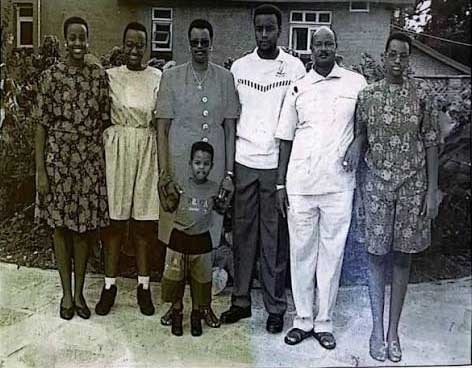
Museveni’s family at an earlier stage
“The modern way has taught us you can share your parent’s properties without chopping them up,” he said.
To illustrate his argument, the President compared land subdivision to breaking a household water pot into pieces simply because several families were entitled to use it.
“If you have one water pot that needs to be shared among five households, do you break it up and give pieces to each family? You keep it whole and let each household use it in turn,” he explained.
He added: “Modernity has taught us that children can take up shares in their parents’ estate and only split up earnings coming from the estate.”
The approach, he believes, allows family land to remain large enough for productive agriculture, commercial investment and other economic activities, while ensuring that every beneficiary receives an economic return.
Fragmentation of family wealth
Museveni particularly singled out Ankole and Kigezi, where he said subdivision of inherited land was threatening family wealth and undermining national development.
“If we do not stop splitting up inheritance, our country is in danger,” he warned.
His concern is that repeated subdivision across generations can leave families with increasingly small plots that are difficult to use for commercial agriculture. Instead of maintaining viable farms, families risk ending up with fragmented holdings that cannot support large-scale production or generate substantial income.
The President has previously urged Ugandans to establish companies and associations to manage inherited property collectively, arguing that such structures can protect family assets while allowing beneficiaries to share profits.
Succession arrangement already taking shape
Museveni has articulated the same position on several occasions, including in November and December 2022, when he said Rwakitura would remain intact after his death and that his children and descendants would inherit ownership shares rather than separate portions of land.
In December 2024, he disclosed that his children collectively held 40 per cent of the family estate, while he retained 60 per cent. He also suggested that he could allocate a controlling 51 per cent stake to his eldest son, Gen Muhoozi Kainerugaba, to prevent disagreements over management and decision-making.
Museveni and First Lady Janet Kataaha Museveni have four children: Muhoozi, Natasha Karugire, Diana Kamuntu and Patience Rwabogo. The President has previously stated that his daughters would also inherit his wealth, rejecting customary practices that exclude women from family inheritance.
The family has also been separating ownership from day-to-day management as its agricultural enterprises expand. In an October 2024 explanation, Museveni said the family intended to strengthen its farming operations through a professional board responsible for appointing managers and evaluating business performance.







About the Author