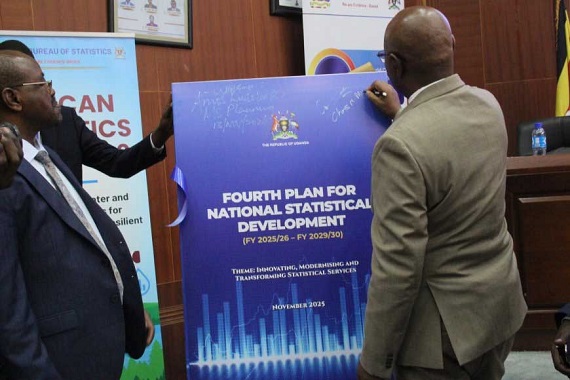
Dr Chris Mukiza, the UBOS Executive Director appending his signatures on one of the three strategies that was unveiled recently
HABARI DAILY I Kampala, Uganda I The Uganda Bureau of Statistics (UBOS) has launched three strategic documents aimed at transforming the country’s statistical system, improving public access to reliable information and supporting Uganda’s ambition of achieving tenfold economic growth.
The move is intended to shift national planning from reliance on estimates and fragmented information to evidence-based decision-making, ensuring that government policies, investments and development programmes are guided by accurate and timely statistics.
Unveiled during Africa Statistics Week 2026, which runs from November 12 to 20, the documents are the Fourth Plan for National Statistical Development (PNSD IV), UBOS Strategic Plan IV and the UBOS Service Delivery Standards.
The three frameworks seek to modernise how national data is collected, coordinated, disseminated and used, while strengthening accountability within the national statistical system.
UBOS Executive Director Dr Chris Mukiza said statistics should be recognised as a strategic national asset rather than treated as a routine administrative requirement.
The initiative comes as Uganda pursues the ambitious tenfold economic growth agenda, which requires reliable information to identify investment opportunities, measure development progress and ensure resources are directed towards priority sectors.
Modernising national data collection
The first document, PNSD IV, provides a five-year framework for strengthening the National Statistical System during the 2025/26–2029/30 period.
It introduces modern technologies, including artificial intelligence, Big Data, geospatial analytics and automated systems, to improve the collection, processing and dissemination of statistics.
The plan also seeks to strengthen coordination among ministries, departments, agencies and local governments to eliminate duplication, harmonise statistical standards and improve the quality of information generated by public institutions.
Mukiza said the adoption of modern technologies would improve the production and dissemination of official statistics, while strengthening the country’s ability to respond to emerging data demands.
“The Board takes great pride in overseeing the production of quality official statistics that support evidence-based planning, monitoring and evaluation of government programmes,” Mukiza said.
He emphasised that reliable statistics should not merely be viewed as a technical requirement for policymakers but as a strategic national asset that supports informed decisions and national transformation.
Improving the quality of official statistics
The second document, UBOS Strategic Plan IV, is the bureau’s institutional roadmap for improving its performance and the quality of statistics it produces.
Developed from the mid-term evaluation of the previous Strategic Plan III, it aligns the bureau’s priorities with the Fourth National Development Plan (NDP IV), the United Nations Sustainable Development Goals and the African Union’s Agenda 2063.
The plan seeks to broaden the availability and quality of official statistics, particularly disaggregated data that can help policymakers identify inequalities and understand the different development needs of communities.
It will also guide the production of information required for national planning, budgeting, monitoring and evaluation of government programmes.
The third document, UBOS Service Delivery Standards, establishes expectations for how the bureau should serve the public and other users of statistical information.
The standards provide for transparency, impartiality, confidentiality and predictable timelines for responding to requests for information.
They are intended to make UBOS more accountable to citizens, researchers, government institutions and private-sector players seeking official statistics.
Thomas Rutaro, UBOS Director for Methodology and Statistical Coordination Services, said the standards would ensure that the bureau delivers on the commitments contained in its strategic plan.
“The service delivery standards and guidelines will help us deliver the outputs we have highlighted in the strategic plan. They will enable you to hold us accountable on what we promise to deliver,” Rutaro said.
Using statistics to improve public services
Beyond economic planning, UBOS says reliable statistics are essential for addressing everyday challenges, particularly gaps in access to safe water and sanitation.
Dr Vincent Fred Ssenono, the bureau’s Deputy Executive Director, highlighted the importance of accurate water and sanitation statistics in identifying underserved communities and directing public investments to areas where they are most needed.
He cited findings from the 2022 Uganda Demographic and Health Survey showing that although more than 80% of Ugandan households obtain water from improved sources, 89% remain at risk of waterborne diseases because of contamination.
In rural communities, the proportion rises to 93%, demonstrating that access to an improved water source does not necessarily guarantee safe drinking water.
To address such information gaps, UBOS has partnered with local governments to develop a digital application that maps water sources across districts.
The application is intended to help local authorities identify the location of water sources, assess community needs and plan investments more accurately.
Ssenono said reliable statistics would help government institutions establish where services are lacking, determine investment priorities and monitor whether resources reach their intended beneficiaries.
The reforms also seek to make official information easier to access through UBOS’s digital data dissemination portal, allowing researchers, investors, policymakers and members of the public to obtain statistics directly from the bureau.
Meanwhile, State Minister for Finance and Planning Amos Lugoloobi challenged government institutions to use verified statistics in planning and budgeting rather than relying on inflated or inaccurate figures.
He also urged ministries, departments, agencies and local governments to strengthen their statistical capacity and embrace artificial intelligence and Big Data analytics.
The launch formed part of Africa Statistics Week activities, which also include a professional seminar, students’ symposium, sports gala, blood donation drives and tree-planting exercises.
Through the three frameworks, UBOS seeks to strengthen the country’s statistical infrastructure and ensure that Uganda’s tenfold economic growth ambition is supported by credible evidence, effective resource allocation and measurable development outcomes.