
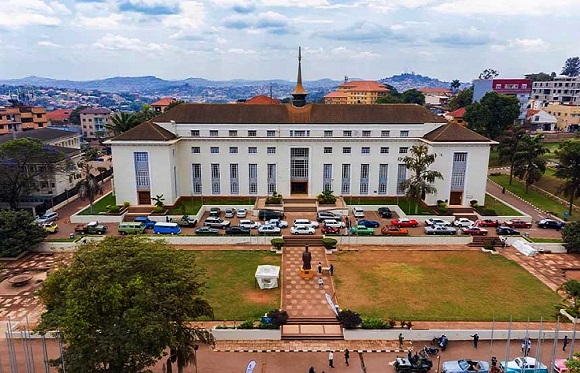
Mengo, the seat of the Buganda kingdom administration
HABARI DAILY I Kampala, Uganda I After years of waiting and begging for the restoration of its confiscated properties, the Buganda Kingdom has expressed gratitude to the Government for beginning to honour its compensation obligations, following the payment of Shs40 billion towards assets taken over during the 1966 political crisis and subsequent periods.
The Kingdom says the payment marks an important milestone in addressing a historical injustice that has strained its relationship with successive central governments for six decades, while providing resources to strengthen its financial position and expand investments in healthcare, education and poverty reduction.
In a statement issued on November 22, 2026, the Kingdom’s Minister of Information and spokesperson, Owek. Israel Kazibwe Kitooke, welcomed the payments, saying they demonstrated the government’s willingness to fulfil its obligations arising from the confiscation of Buganda’s properties.
“The compensation runs into billions of shillings. We are happy that the Government has started honouring its obligation to restore the Kingdom’s properties through compensation,” Kitooke said.
Although the Kingdom’s statement did not provide a consolidated figure for all the payments received, the latest reported Shs40 billion compensation represents a significant step towards resolving the long-standing dispute.
Outstanding Properties
The compensation relates to properties confiscated following the 1966 attack on the Lubiri (Mengo Palace) by the Obote-led government, as well as other assets subsequently taken over or occupied by central government installations.
Among the properties is Muteesa House in London, which was confiscated and sold by the government. The property is particularly significant because of its association with the former Kabaka of Buganda, Edward Muteesa II, who was forced into exile following the 1966 political confrontation.
Another major asset is Plot 52 Kampala Road, currently known as King Fahad Plaza. The property was confiscated and subsequently donated by the Idi Amin administration to the Muslim community.
The compensation also covers land occupied by Makindye Military Barracks and the Court Martial, as well as the land hosting the Lubigi Sewage Treatment Plant, among other properties.
These assets illustrate the extent of the historical property dispute, particularly because the Kingdom’s ownership interests were not fully restored despite the return of its property titles in 1993.
Following the restoration of the Kingdom, government installations continued occupying some of the contested properties, prompting disagreements and court proceedings before negotiations eventually paved the way for compensation.
The settlement is therefore significant because it provides a financial resolution for properties that the government has continued using or which were transferred to other parties, while offering an opportunity to improve relations between the central government and the cultural institution.
Additional compensation directives
Beyond the reported Shs40 billion payment, reports indicate that President Yoweri Museveni directed the Ministry of Finance to pay an additional Shs162 billion for verified properties seized after 1966.
There were also reported directives for Shs45 billion towards claims relating to Muteesa House and King Fahad Plaza.
These figures point to the wider financial obligations associated with settling Buganda’s property claims, although the additional amounts should not be confused with money already paid into the Kingdom’s accounts.
The Kingdom has consequently urged the government to clear the outstanding compensation balances and ensure regular payment of rent for government installations occupying its land.
For Buganda, the significance of the settlement goes beyond recovering the financial value of its lost properties. The Kingdom wants to transform the compensation into sustainable investments that can improve the livelihoods of its people.
Kitooke said the resources had enabled the institution to strengthen its annual budget and undertake development projects that would otherwise have been difficult to finance.
Transforming healthcare and education
One of the most visible benefits of the compensation has been the construction of three Health Centre IV facilities at Busimbi in Mityana District, Mukungwe in Masaka District and Buikwe District.
The facilities serve the communities in Singo, Buddu and Kyaggwe counties, respectively, and have been named Muteesa II in memory of the former Kabaka.
The investments are intended to improve access to healthcare by bringing medical services closer to communities, reducing the distances residents have to travel to seek treatment.
The Kingdom has also expanded its health interventions through medical camps and blood donation campaigns aimed at improving health standards among its communities.
In education, the additional resources have strengthened the Kabaka Education Fund, which provides bursaries to disadvantaged pupils and students in primary, lower secondary and upper secondary schools.
According to Kitooke, more than 20,000 children are currently benefiting from the programme.
The Kingdom has further used part of its resources to expand its asset base through the acquisition of alternative pieces of land, including property at Mutundwe Hill.
The investments are intended to strengthen the institution’s long-term financial sustainability and provide additional assets that can support future development programmes.
Kingdom seeks outstanding payments
Despite welcoming the compensation, Buganda has emphasised that the settlement process remains incomplete, insisting that government should clear the outstanding balances and pay rent regularly and on time for installations occupying Kingdom land.
The Kingdom considers these payments important because they would provide additional resources for grassroots economic empowerment, particularly through its Mwanyi Terimba initiative, which seeks to lift communities out of poverty.
“We call upon the Government to pay the remaining debt and to pay rent regularly and on time for the installations it has on Kingdom land, so that Buganda can invest more in grassroots projects such as ‘Mwanyi Terimba’, which can uplift people out of poverty,” Kitooke said.
The Kingdom has also indicated that more development programmes will be unveiled in its 2027/2028 Budget, building on the resources generated through compensation and other revenue streams.
Historical reconciliation
The compensation comes against the background of a six-decade dispute that began with the 1966 political crisis, when the central government confiscated Kingdom properties following the attack on the Lubiri and the subsequent abolition of traditional institutions.
Although Buganda’s property titles were restored in 1993, the continued occupation and use of some assets by government agencies meant that the question of compensation remained unresolved.
The latest payments therefore represent an important acknowledgement of the Kingdom’s property claims and an opportunity to rebuild trust between the two institutions.
Kitooke expressed appreciation for the progress, despite the lengthy period the Kingdom had waited for the government to fulfil its obligations.
“We are thankful that, despite the delay, concrete steps are now being taken to correct this historical injustice,” he said.







About the Author