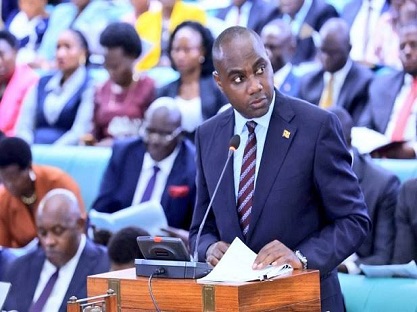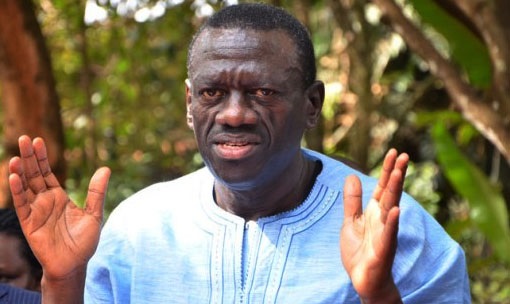

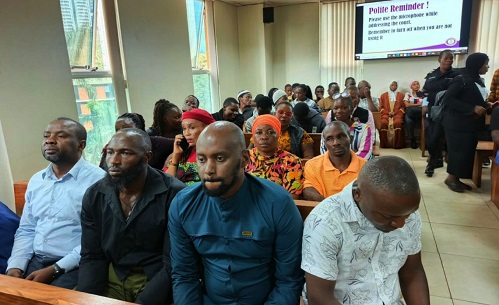
Lewis Rubongoya (2nd R) and colleagues attending court recently
HABARI DAILY I Kampala, Uganda I The High Court has pronounced itself on the admissibility of evidence in the Kampala Central parliamentary election petition, striking out 97 affidavits filed by National Unity Platform (NUP) Secretary General David Lewis Rubongoya, a decision that is likely to significantly narrow the evidence available to challenge the election of Minister Minsa Kabanda Nabbengo.
Presiding judge Justice Flavia Nabakooza Kalungi ruled on Wednesday, October 7, 2026, that the additional affidavits were introduced irregularly and without the mandatory leave, or permission, of the court. Their removal does not, however, bring the petition to an end, leaving Rubongoya to pursue the remaining grounds as the case moves towards a scheduling conference.
Court rejects late evidence
Rubongoya filed Election Petition No. 10 of 2026 on March 30, challenging Kabanda’s victory in the January 15 parliamentary election for Kampala Central.
However, the 97 additional affidavits were filed later, in June and August, after the Electoral Commission and Kabanda had already filed their responses to the petition.
Justice Nabakooza held that the documents amounted to supplementary affidavits and therefore could not simply be placed on the court record without first obtaining permission.
The judge relied on Rule 4(8) of the Parliamentary Elections (Interim Provisions) (Election Petitions) Rules, which governs the filing of affidavits accompanying election petitions.
The court also relied on the Court of Appeal decision in Mutembuli vs Nagwomu & Another, concluding that documents filed months after the original petition could not legally be treated as having accompanied it.
The affidavits were therefore declared “bad in law” and struck out.
The decision followed consolidated applications by the Electoral Commission and Kabanda’s legal team, who had challenged the late introduction of the documents.
Blow to petitioner’s evidence
The immediate effect of the ruling is to substantially reduce the body of evidence Rubongoya can rely on as he seeks to overturn Kabanda’s election.
The 97 affidavits could potentially have provided additional witness accounts and factual material in support of the petition. Their exclusion means the petitioner cannot rely on that evidence during the hearing unless the court’s ruling is successfully challenged.
The ruling also prevents a litigant from effectively expanding an election petition after seeing the responses of the respondents.
The respondents had argued that allowing the affidavits would give Rubongoya an opportunity to introduce fresh evidence after gaining knowledge of their defence.
By striking out the documents, the court has reinforced the principle that election petitions must comply strictly with statutory timelines and procedural requirements.
Three witnesses allowed
Rubongoya also suffered another limitation when the court restricted him to three witnesses, instead of the 101 witnesses he had initially sought to call.
The restriction could further affect how the petitioner presents his case.
With only three witnesses available, Rubongoya’s legal team will have to identify the most important evidence and present it through a much smaller number of witnesses.
This makes the organisation and relevance of the remaining evidence particularly important as the case progresses.
Polling station complaint dismissed
The court further struck out Rubongoya’s complaint concerning the location of 23 polling stations in Nakasero II and Kololo II.
The petitioner had challenged their location in restricted security zones.
However, Justice Nabakooza ruled that the polling stations had been gazetted by the Electoral Commission before election day. Any objection to their locations, she held, should therefore have been raised with the electoral body before voting took place.
The High Court consequently lacked original jurisdiction to entertain that particular complaint.
The ruling effectively removes another ground on which Rubongoya sought to challenge the election.
Some grounds survive
Despite these setbacks, the petition has not been dismissed altogether. The judge rejected Kabanda’s objections concerning her academic qualifications and variations in her names, allowing those grounds raised by Rubongoya to remain part of the case.
This means the petitioner still has an opportunity to pursue the surviving grounds during the substantive hearing.
With the pleadings now formally closed, the case will proceed to a scheduling conference, where the parties will agree on the issues for determination and other matters necessary for the hearing.