
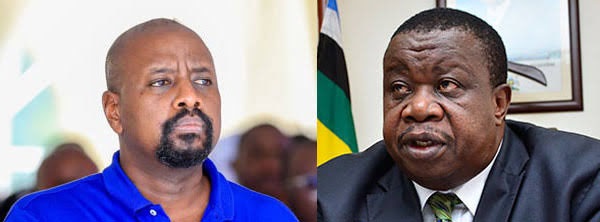
Gen. Muhoozi (L) and Kahinda Otafiire fued
HABARI DAILY I Kampala, Uganda I The NRM party should kick out all public officials accused of corruption, the Patriotic League of Uganda has said, warning that it could reconsider its alliance with the ruling National Resistance Movement unless President Yoweri Museveni removes officials it accuses of corruption, including Rtd Gen Kahinda Otafiire.
The warning has exposed fresh cracks within the political partnership between NRM and PLU, commonly referred to as the “Tuko Pamoja” alliance, while deepening an increasingly public rivalry between Otafiire and PLU chairman Gen Muhoozi Kainerugaba, the Chief of Defence Forces.
PLU Secretary General Daudi Kabanda said the organisation could abandon its cooperation with NRM if what he described as corrupt officials continue to occupy senior government positions.
“If the President does not get rid of these corrupt people like Otafiire from our coalition government, we shall be forced to ask our Chairman to reconsider this coalition with NRM and start our own family,” Kabanda said.
The statement, titled “NRM Should Not Take TUKO PAMOJA Alliance For Granted,” accuses some senior figures within the ruling party of failing to recognise the contribution of young people and PLU supporters to NRM’s electoral performance.
Kabanda, however, did not provide evidence to substantiate the corruption allegations against Otafiire. The veteran politician has previously dismissed accusations of wrongdoing.
Otafiire-Muhoozi feud threatens alliance
The latest warning comes against the backdrop of a bitter public exchange between Otafiire and Muhoozi that has increasingly moved beyond personal disagreement and into the political relationship between their respective camps.
On October 2, Muhoozi demanded a public apology from Otafiire within three days and warned in social media posts that security forces would arrest him if he failed to comply.
The confrontation followed comments made by Otafiire in Parliament and later at Valley University of Science and Technology in Bushenyi, where he spoke about political tolerance and his long involvement in Uganda’s political struggles.
At the university, Otafiire distanced himself from PLU, saying he could not speak for an organisation to which he did not belong.
He also invoked his history of participating in struggles against the governments of Idi Amin and Milton Obote to defend his willingness to take political risks.
“I would rather die on my feet fighting than live on my knees begging,” Otafiire said.
His comments followed his appeal in Parliament for greater political tolerance and his warning against treating opposition politicians as enemies.
The remarks appear to have further aggravated tensions with Muhoozi, who has emerged as a powerful political figure within the ruling establishment and the chairman of PLU.
‘Tuko Pamoja’ alliance faces a test
Kabanda’s intervention has now linked the Otafiire-Muhoozi confrontation directly to the future of the NRM-PLU partnership.
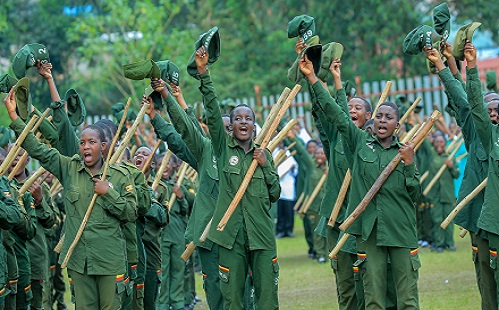
He said Muhoozi had instructed PLU to enter into a memorandum of understanding with NRM ahead of the 2026 general elections, under which PLU would mobilise support for ruling-party candidates “from the President down to the village level.”
NRM and PLU publicly announced coordinated electoral mobilisation in September 2025, with the partnership setting an ambitious target of securing more than 80% of the presidential vote for Museveni.
Kabanda said young people and PLU supporters played a significant role in delivering what he described as a historic 72% victory.
“It therefore puzzles us to see some historicals of the Movement, like Hon. Kahinda Otafiire, failing to appreciate the contribution of the young people and all PLU supporters,” he said.
The remarks suggest that PLU increasingly sees itself not merely as an auxiliary mobilisation structure for NRM, but as a political force entitled to influence the conduct and composition of the ruling coalition.
Corruption becomes the fault line
For PLU, the disagreement is not simply about Otafiire’s statements or his rivalry with Muhoozi. Kabanda presented corruption as one of the central issues underpinning the organisation’s cooperation with NRM.
“In our cooperation agreement with NRM, we were clear: the core problem of Uganda is corruption and it must be dealt with decisively,” he said.
He further criticised the continued political influence of officials who invoke their contribution to Uganda’s liberation struggle as justification for retaining senior positions.
“It bothers us to see figures associated with impunity and arrogance still being protected and given serious responsibilities under the cover of ‘We fought.’ Did they fight to steal?” Kabanda asked.
The criticism puts pressure on Museveni, who has historically maintained a broad coalition around the NRM that includes veterans of the liberation struggle, established politicians and newer political actors.
PLU’s demand for the removal of officials accused of corruption could therefore test the limits of that coalition, particularly if the organisation expects its electoral contribution to translate into greater influence over government appointments and political direction.
Threat of ‘our own family’
The most significant part of Kabanda’s statement was the threat that PLU could reconsider its relationship with NRM and establish what he called “our own family.”
Although he gave no details or timetable for such a move, the language introduces the possibility of a separate political direction for the organisation.
For now, PLU remains aligned with Museveni and the NRM, but the increasingly public disagreement over Otafiire illustrates the fragility of the partnership.
What began as an electoral mobilisation alliance is now facing questions over loyalty, generational influence, corruption and political authority.
The dispute also highlights a broader tension within the ruling establishment: the relationship between the historical figures who built and sustained the Movement and younger forces seeking a greater role in determining its future.
Whether the “Tuko Pamoja” partnership survives the latest confrontation may depend on how Museveni responds to PLU’s demands—and whether the President can contain the widening rivalry between the veteran politicians and the younger political forces surrounding Muhoozi.







About the Author