
HABARI DAILY I Kampala, Uganda I Examinations cheating has become so intolerable that South Korea’s Education Minister Choi Kyo-jin has resigned after taking responsibility for the confusion and public outrage triggered by hurried anti-cheating measures introduced ahead of the country’s fiercely competitive university entrance examinations.
Choi, 72, announced his resignation on Sunday, November 22, 2026, following criticism over his ministry’s failure to anticipate the growing threat of artificial intelligence-assisted examination malpractice and its decision to introduce disruptive security measures just days before the national college entrance examination, popularly known as Suneung.
President Lee Jae Myung accepted his resignation approximately an hour after the announcement, bringing an end to Choi’s tenure amid mounting pressure over the government’s handling of an examination cheating scandal that exposed vulnerabilities in South Korea’s high-stakes education system.
In a statement published on X, Choi acknowledged that the Education Ministry had failed to adequately prepare for the emerging threat of technology-assisted cheating, admitting that he could not escape criticism for the confusion caused by the last-minute interventions.
“As the minister in charge, I believe I cannot escape criticism that we failed to prepare in advance,” he said.
“Now that the exam has concluded, I feel a deep sense of responsibility and am offering my resignation,” he added.
The controversy was triggered by revelations involving Han Won-seok, a 34-year-old candidate who emerged as the top scorer in South Korea’s national tax accountancy examination in April, getting only one question wrong out of 160.
A week before the Suneung examination, Han released a video confession admitting that he had used a concealed microcamera, a smartphone and artificial intelligence tools to cheat during the professional examination.
He explained that he photographed examination questions using a hidden camera, transmitted the images to an artificial intelligence system and subsequently checked the answers on his smartphone.
The confession sparked widespread concern about the ability of examination authorities to detect sophisticated cheating methods involving artificial intelligence and concealed electronic devices.
However, Choi further inflamed public anger during a parliamentary hearing on Monday, November 16, when he admitted that he was not confident authorities could effectively detect AI-assisted cheating, citing his age.
His remarks attracted criticism, particularly because the government was expected to demonstrate preparedness to protect the integrity of the country’s most important academic examination.
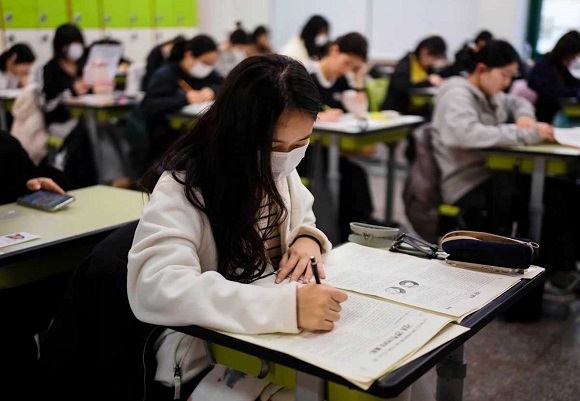
With only days remaining before the November 19 Suneung, the ministry hurriedly introduced an extraordinary series of security measures targeting electronic devices that could be used to facilitate examination malpractice.
Among the measures, candidates were required to cover buttons on their shirts and jackets with stickers to prevent the concealment of miniature cameras. Authorities also introduced inspections of candidates’ eyewear to identify possible smart glasses and other surveillance equipment.
In an unprecedented move, the government deployed its national disaster alert system to detect candidates who might have concealed mobile phones inside examination rooms.
Three nationwide emergency alerts were broadcast between 8am and 3pm on Thursday, forcing mobile phones across South Korea to produce loud warning sounds, even when they had been placed on silent mode. The alerts also reached tourists using international data roaming services.
Phones that were switched off or placed in airplane mode were not affected.
The intervention, which marked the first time South Korea had deployed its national disaster alert system to catch examination cheats, generated further complaints because it disrupted the examination environment and heightened anxiety among candidates.
Some students feared that ordinary personal belongings could be mistaken for sophisticated cheating equipment. One high school candidate told the Korea Times that he was worried his horn-rimmed spectacles could be mistaken for smart glasses.
Despite the extensive security operation, authorities reported that 111 candidates had been found possessing unauthorised electronic devices during the examination, which attracted approximately 550,000 candidates.
The Suneung examination lasts up to nine hours and is considered a defining moment in South Korean education because students’ performance can significantly influence university admissions, employment prospects and their future careers.
Choi’s resignation therefore follows a scandal that exposed the difficulties facing examination authorities as artificial intelligence and increasingly sophisticated electronic devices create new opportunities for academic dishonesty.







About the Author