
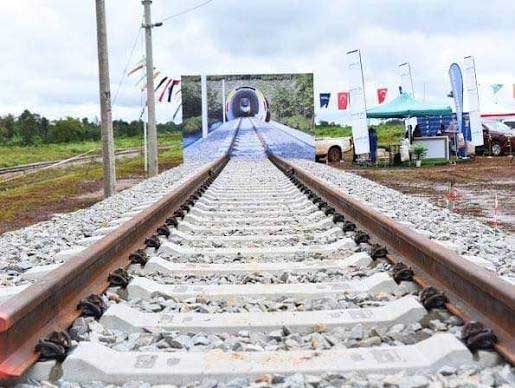
HABARI DAILY I Kampala, Uganda I The Government of Uganda is turning to its first-ever sovereign Sukuk bond to finance 15% of the first phase of the long-awaited Standard Gauge Railway (SGR) from Malaba to Kampala, as it seeks to diversify sources of infrastructure financing while reducing pressure on public debt. Shs1.83 trillion Islamic bond forms part of blended financing for 272-kilometre railway.
The €405.5 million bond, equivalent to approximately Shs1.75 trillion to Shs1.83 trillion, forms part of a blended financing structure for the 272-kilometre Malaba-Kampala SGR whose estimated cost stands at €2.7 billion.
Under the financing arrangement, 60% of the project cost will come from Export Credit Agencies (ECAs), 25% from Development Finance Institutions (DFIs), while the remaining 15% will be financed through the inaugural sovereign Sukuk.
Announcing the Cabinet decisions on October 6 at the Uganda Media Centre, Minister for ICT and National Guidance Justine Kasule Lumumba said the financing initiative was part of government’s broader efforts to modernise the country’s railway infrastructure and strengthen its capacity to support economic development.
The decisions were approved by Cabinet on September 28 at State House Entebbe.
Sukuk opens new financing avenue
Unlike conventional government bonds, the Sukuk is structured to comply with Islamic finance principles and is backed by underlying assets. The instrument is being issued through a Special Purpose Vehicle, with investors acquiring fractional ownership in the underlying assets rather than simply lending money to government at an interest rate.
Investors earn returns in the form of rental income generated from the assets.
The structure is intended to allow Uganda to tap into a wider pool of investors, including those in Islamic financial markets, while creating an alternative source of long-term infrastructure financing.
The Sukuk will also be listed on the Uganda Securities Exchange, while its returns will be tax-exempt. Government has set the minimum investment threshold at Shs1 million, a move intended to broaden participation beyond large institutional investors and attract both domestic and regional investors.
For Uganda, the instrument represents an attempt to diversify its financing base at a time when infrastructure projects require substantial amounts of long-term capital.
Rail project targets freight transformation
The Malaba-Kampala SGR is a central component of government’s plans to transform freight transportation and shift heavy cargo from roads to rail.
The railway is expected to provide a faster and more efficient alternative for moving bulk goods along the Northern Corridor, linking the port of Mombasa through Kenya to Uganda and the wider regional market.
President Yoweri Museveni has repeatedly advocated for the movement of heavy cargo from roads onto railways, arguing that this would reduce deterioration of Uganda’s paved road network and extend the lifespan of expensive road infrastructure.
The SGR is consequently being presented not merely as a transport project but as an important piece of Uganda’s strategy to reduce logistics costs, improve regional trade and strengthen the competitiveness of the economy.
Railway sector faces wider overhaul
The Sukuk financing comes alongside Cabinet approval of the Uganda Railways Bill, 2026, which is intended to replace the Uganda Railways Corporation Act, Cap. 216, enacted in 1992.
One of the most significant proposed changes is the separation of railway regulation from operations.
Under the proposed law, regulatory responsibilities currently exercised by Uganda Railways Corporation (URC) would be transferred to the Ministry of Works and Transport, leaving URC to focus primarily on operating railway services.
Government also intends to open selected areas, including passenger rail services and railway workshops, to private investment, although heavy and bulk cargo transportation would remain under URC.
The proposed legislation further seeks tougher protection of railway land, stronger enforcement against encroachment and updated penalties for violations.
The reforms come amid scrutiny of URC, including parliamentary investigations into a reported Shs125 billion accountability crisis involving missing rolling stock, questionable contracts and alleged disposal of assets.
A bet on alternative capital
By using the Sukuk to cover 15% of the SGR’s first-phase financing, government is effectively combining conventional development and export-credit financing with Islamic capital.
The approach gives Uganda access to a different investor base while keeping the SGR within a broader financing framework involving ECAs and DFIs.







About the Author