
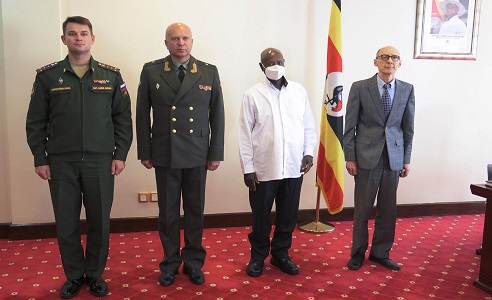
A Russian delegation pauses for photos with President Museveni after a recent meeting at State House Entebbe
HABARI DAILY I Kampala, Uganda I President Yoweri Museveni is to write a personal letter to Russian President Vladimir Putin thanking him for Moscow’s continued military support to Uganda, following the completion of several defence infrastructure projects aimed at strengthening the operational capabilities of the Uganda People’s Defence Forces (UPDF).
Museveni made the announcement while meeting a Russian delegation led by Maj. Gen. Sergei Marchuk, Head of Russian Military Experts in Uganda, at State House, Entebbe, during activities marking Uganda’s 64th Independence Day celebrations.
The President commended Russia for its contribution to Uganda’s military development, specifically citing projects and facilities in Magamaga, Entebbe, Kalangala and Karama.
“Thank you for your military support in Magamaga, Entebbe, Kalangala, and Karama,” Museveni said.
He added that the assistance was strengthening Uganda’s military capabilities and pledged to formally communicate his appreciation to the Russian leader.
“I shall also write officially to President Vladimir Putin thanking him,” he said.
The planned letter underscores the importance Museveni attaches to Uganda’s defence partnership with Russia, which has continued through military infrastructure development, equipment maintenance and training of personnel.
Russian projects strengthen UPDF
During the meeting, Maj. Gen. Marchuk briefed Museveni on the completion of several military infrastructure projects undertaken with Russian support, saying the team had fulfilled commitments made during a previous meeting with the President a year earlier.
“We were received by the President in this same period last year, and we promised to complete all the construction. We have done our mission with great pleasure and honour,” Marchuk said.
Among the completed projects is a park for arms and military equipment at Magamaga, intended to strengthen the management and handling of military assets.
In Entebbe, the Russian team supported the establishment of a maintenance and repair centre for watercraft and a station for quick-response duty units. These facilities are intended to enhance equipment maintenance and operational readiness.
The delegation also reported equipping the Marines pier at Port Alice with a floating berth and technical equipment for security operations.
At the Marines School in Kalangala, a mobile command post was deployed to support military command and coordination.
Meanwhile, at the Mechanised Warfare College in Karama, the Russian team established a multimedia classroom for crews operating BRDM-2M armoured reconnaissance vehicles.
The projects collectively target different aspects of military preparedness, including equipment maintenance, maritime operations, command coordination and specialised training.
For the UPDF, such infrastructure can support the sustained use of military equipment while improving the ability of personnel to undertake assigned duties.
However, the long-term impact will depend on continued maintenance, adequate personnel training and the effective integration of the facilities into the military’s operational requirements.
Museveni traces friendship to 1917
Museveni described Uganda’s relationship with Russia as historic, tracing its origins to the 1917 Bolshevik Revolution.
“This cooperation and friendship between Uganda and Russia is historical. It started in 1917 with the Bolsheviks,” he said.
His remarks reflect Kampala’s emphasis on maintaining longstanding international partnerships as Uganda develops its defence infrastructure and pursues its security priorities.
On his part, Marchuk said Russia had supported Uganda since independence and thanked Museveni for receiving the delegation during the national celebrations.
“Russia has supported Uganda since its independence. We are grateful to the President for receiving us on Independence Day, such a special day, and wish Your Excellency a happy and long life,” Marchuk said.
The meeting provided an opportunity for both sides to review ongoing cooperation and consider areas in which their military relationship could be expanded.
Russian language training to continue
Beyond infrastructure and equipment, the two sides are considering further cooperation in military personnel training.
Marchuk proposed extending Russian language training for Ugandan personnel beginning December 1, 2026, alongside a supplementary agreement covering five years and involving five instructors.
“We propose to continue Russian language training from 1 December 2026 and to sign a supplementary agreement for five years with five instructors,” he said.
Museveni welcomed the proposal, signalling his willingness to sustain cooperation between the two countries.
Language training could help Ugandan personnel participating in programmes involving Russian instructors and equipment to communicate more effectively and improve their understanding of technical training materials.
The proposed five-year arrangement would also provide a framework for continued engagement in personnel development, subject to the conclusion of the supplementary agreement.
Defence partnership remains a priority
Museveni’s planned letter to Putin adds a diplomatic dimension to the military cooperation highlighted during the meeting.
While the President’s remarks focused on gratitude for completed projects, the discussions also pointed to the continuation of cooperation in infrastructure, equipment support and training.
For Uganda, the immediate priority is to ensure that the facilities established with Russian assistance deliver sustained improvements in military readiness and operational efficiency.
For Russia, the projects demonstrate its continuing defence relationship with a longstanding partner in East Africa.
The planned communication to Putin therefore serves both as an expression of appreciation and as a reaffirmation of the bilateral relationship, with further cooperation expected to focus on strengthening Uganda’s military capabilities and developing the personnel requir







About the Author