
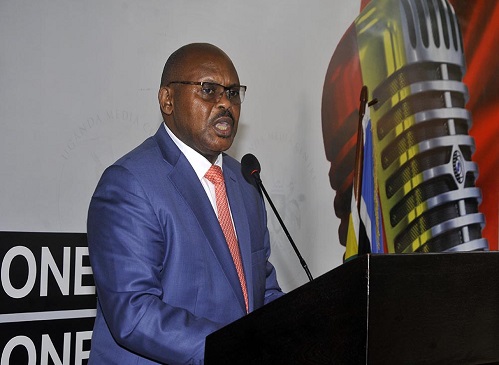
Isaac Musumba Chairperson of Local Government Finance Commission addressing a press conference regarding a conference for local governments to create local revenue for local governments 12 October 2026.Photo by Wilfred Sanya
Isaac Musumba, the LGFC Chairman addressing the media today, Monday, 12th October 2026 at the Uganda Media Center
HABARI DAILY I Kampala, Uganda I The Local Government Finance Commission (LGFC) has proposed that Uganda’s estimated one million motorcycle taxi operators pay a modest daily or monthly levy to boost local government revenues, despite concerns about regulating and tracking the largely informal sector.
The proposal is intended to ensure that everyone earning an income contributes towards financing services provided by districts, cities, municipalities and town councils.
Isaac Musumba, the LGFC chairperson, said the commission believes boda boda operators can be brought into the local revenue collection system through their existing associations and cooperation with local government authorities.
“We know it is possible. And for fairness, because if others are paying, these people who are in the markets are paying, these ones who are in the businesses are paying,” Musumba said, adding: “So whoever is earning, in fact the objective is, whoever is earning some income, should contribute to the local government, so not leave out some sections.”
The proposal, however, raises questions about how the levy would be enforced in a sector characterised by numerous operators, changing work locations and challenges in establishing a comprehensive register of motorcycle taxi riders.
Can an informal sector be taxed?
One of the biggest challenges facing the proposal is regulation. Without a reliable register of operators, identifying who should pay, tracking compliance and preventing multiple charges across different operating areas could prove difficult.
Musumba acknowledged that organising the operators would be important but argued that their existing associations could provide a starting point for implementing the proposal.
“Organising them, they have associations, and it can be worked out well,” he said.
He revealed that the commission had already engaged local government associations, which had in turn held discussions with some boda boda associations about the proposed revenue contribution.
“In fact, we had Saturday, doing some work with the local government associations, which had already engaged some associations, and they already fell,” Musumba said, referring to discussions that had begun with the operators.
He acknowledged that regulation was one of the issues requiring attention but maintained that the riders could be organised because they operate within local government jurisdictions.
“Yes, regulation is one of them, but yes, they can be organised, because they belong to the local governments,” he said.
However, the commission has not yet announced a final rate, a collection mechanism or the arrangements that would prevent riders from being charged repeatedly when they operate across different districts or urban authorities.
These questions are likely to be central to determining whether the proposed levy can be implemented fairly and efficiently.
One million riders targeted
Musumba said the commission wants Uganda’s estimated one million boda boda operators to make a modest contribution to local government revenue, although the amount and frequency of payment would be determined through further discussions.
“We will want the one million boda bodas to make a contribution to local governments’ revenue base by charging or paying some nominal or token amount of money monthly or daily as the discussion will be able to determine,” he said.
The proposal forms part of a broader effort by the commission to expand the local revenue base at a time when many local governments rely heavily on central government transfers to finance their operations.
Musumba argued that locally generated revenue is necessary to supplement central government funding and support services such as garbage collection, street lighting and other activities that may not receive sufficient funding from the centre.
Adam Babaale, the LGFC secretary, is part of the commission’s leadership promoting measures to strengthen local revenue mobilisation. The commission’s position is that expanding the taxpayer base should help local authorities generate additional resources to meet their responsibilities.
The commission does not directly collect the proposed levy. Instead, it supports local governments by providing guidance, training leaders, promoting electronic collection systems and helping authorities improve taxpayer registration.
Conference to discuss proposals
The proposed boda boda levy is expected to feature among the revenue mobilisation ideas discussed at the LGFC’s Local Revenue Conference scheduled for October 15, 2026.
Musumba said the conference would seek to popularise local revenue matters, encourage local government leaders to take revenue collection seriously and build support for proposals intended to increase collections.
The commission has invited the Speaker of Parliament as guest of honour, alongside district, city and town council leaders who will be central to implementing any agreed measures.
The conference will also recognise high-performing local governments while encouraging those collecting less revenue to improve their performance.
Musumba said local government leaders seeking office should understand that mobilising revenue is part of their responsibility.
“If anybody wants to vie for a leadership office in the local government, they must be prepared to collect revenue. If you can’t, don’t vie for that office,” he said.







About the Author