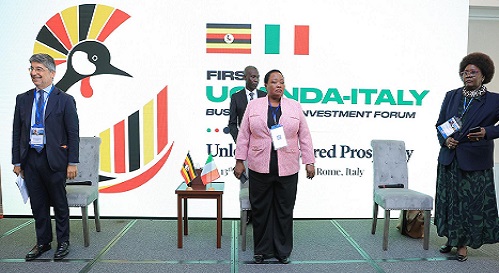
The Prime Minister of Uganda Robinah Nabbanja centre at the opening of the first Uganda–Italy Business and Investment Forum at Rome Cavalieri, a Waldorf Astoria hotel in Italy Tuesday 13 October 2026.
HABARI DAILY I Kampala, Uganda I Robinah Nabbanja, Uganda’s Prime Minister, has asked Italian companies to process Ugandan coffee, milk and minerals inside Uganda instead of importing it as raw materials.
She made the remarks during the opening of the first Uganda–Italy Business and Investment Forum at Rome Cavalieri, a Waldorf Astoria hotel in Italy on Tuesday October 13.
“We want our people from Italy to take coffee made in Uganda. Not grown in Uganda,” Nabbanja told Ugandan officials and Italian business leaders. She said roasting and packing coffee would create jobs for Uganda’s young population.
Nabbanja’s remarks were contained in a statement issued by Uganda Media Centre on October 13, 20026.
Currently, Italy is the biggest buyer of Ugandan coffee with 8.8 million 60kg bags of coffee exported annually, earning $2.4b (about sh10b), according the agriculture ministry reports.
Stay Updated by Clicking on Our Social Media Channels above:
Nabbanja said Ugandan farmers who grow and harvest coffee earn very little from raw beans, while a kilogramme of finished coffee goes for sh231,550 (about 50 Euros) in Italy.
“That is where I want partnerships so that we can help Ugandans to make you have a cup of coffee on the table,” she said.
She tied each of the four Agro-Industrialisation, Tourism, Minerals and Science, Technology and Innovation (ATMS)pillars to openings for Italian firms, citing agro-processing, machinery and cold chains to hotels, mineral value addition and pharmaceuticals.
She said the Government planned to generate 52,000 megawatts of electricity by 2040, saying industrialisation was impossible without power.
Dr Gerald Kyalo, Commissioner for Coffee at the Ministry of Agriculture, Animal Industry and Fisheries, said Uganda is Africa’s biggest producer of robusta coffee that accounts for 89% of the country’s coffee, while arabica accounting is 11%.
Over 1.5 million farmers are registered, while 1.6 million coffee gardens are mapped, according to Kyalo. “We expect the number to reach 2.6 million farmers by the end of the year,” he said.
Kyalo said Uganda consumes only about 7% of the coffee it produces, and invited Italian firms to set up soluble coffee plants. He said Ugandan coffee exports would carry a national “Ugandan Coffee” brand and logo starting next financial year.
He said the Tenfold Growth Strategy seeks to expand the economy from $50b to $500 billion by 2040 through agro-industrialisation, tourism, mineral development, and science, technology and innovation that will attract investment to $50b by 2040.