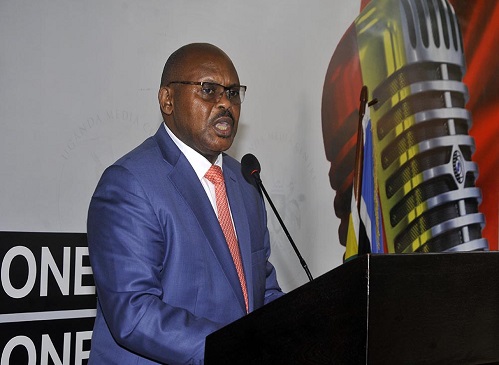

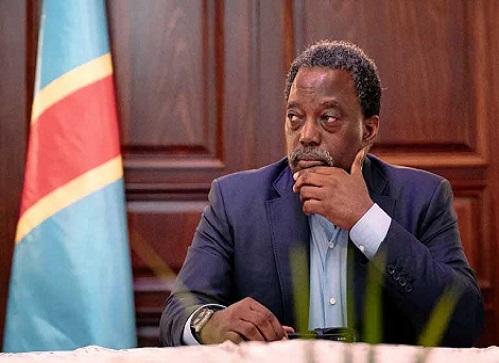
Kabila addressing a press briefing to announce the new armed alliance with M23 rebels
HABARI DAILY I Kampala, Uganda I Former Democratic Republic of Congo (DRC) President Joseph Kabila is facing mounting international condemnation, US sanctions, domestic legal action and political isolation following allegations linking him to the Rwanda-backed M23 rebel movement.
His decision to launch a new political-military coalition has intensified scrutiny of his activities and raised concerns about escalating violence in eastern Congo.
In April 2026, the US Department of the Treasury’s Office of Foreign Assets Control (OFAC) imposed sanctions on Kabila, accusing him of providing financial, political and technological support to M23 and its political-military affiliate, the Congo River Alliance (AFC).
Washington also alleged that Kabila encouraged Congolese soldiers to defect and sought to regain political influence by supporting efforts against President Félix Tshisekedi’s government. The sanctions significantly increased pressure on the former president, whose alleged involvement in the rebellion has become a major point of contention in Congolese politics.
Kabila has rejected the accusations and challenged the US blacklist in a federal court in Washington, D.C. He argues that American authorities failed to provide concrete evidence or identify specific financial transfers connecting him to the rebels.
He has also dismissed the sanctions as politically motivated, maintaining that Tshisekedi’s administration and its international partners are attempting to discredit him amid the country’s continuing security crisis.
The legal challenge introduces another dimension to the dispute, placing Kabila’s allegations against Washington’s justification for its sanctions before a US judicial process.
New Rebel-Linked Political Coalition
The controversy intensified on October 12, 2026, when Kabila officially launched the Front for the Refoundation of the Nation (FRN) in Goma, a major city in eastern DRC under M23 control since January 2025.
The new coalition incorporates groups previously associated with the AFC, the political-military alliance linked to the rebellion. Former electoral commission chairman Corneille Nangaa, who led the AFC, serves as a vice president within the FRN.
The coalition also brings Kabila into closer political alignment with M23 figures, including political leader Bertrand Bisimwa and military commander Sultani Makenga. The development is particularly striking because M23 previously fought Kabila’s government between 2012 and 2013 before being defeated by Congolese forces supported by United Nations troops.
The FRN presents itself as an alternative to Tshisekedi’s administration, accusing the government of weakening democratic institutions, failing to restore security and mishandling the national crisis. Its founding declaration calls for national reconstruction, reconciliation, justice and the return of refugees.
However, the coalition’s emergence in rebel-controlled territory has intensified concerns that political opposition is becoming increasingly intertwined with armed conflict.
There was no immediate response from the Congolese government to the announcement. Nevertheless, officials aligned with Tshisekedi have argued that the FRN represents a continuation of the existing rebellion under a different name.
Death Sentence, Domestic Legal Action
Kabila’s political activities are unfolding against the backdrop of serious criminal proceedings in the DRC. A Congolese military court sentenced him to death in absentia in September 2025 on charges including treason, war crimes and crimes against humanity linked to his alleged collaboration with M23 and Rwanda.
The former president was not present during the proceedings and has denied the allegations, describing the case as politically motivated.
Before the trial, the Congolese Senate voted to lift his parliamentary immunity, clearing the way for national authorities to pursue prosecution. The proceedings have further complicated his political position, placing him at odds with institutions of the state he governed from 2001 to 2019.
The sentence represents a major escalation in the confrontation between Kabila and Tshisekedi’s administration. However, the allegations and judicial findings remain disputed by Kabila, who insists that the government is using legal action to weaken its political opponents.
The dispute also raises questions about how the Congolese authorities will respond to the former president’s new coalition and whether the development will lead to further legal or security measures.
Allies Distance Themselves From Kabila
Beyond international sanctions and domestic prosecution, Kabila is facing growing opposition from within his own political circles.
Former human rights minister Marie-Ange Mushobekwa publicly distanced herself from his decision to pursue an armed political strategy. Although she acknowledged her previous loyalty to Kabila, she said she could not support his association with a politico-military movement.
Mushobekwa maintained that political disagreements should be addressed through constitutional means and called for inclusive dialogue to resolve the country’s crisis. Her position highlights an important distinction within the opposition: critics of Tshisekedi do not necessarily support an alliance with armed rebels.
Aristote Ngarime, the People’s Party for Reconstruction and Democracy’s (PPRD) national secretary for communication and media, also rejected the FRN. He reaffirmed his commitment to the Congolese Constitution and explicitly opposed rebellion.
Patrick Nkanga Bekonda, rapporteur of the PPRD Political Bureau, announced his resignation from the party after nearly two decades of membership. Although he did not explicitly attribute his departure to the FRN’s formation, the timing added to uncertainty about Kabila’s political support.
These departures could weaken the networks of party officials and political allies that helped sustain Kabila’s influence after his presidency.
Allies Condemn the Alliance
Senior figures associated with Tshisekedi’s government have also criticised Kabila’s new political direction.
Peter Kazadi, a former deputy prime minister and interior minister, said Kabila’s appointment as FRN leader removed ambiguity surrounding his public association with the rebellion. He argued that the coalition was not fundamentally different from the AFC-M23 structure.
Deputy Prime Minister Jacquemain Shabani Lukoo also criticised Kabila’s association with the armed movement, while opposition figure Marley Vuvu announced that his movement was withdrawing its support for the former president.
Their reactions demonstrate the breadth of political resistance to the FRN, extending beyond the ruling party to figures who favour opposition politics conducted outside armed movements.
The criticism has also sharpened debate over sovereignty, constitutional obligations and the legitimacy of using military force to challenge the government.
Fears of Escalating Conflict
Kabila’s announcement has heightened concerns that the conflict in eastern DRC could intensify. M23 has captured extensive territory, including Goma and Bukavu, and has maintained control over strategic infrastructure and important border crossings.
Congolese government forces have struggled to reverse the rebels’ territorial gains, while negotiations have repeatedly encountered difficulties. Planned talks involving government and M23 representatives in Qatar in November 2026 could face additional obstacles following the FRN’s formation.
Yvon Muya, a researcher at the University of Ottawa, warned that the announcement could increase the likelihood of confrontation between Kabila and Tshisekedi. Analysts have also raised concerns that Kabila’s military background could encourage defections among government troops, although the extent of any such movement remains uncertain.
A United Nations Group of Experts report published in July 2026 reportedly described ambitions by Kabila and Nangaa to capture Kinshasa, while noting differences between their political objectives and those of M23 military leaders, some of whom preferred consolidating control over North and South Kivu.
The DRC, the United States and UN experts have accused Rwanda of supporting M23, allegations that Kigali denies.
Deepening Political Crisis
Kabila’s launch of the FRN marks a significant development in Congo’s prolonged political and security crisis. US sanctions, a contested death sentence, legal challenges and defections among former allies have placed the former president under mounting pressure.
His supporters present the coalition as an alternative to Tshisekedi’s government, while critics argue that its links to an armed rebellion threaten national stability and undermine prospects for negotiations.
With violence continuing in eastern Congo and diplomatic efforts still uncertain, the FRN’s emergence could complicate attempts to achieve a settlement.
The immediate challenge for the DRC is to prevent the political confrontation from producing further violence, protect civilians and revive credible negotiations. For Kabila, the alliance has created new political opportunities among the armed opposition while deepening international scrutiny and divisions among his former allies.







About the Author