
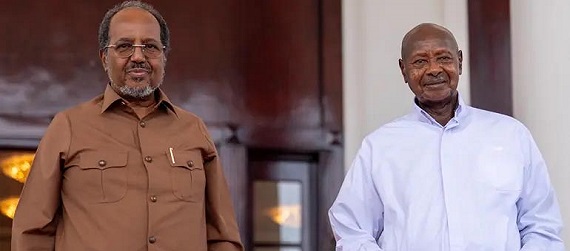
President Hassan Sheikh Mohamud of Somalia (L) and Uganda’s President Yoweri Museveni shortly after the State House meeting held on Tuesday, October 27, 2026
HABARI DAILY I Kampala, Uganda I Somali President Hassan Sheikh Mohamud has appealed to Uganda’s President Yoweri Museveni to delay the withdrawal of Uganda People’s Defence Forces (UPDF) troops from strategic areas in southern Somalia, fearing that a premature exit could create a security vacuum that the Al-Shabaab militant group could exploit to recapture liberated territories.
Mohamud reportedly made the request during a visit to State House Entebbe on Tuesday, October 27, 2026, where he held talks with Museveni on Somalia’s security situation and relations between the two countries.
The appeal follows Uganda’s communication to the Somali government about plans to withdraw troops from four locations in the Lower Shabelle region: Barawe, Bulo Marer, Qoryoley and Janaale. Ugandan forces have been involved in operations against Al-Shabaab in the area, which remains important to efforts to stabilise southern Somalia.
Somali media reports indicate that Mohamud wants Ugandan troops to remain longer to give Somali security forces additional time to prepare to assume responsibility for the affected locations. However, Museveni did not publicly confirm the reported request or announce any decision to extend the deployment.
Fear of Al-Shabaab Regaining Ground
The immediate concern for Mogadishu is whether Somali forces can maintain security in the four locations after the departure of Ugandan troops.
Al-Shabaab, an armed group that has fought Somalia’s federal government and international forces for years, continues to pose a threat to security operations and the government’s efforts to extend its authority across the country.
Somali authorities reportedly fear that withdrawing Ugandan troops before local forces are fully prepared could leave vulnerable positions exposed to renewed attacks. The concern has been heightened by reports that some Somali troops previously stationed in the affected locations have been redeployed elsewhere, raising questions about the capacity available to take over.
The four locations are therefore central to the transition. If Somali forces cannot secure them effectively, the government could face renewed pressure to defend areas already recovered from the militants, while civilians could be exposed to fresh insecurity.
For Mohamud, delaying the withdrawal would provide a buffer as Somali forces strengthen their operational readiness and work to sustain security without depending entirely on foreign troops.
Somali Forces Need More Time
The appeal also reflects the wider challenge of transferring security responsibilities from African Union peacekeepers to Somalia’s national forces.
Uganda was the first country to deploy troops under the African Union Mission in Somalia (AMISOM) in March 2007. Its forces have since played a major role in operations against Al-Shabaab and in supporting the Somali government’s efforts to stabilise the country.
Ugandan troops now serve under the African Union Support and Stabilisation Mission in Somalia (AUSSOM), which replaced the African Union Transition Mission in Somalia (ATMIS) on January 1, 2025.
The mission supports Somali security forces as they gradually assume greater responsibility for protecting the country. That transition requires trained personnel, reliable logistics, effective command structures and the ability to hold territory after offensive operations.
Mohamud’s reported request suggests that Somali authorities remain concerned about whether those capabilities are sufficient in every location where foreign troops are expected to leave.
A withdrawal without an effective handover could undermine the gains made through years of military operations. Maintaining Ugandan troops for longer would give Somalia additional time to prepare its forces and reduce the risk of gaps in security during the transition.
Funding Pressure Complications
The request comes amid financial uncertainty surrounding the African Union mission. Reports have pointed to concerns over international funding arrangements, including the future of direct United States support when current arrangements expire at the end of 2026.
Any reduction in external financing could complicate the mission’s ability to sustain deployments, provide logistical support and maintain operations against Al-Shabaab.
Somalia is therefore relying on regional partners, including Uganda, to maintain security support while diplomatic efforts continue to secure predictable financing and the necessary international backing for AUSSOM.
However, Uganda’s willingness to sustain a lengthy deployment cannot be taken for granted. Ugandan forces have been engaged in Somalia for nearly two decades, with personnel exposed to repeated attacks and casualties.
In May 2023, Al-Shabaab militants overran a UPDF base at Bulo Marer, one of the locations now reportedly affected by the planned withdrawal. The attack underscored the risks facing troops deployed in the region.
Uganda’s Chief of Defence Forces, Gen Muhoozi Kainerugaba, has also previously questioned how long the country can maintain its military commitment in Somalia, raising the prospect of withdrawing troops.
These pressures help explain why Mogadishu is seeking additional time, even as Kampala weighs the costs and demands of the deployment.
Political Differences
Beyond military preparedness and funding, reports suggest that the discussions between Museveni and Mohamud were also shaped by Somalia’s internal political divisions.
Museveni has reportedly urged Mohamud’s government to engage opposition leaders and federal states, including Puntland and Jubaland, amid tensions over the country’s political direction.
Some reports said Museveni pressed for broader dialogue and raised the possibility of troop pullbacks or redeployments if political divisions continued. These accounts have not been confirmed in the public statement released after the meeting.
Following the visit, Mohamud reportedly moved to invite opposition leaders to a national consultative conference, a development that could signal an effort to ease tensions. The available public account, however, does not establish whether this move was directly linked to Museveni’s reported position on the troops.
The political dimension matters because a more unified Somali leadership could help coordinate security operations, mobilise resources and support the transfer of responsibilities to national forces.
Museveni Makes No Public Commitment
In his account of the meeting, Museveni confirmed that security in Somalia featured prominently in the discussions but did not mention the reported request to delay the withdrawal.
“Today, I welcomed H.E. Hassan Sheikh Mohamud, President of the Federal Republic of Somalia. We discussed matters concerning our two countries, especially the security situation in Somalia,” Museveni said.
He also announced plans to expand commercial ties, saying Somalia would soon begin receiving Uganda’s value-added coffee. He did not specify when exports would start or the volumes expected.