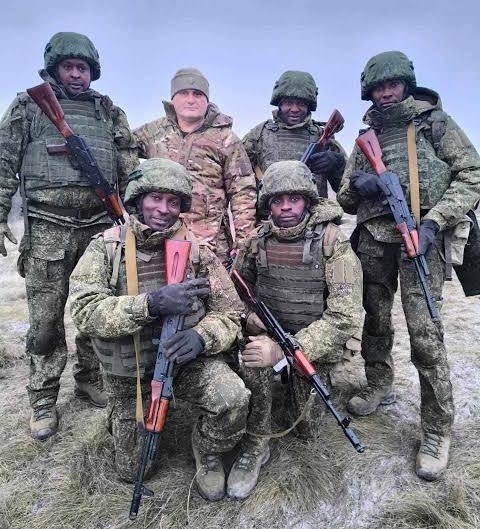
Ugandans serving in the contingent of the Russian armed forces on the Ukrainian war front
HABARI DAILY I Kampala, Uganda I Although death is part of warfare, the confirmation that 11 Ugandans recruited into the Russian military have died fighting in Ukraine has raised troubling questions about accountability, the treatment of foreign recruits and the apparent inability of their government to secure the return of their remains.
The Russian government has confirmed the deaths of 11 Ugandan nationals who joined its military operations in Ukraine, while another 16 have been classified as missing and presumed dead, according to diplomatic correspondence from Uganda’s embassy in Moscow.
However, despite the confirmation of the deaths, the prospects of repatriating the remains of the deceased to Uganda remain uncertain, with financial constraints and diplomatic challenges complicating efforts to bring closure to grieving families.
The revelations are contained in a letter dated October 17, 2026, written by Uganda’s Ambassador to Russia, Moses Kizige, to the Permanent Secretary of the Ministry of Foreign Affairs in Kampala.
The correspondence provides one of the clearest official accounts yet of Ugandans recruited into the Russian military, following months of appeals by families seeking information about relatives who travelled abroad in search of employment but allegedly ended up on the battlefield.
Russia Confirms 11 Deaths
According to the diplomatic report, Russian authorities confirmed that the following Ugandans had died: Ronald Bugiri, John Male, Francis Ngabirano, Innocent Agaba, Levi Kasule, Bigirwa Mugisa, Richard Twine, Junior Moses Mawejje, Pius Byamugisha, David Buyondo and Godfrey Kamugira.
The correspondence, however, does not specify when or where each individual died, nor does it establish whether their remains have been recovered and preserved for repatriation.
That uncertainty leaves their families facing the prospect of mourning relatives whose final circumstances remain largely unexplained.
Beyond the 11 confirmed deaths, Russian authorities identified 16 other Ugandans whose whereabouts remain unknown. They include Maxima Tindyebwa, Darius Twebaze, Alex Katurebe, Miro Mukasa, Eric Kwesiga, Kosiaa Kusima, Johnson Kakuru, Edwin Musasizi, Vicent Musisi, Nelson Mugyenyi, Alex Akanshabira, David Kiwanuka Ssekisibo, Henry Rwakiziri Bamutina, Stephen Muhame, William Kyoffa and Nelson Lukwita.
The embassy said the missing individuals were believed to have died because their bodies could not be located and they were not known to be prisoners of war.
“It is important to note that the persons listed in this category are effectively dead, but their bodies could not be located anywhere. They are also not known to be prisoners of war,” the letter states.
The classification raises further questions about the circumstances under which the men disappeared and what steps Russian authorities have taken to establish their final fate.
Repatriation Faces Financial Hurdles
For the bereaved families, confirmation of death is only part of the battle. Securing the remains of their loved ones and bringing them home for burial presents another major challenge.
In February 2026, State Minister for Foreign Affairs Henry Okello Oryem said the Ugandan government lacked the capacity to repatriate the bodies of citizens who die abroad.
“The government of Uganda does not have the capacity to repatriate the bodies of Ugandans who lose their lives abroad. That is why we advise Ugandans travelling abroad to go through official channels,” Oryem said.
His remarks followed appeals from the family of Edson Kamwesigye, a Ugandan reportedly killed while fighting for Russia in Ukraine.
Other Ugandans, including Michael Atuhaire and Ashiraf Damulira, had also previously been reported killed while serving in Russian forces.
The government’s position places families in a difficult situation, particularly when they have limited financial resources and little information about where their relatives died or whether their bodies can be recovered.
The diplomatic correspondence does not indicate that Russia has committed to paying for the repatriation of the 11 confirmed dead or provided a timetable for handing over their remains.
For families already struggling to establish the truth, the absence of clear arrangements leaves an additional burden of uncertainty.
Allegations of Deception and Human Trafficking
The circumstances surrounding the recruitment of the Ugandans have intensified concerns about possible human trafficking networks exploiting unemployed citizens and former security personnel.
Several families have alleged that their relatives travelled to Russia after being promised well-paying civilian jobs, including positions as security guards, drivers and factory workers.
Instead, some reportedly discovered upon arrival that they were expected to sign military contracts, undergo training and deploy to the frontline in Ukraine.
Elizabeth Tabamubi, whose husband Byamugisha reportedly travelled to Russia in December 2025 after being promised a security job, told The Observer that a Russian recruiter identified as Dimitry had offered employment to her husband and about 30 other Ugandans.
She said her husband contacted her within days of arriving to report that circumstances had changed, and that he and other recruits had been taken to a military camp before being deployed to the battlefield.
Other families have reportedly received photographs of deceased relatives through social media rather than through official diplomatic channels. Some have also complained that promised salaries and benefits never reached them.
The allegations have raised questions about whether recruits fully understood the terms of their contracts and the risks they faced before leaving Uganda.
The Ugandan Parliament has demanded explanations from the government regarding recruitment networks allegedly targeting unemployed citizens and veterans for foreign military service.
However, the precise circumstances surrounding each recruit’s enlistment have not been independently established, and the allegations against individual recruiters require investigation.
Embassy Pursues Answers from Moscow
Ambassador Kizige said he began pursuing the matter in August after receiving telephone calls from Innocent Kato, who represents families of Ugandans believed to have joined the Russian military.
Kato supplied passport details for some of the missing individuals, which the ambassador verified through Uganda’s Directorate of Citizenship and Immigration Control.
The embassy subsequently contacted Russia’s Ministry of Foreign Affairs on August 19, requesting information about the Ugandans.
Russia responded on October 8, providing details of those confirmed dead, those missing, five still serving in the military and one individual who had been dismissed.
Kizige then forwarded the findings to Kampala on October 17, requesting urgent communication with the affected families.
The inquiry followed an earlier directive issued on July 23 by Foreign Affairs Permanent Secretary Vincent Bagiire, instructing the ambassador to investigate allegations that Ugandans had been trafficked to Russia and deployed to the battlefield.
The correspondence also identified five Ugandans still serving in the Russian military: Rogers Mwebaze, Evarist Barigye, Honest Mugabi, Eric Kisakye and Ronald Samula Tenywa. They are expected to leave the service when their contracts expire.
Another Ugandan, Robert Tumwebaze, was reportedly dismissed from the Russian armed forces. However, his whereabouts remain unknown following his transfer from a military hospital in Nizhny Novgorod.
These cases illustrate the difficulties facing diplomatic officials attempting to trace foreign recruits whose movements and military status are largely controlled by the country in which they serve.
Families Demand Accountability
Kato has called on Russia to account for Ugandans who died while serving under its military command, arguing that the circumstances of their deaths should not prevent families from receiving answers.
“For those who died, there should be accountability. Russia should account for these people. They were serving under Russia, and it should account for them,” he said.
The demand raises fundamental questions about the responsibilities of military authorities towards foreign recruits, particularly regarding notification of deaths, identification of remains, communication with relatives and arrangements for burial.
While Uganda’s government has pursued diplomatic inquiries, the available correspondence does not establish whether Moscow has accepted responsibility for repatriating the deceased or agreed to compensate their families.
The lack of a clear public commitment on these matters has fuelled concerns that families may be left to bear the emotional and financial consequences of a conflict they had little control over.
For relatives of the 16 missing Ugandans, the uncertainty is even greater. Without recovered bodies or confirmation that the men are prisoners of war, families have limited means of determining whether their loved ones are alive.
The five Ugandans still serving in the Russian military also remain a concern, particularly given the allegations that some recruits were misled about the nature of the jobs they had accepted.
The latest revelations therefore place pressure on both governments to establish transparent procedures for investigating recruitment allegations, tracing missing nationals and communicating with affected families.







About the Author