
Gen. Salim Saleh
HABARI DAILY I Kampala, Uganda I Five-year Consociational Democracy Agreement seeks to replace winner-takes-all politics with inclusive governance, while renewed engagements with Dr Kizza Besigye and other opposition figures offer a possible starting point for national reconciliation.
Salim Saleh’s peace building credentials are set to be put to the test as the senior military officer embarks on an initiative to bring Uganda’s ruling National Resistance Movement (NRM) and opposition political parties together under a proposed power-sharing arrangement aimed at addressing decades of political divisions.
Gen. Saleh, President Yoweri Museveni’s younger brother and Chief Coordinator of Operation Wealth Creation, is promoting a Consociational Democracy Agreement (CDA), a framework developed in collaboration with historian Prof. Ogenga Otunnu, which seeks to move Uganda away from the winner-takes-all electoral system towards a more inclusive form of governance.
The proposal envisages a five-year national process involving political parties, civil society organisations, religious institutions and cultural leaders to rebuild trust, address historical grievances and strengthen democratic institutions.
At the centre of the initiative is the argument that Uganda’s political stability cannot be secured through electoral victories alone, particularly where sections of the population feel excluded from national decision-making.
The proposal therefore seeks to establish structured cooperation between competing political groups, potentially allowing them to participate in governance and national development beyond the traditional boundaries of government and opposition.
Revisiting the divisions within the NRM
One of the key issues Saleh wants the proposed agreement to address is the political fragmentation that followed the NRM’s assumption of power in January 1986.
The original National Resistance Movement brought together different political, military and social forces that had opposed previous governments. However, disagreements within the coalition subsequently contributed to divisions among some of its founding actors.
Saleh believes that understanding and addressing these historical disagreements is essential to preventing similar conflicts from being passed on to younger generations.
Rather than treating political competition as an unavoidable struggle for control of the state, the CDA proposes a negotiated framework through which different political constituencies can participate in shaping the country’s future.
The five-year transition is expected to provide sufficient time for dialogue, reconciliation and institutional reforms, rather than relying on short-term political agreements that may collapse when competing interests emerge.
The proposal also draws on President Museveni’s historical practice of accommodating some rival political actors and former insurgents through negotiated political compromises.
Saleh appears to regard these experiences as evidence that political differences can be addressed through engagement rather than continued confrontation.
Besigye’s state opened a channel for engagement
Saleh’s recent intervention in the case of detained opposition politician Dr Kizza Besigye has provided a practical example of his stated interest in reconciliation across Uganda’s political divide.
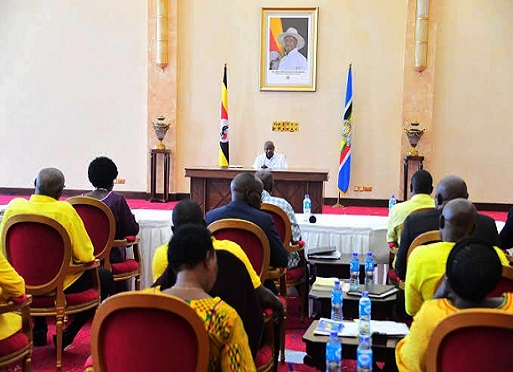
Speaking to more than 100 Members of Parliament, mostly from the ruling NRM, at Kapeeka in Nakaseke District, Saleh revealed that he intervened to secure better medical care for Besigye after finding him in a critical condition.
The legislators had visited factories at Namunkekera Liao Shen Industrial Park when Saleh recounted how he became involved in efforts concerning the veteran opposition politician.
He said he acted after seeing an X post by his nephew, Chief of Defence Forces Gen. Muhoozi Kainerugaba, suggesting that he was best placed to intervene in Besigye’s legal troubles.
“I saw the post and contacted General Muhoozi and asked him if he was serious. He actually didn’t know that it was an opportunity to reconnect with an old friend,” Saleh said.
He subsequently visited Besigye and was concerned by his condition, prompting him to arrange his transfer to the Joint Clinical Research Centre (JCRC) in Lubowa.
“The sick bed Besigye is in right now is the same bed I would be in if I was also sick,” Saleh said, drawing applause from the legislators.
Besigye was transferred from Luzira Prison to JCRC in August alongside former Kampala Lord Mayor Erias Lukwago for medical attention. Uganda Prisons Service confirmed the transfer on August 31.
Saleh’s intervention was significant because it involved an individual who has been one of Museveni’s most prominent political challengers for decades.
However, Saleh declined to confirm media reports that he was leading negotiations intended to secure Besigye’s release.
Opposition questions and the limits of reconciliation
Saleh’s reported engagements have also involved consultations linked to former Kampala Lord Mayor Erias Lukwago and other opposition figures, although the precise scope and participants in the discussions have not been publicly established.
In early October, reports emerged that Saleh was coordinating a group of eminent persons to engage opposition representatives over Besigye’s continued detention.
However, the People’s Front for Freedom (PFF) subsequently denied that it was negotiating with Saleh for its leader’s release. The party’s deputy chief of cabinet for policy and communication, Harold Kaija, said no senior party official had been granted access to Besigye since his collapse in court on July 29, making it impossible for the party to negotiate on his behalf without his instructions.
Besigye’s wife, Winnie Byanyima, also rejected claims that her husband was involved in negotiations, insisting that his health, freedom and constitutional rights should not be treated as bargaining instruments.
She nevertheless encouraged Saleh to pursue any genuine national dialogue openly and inclusively, but separately from her husband’s legal case.
The competing positions illustrate one of the challenges facing the proposed reconciliation initiative: securing the participation and confidence of political actors who may have different views about how political disputes should be resolved.
Besigye has been on remand since November 2024, following his arrest in Nairobi, Kenya, and subsequent transfer to Uganda. He faces treason charges alongside his political aide, Hajji Obeid Lutale, and retired UPDF officer Capt Denis Oola. The three deny the allegations.
His trial is before the High Court Criminal Division, presided over by Justice Emmanuel Baguma.
Five years to build a new political consensus
Beyond the immediate question of Besigye’s detention, the Consociational Democracy Agreement seeks to address the broader political and institutional questions that have shaped Uganda’s governance.
The proposed five-year process is expected to bring together political parties, religious leaders, cultural institutions, civil society organisations and ordinary citizens to identify the causes of national divisions and negotiate a framework for peaceful coexistence.
Prof. Otunnu has argued that the initiative should not be confined to political elites but should involve ordinary Ugandans whose experiences and grievances are central to the country’s divisions.
The consociational model is based on power-sharing, mutual recognition and cooperation among different political and social constituencies. It has been used in other countries to manage societies characterised by deep political, ethnic or religious divisions.
Under such arrangements, important national decisions are made through negotiated participation rather than allowing one political group to exercise unrestricted control simply because it has won an election.
For Uganda, this could mean developing mechanisms that give opposition parties a meaningful role in national decision-making, alongside reforms aimed at strengthening public institutions and protecting political participation.
However, the proposal’s practical details, including how positions would be shared, how competing interests would be represented and what constitutional changes might be necessary, remain matters for further discussion.
A test of political goodwill
Saleh’s initiative comes at a time when Uganda continues to grapple with disagreements over political competition, the treatment of opposition leaders and public confidence in democratic institutions.
Its success will depend not only on the willingness of the ruling NRM to accommodate competing political interests but also on whether opposition parties consider the proposed process credible, inclusive and capable of delivering meaningful reforms.
It will also require clarity on whether the CDA is intended to complement the existing constitutional and electoral framework or introduce more fundamental changes to Uganda’s system of government.
For Saleh, who has maintained relationships with several political actors despite their disagreements with his brother’s government, the initiative presents an opportunity to translate personal engagements into a broader national reconciliation process.
His appeal to prevent younger Ugandans from inheriting political quarrels from previous generations captures the central argument behind the proposal.
“We are trying to help young people not to inherit generational quarrels. I hope we can convince each other in the next three or six months to get the Uganda we want,” he told the legislators.







About the Author