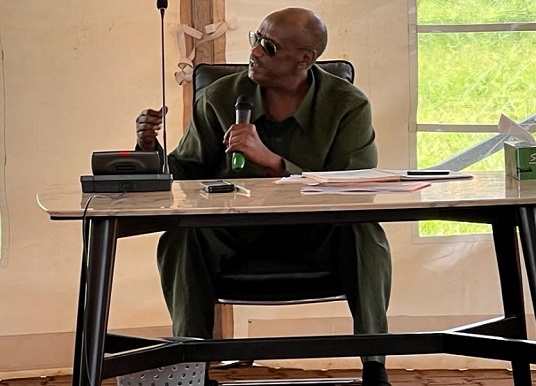
Uganda and Tanzania recently entered into a digital infrastructure partnership
HABARI DAILY I Kampala, Uganda I Uganda and Tanzania are strengthening their digital infrastructure partnership through a series of fibre-optic connectivity initiatives intended to reduce internet costs, improve reliability and open new opportunities for regional trade, as Uganda seeks to end its heavy dependence on internet routes passing through Kenya.
The partnership, which brings together the National Information Technology Authority-Uganda (NITA-U), Tanzania Telecommunications Corporation (TTCL), Uganda Electricity Transmission Company Limited (UETCL) and other private-sector players, is expected to give Uganda alternative access to international internet capacity through Tanzania.
At the centre of the initiative is a $28.8 million agreement signed between NITA-U and TTCL on September 29, 2023, to integrate Uganda’s National Backbone Infrastructure (NBI) with Tanzania’s National ICT Broadband Backbone (NICTBB).
The 15-year agreement provides for the interconnection of the two countries’ national fibre-optic networks through the Mutukula border point, creating an alternative route through which Uganda can access international submarine internet cables connected to Tanzania.
The agreement was signed in Dar es Salaam, with Tanzania’s then Minister of Information, Communications and Information Technology, Nape Nnauye, confirming that the deal was worth approximately $28 million, equivalent to 71.7 billion Tanzanian shillings.
The integration was officially commissioned in May 2023 by President Yoweri Museveni and his Tanzanian counterpart, Samia Suluhu Hassan, in Isingiro District, marking an important milestone in the two countries’ digital cooperation.
According to NITA-U, the connection was designed to enhance internet infrastructure, improve connectivity and provide Uganda with an alternative route to international submarine cables through Dar es Salaam.
The significance of the arrangement is particularly important for a landlocked country such as Uganda, whose internet connectivity has traditionally depended heavily on fibre networks connecting to submarine cables through neighbouring Kenya.
Such dependence exposes Uganda to disruptions whenever there are problems along the Kenyan route. It also creates opportunities for multiple commercial intermediaries to influence the cost of wholesale internet capacity.
By accessing Tanzania’s extensive network of submarine cable connections, Uganda hopes to increase competition among international bandwidth suppliers and eventually reduce the cost of internet services for businesses, government institutions and ordinary consumers.
New investment and alternative routes
Beyond the NITA-U and TTCL agreement, Uganda is pursuing additional infrastructure investments to strengthen connectivity through Tanzania.
Reports have highlighted a proposed $300 million fibre-optic infrastructure expansion associated with the Pondway-Mutukula corridor, intended to extend connectivity to additional Ugandan districts while creating another route for international internet traffic.
The broader objective is to establish redundancy in the country’s digital infrastructure, ensuring that disruptions along one international connection do not bring internet services to a standstill.
Uganda’s National Backbone Infrastructure has already been extended to Masaka, Mutukula, Mbarara, Kabale and other locations. NITA-U identifies the Mutukula-Dar es Salaam connection as an alternative route to undersea cables.
However, the proposed $300 million expansion should be distinguished from the already signed $28.8 million NITA-U-TTCL agreement, as publicly available documentation does not yet establish the full financing and implementation arrangements for the larger proposal.
Museveni explores electricity and oil pipeline corridors
The government’s latest thinking also involves using existing infrastructure corridors to expand fibre-optic connectivity.
President Museveni has directed relevant ministries to explore the possibility of installing or utilising digital connectivity infrastructure alongside Tanzania’s high-voltage electricity transmission lines and the East African Crude Oil Pipeline (EACOP) corridor.
The proposal involves leveraging the electricity transmission infrastructure managed by UETCL and fibre-optic facilities associated with the petroleum pipeline to create cheaper connectivity alternatives.
The discussions have brought Samanga Utilities and Liquid Telecommunications into the picture, particularly regarding the management and commercialisation of UETCL’s Dense Wavelength-Division Multiplexing (DWDM) fibre network, which stretches more than 1,775 kilometres across Uganda.
Energy Minister Monica Musenero, in a July 27, 2026 directive, instructed UETCL to discontinue an existing procurement process for a commercialisation partner and prepare a fresh proposal involving Samanga Utilities and Liquid Telecommunications.
The proposed arrangement, estimated at $4.6 million, has attracted scrutiny over procurement procedures, the ownership and management of existing infrastructure and whether the initiative involves constructing a new international connection or commercialising existing fibre assets.







About the Author