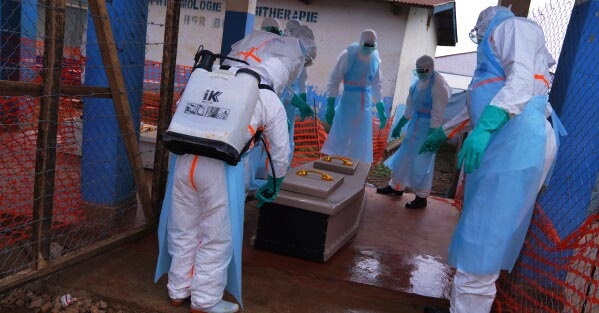
Another victim being prepared to be laid to rest
HABARI DAILY I Kampala, Uganda I WHO warns of escalating regional threat as more than 10,300 confirmed infections are recorded, with Uganda, Kenya and Nigeria also reporting cases amid challenges in containing the deadly Bundibugyo strain.
The World Health Organisation has warned on an Ebola continent wide escalation following the death of more than 5,000 people in the Democratic Republic of Congo (DR Congo), where an ongoing outbreak has spread to eight of the country’s 26 provinces, raising fears of further cross-border transmission.
According to the Congolese government, the epidemic has so far registered more than 10,300 confirmed infections, with a case fatality rate of 48.6 per cent, meaning nearly half of those confirmed to have contracted the virus have died.
The outbreak, which began in May 2026, became the deadliest in DR Congo’s history in August, overtaking the previous record of 2,299 deaths recorded between 2018 and 2020.
It is also the second-largest Ebola outbreak ever documented globally, with the United Nations warning that the current epidemic is claiming lives at a much faster rate than previous outbreaks.
The latest developments have heightened concern among public health authorities because infections have also been confirmed in Uganda, Kenya and Nigeria, demonstrating the risk of the virus spreading beyond DR Congo.
Conflict-hit Ituri remains the epicentre
The Congolese Ministry of Health says Ituri Province, in the country’s north-eastern region, remains the epicentre of the epidemic.
The security situation in the area, which has experienced prolonged armed conflict and instability, has complicated efforts to contain the virus, particularly access to affected communities and the delivery of medical services.
Health workers face difficulties conducting surveillance, tracing people who have come into contact with infected individuals and ensuring that suspected cases receive timely treatment.
The World Health Organisation’s Africa office has called for an intensified response if a continent-wide escalation is to be prevented, emphasising the need for expanded control measures, improved access to affected areas and stronger community engagement.
It said testing and treatment activities were continuing, alongside clinical trials of vaccines, as health authorities and international partners worked to contain the outbreak.
However, the response faces a major scientific challenge because the current epidemic is caused by the Bundibugyo species of the Ebola virus, for which there is currently no approved specific treatment or vaccine.
This limits the medical tools available to health workers, making early detection, supportive clinical care, isolation and infection prevention particularly important.
Outbreak overtakes previous DR Congo record
The current epidemic marks the 17th Ebola outbreak in DR Congo’s history, according to the United Nations.
Its death toll has already exceeded the 2,299 fatalities recorded during the 2018–2020 outbreak, which was previously the country’s deadliest.
Globally, the deadliest Ebola epidemic occurred in West Africa between 2014 and 2016, killing more than 11,325 people and spreading across several countries.
The outbreak also resulted in cases outside Africa, including in Italy, the United Kingdom and the United States.
The United Nations has warned that the present DR Congo outbreak is taking lives at a considerably faster rate, raising concerns that continued transmission could result in further fatalities unless containment efforts are strengthened.
Attacks on health workers escalate
Efforts to contain the outbreak have also been complicated by violence against health workers and other people involved in public health campaigns.
Earlier this week, a nurse was killed and another health worker seriously injured while responding to an Ebola alert in Bafwasende, Tshopo Province.
According to the UN-backed Radio Okapi, local youths attacked the medical workers after accusing them of contaminating water sources and spreading the virus.
The World Health Organisation condemned the attack, warning that violence against frontline personnel threatens efforts to control the epidemic.
Last month, a politician was beaten to death after promoting measures intended to prevent the spread of Ebola.
The Red Cross also reported 11 violent incidents during the first 100 days of the outbreak in August, including injuries to volunteers and the burning of an ambulance.
Such incidents have increased the difficulties faced by medical teams, particularly in communities where misinformation, fear and distrust of health authorities undermine public health interventions.
Uganda, Kenya and Nigeria affected
The outbreak has also raised concern among neighbouring countries, with Uganda, Kenya and Nigeria reporting infections linked to the regional epidemic.
In Uganda, 20 confirmed cases and two deaths were recorded between May and June 2026. The World Health Organisation declared the country’s outbreak over on August 25, following 42 days without a new confirmed case.
However, authorities have maintained precautionary border measures, including restrictions on non-essential travel to and from DR Congo and a 21-day quarantine requirement for returning Ugandan citizens from affected areas.
Kenya has recorded nine confirmed cases and two deaths, following the importation of the virus from DR Congo through Uganda.
Nigeria has also reported a confirmed case, while two additional suspected cases were identified on Saturday. The country’s disease control authorities said the individuals had been isolated and were undergoing testing.
Earlier in October, a woman who tested positive in Nigeria was evacuated to Switzerland for specialised medical care.
Despite the regional spread, the European Centre for Disease Prevention and Control has assessed the likelihood of infection among people living in Europe as very low.
Limited treatment options
Ebola is a rare but highly infectious disease caused by a virus that can lead to severe illness and death.
Symptoms usually develop suddenly and include fever, fatigue, muscle pain and headaches. As the disease progresses, patients may experience vomiting, diarrhoea and organ failure. Some develop internal and external bleeding.
Transmission occurs through direct contact with the blood and other bodily fluids of infected people, as well as contaminated materials.
The absence of an approved vaccine or specific treatment for the Bundibugyo strain makes prevention, early diagnosis, isolation and supportive medical care particularly important.
With the death toll approaching or exceeding 5,000, depending on the reporting cut-off and classification used, the epidemic has become a major test of regional public health preparedness.







About the Author