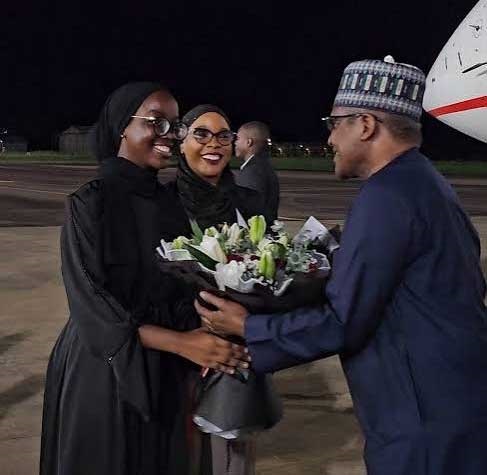
Billionaire Dangote is received at Entebbe International Airport after disembarking from his private jet recently
HABARI DAILY I Kampala, Uganda I Uganda’s efforts to persuade Nigerian billionaire Aliko Dangote to establish major manufacturing industries in the country have entered a critical phase, following a series of high-level engagements aimed at securing multibillion-dollar investments in oil refining, fertiliser production and mineral processing.
The government is seeking to convince Africa’s richest man that Uganda offers a viable investment destination for expanding his industrial empire, with President Yoweri Museveni personally joining negotiations following a Ugandan delegation’s visit to Nigeria.
However, whether the discussions will translate into actual factories and financial commitments remains uncertain, given the enormous capital requirements, technical assessments and commercial considerations involved in the proposed projects.
The latest push began on November 14, 2026, when a Ugandan delegation led by Energy and Mineral Development Minister Dr Monica Musenero Masanza and State Minister for Finance in charge of Privatisation and Investment Hajjat Amina Mukalazi visited Dangote’s industrial facilities in Lekki, Lagos.
The delegation toured the Dangote Petroleum Refinery and Dangote Fertiliser Limited, where officials presented Uganda’s investment opportunities and the country’s natural resource potential.
According to Business Insider Africa, the officials used the engagement to invite Dangote to consider establishing industrial facilities in Uganda, particularly in sectors where the country has locally available raw materials and growing regional markets.
Three days later, on November 17, Dangote travelled to Uganda, where he held investment discussions with Museveni at State House, Entebbe.
The direct presidential engagement signalled the importance Kampala attaches to attracting the Nigerian conglomerate, whose investments could potentially transform Uganda’s industrial landscape.
At the centre of the negotiations is the proposed Hoima oil refinery, a 60,000-barrel-per-day facility estimated to cost approximately $4 billion.
Uganda wants the Dangote Group to take a leading role in developing the refinery, which is expected to process crude oil from the country’s Albertine Graben and reduce dependence on imported petroleum products.
The government is also presenting opportunities in phosphate processing, fertiliser blending and salt manufacturing, hoping to attract investments that would transform locally available resources into finished products.
These projects form part of an integrated industrialisation strategy in which different factories could share infrastructure, logistics and distribution networks, reducing operating costs and improving commercial viability.
One of the arguments being advanced by the Ugandan delegation is the strategic positioning of the country as a gateway to landlocked markets in the Great Lakes and wider East African region.
Mukalazi reportedly argued that a refinery in Uganda would complement Dangote’s planned coastal refinery in Lamu, Kenya, rather than compete with it.
Under this arrangement, the Lamu facility would serve coastal and maritime markets, while a Ugandan refinery could supply inland markets that face additional transportation costs when importing petroleum products through seaports.
The government is also promising to provide institutional support to remove bureaucratic obstacles, facilitate technology transfer and create an environment that allows large-scale investments to proceed.
However, several factors will determine whether the negotiations produce tangible results.
First, the proposed projects require substantial capital, meaning Dangote’s investment team will have to establish whether projected returns justify the financial exposure.
Second, the technical and commercial feasibility of the Hoima refinery and other proposed factories must be independently assessed, including the availability of raw materials, infrastructure, energy and reliable markets.
The government will also need to demonstrate that its investment incentives, regulatory framework and logistical arrangements can support operations over the long term.
Uganda’s regional market access presents an opportunity, particularly given the demand for petroleum products and agricultural inputs across East Africa. However, the actual competitiveness of locally manufactured products will depend on production costs, transportation infrastructure and regional trade arrangements.
For Dangote, whose industrial investments span cement, fertiliser, petroleum refining and other manufacturing activities, Uganda presents an opportunity to extend his operations into an inland market with considerable natural resource potential.
Nevertheless, the engagements have not yet produced a binding financial commitment. The proposed projects still require technical assessment by Dangote’s engineering team before decisions on investment structures, financing and implementation can be made.
Dangote’s net worth
Nigerian billionaire Aliko Dangote’s wealth is estimated at between $39.4 billion and $55.4 billion, making him one of the richest businessmen in the world and Africa’s wealthiest individual.
According to Forbes, Dangote’s net worth stood at approximately $55.4 billion as of late October 2026, while Bloomberg estimated his fortune at $39.4 billion, reflecting differences in their wealth valuation methodologies.
The Nigerian industrialist’s fortune is largely built on his extensive investments in manufacturing, cement production, petroleum refining and other strategic industries across Africa.
A major contributor to his growing wealth is the Dangote Petroleum Refinery in Nigeria, which has significantly boosted his industrial portfolio.
The refinery experienced a sharp increase in valuation following a private placement and the launch of its initial public offering (IPO) in September 2026, strengthening Dangote’s position in the global energy industry.
He also controls a majority stake in Dangote Cement, Africa’s largest cement producer, which operates across several African markets and remains one of his most significant wealth-generating businesses.
Beyond petroleum and cement, Dangote has substantial investments in fertiliser production, sugar, salt and banking, giving him exposure to several sectors of the African economy.
His business empire has positioned him as a major player in Africa’s industrialisation drive, particularly through investments aimed at reducing dependence on imported manufactured products.
Dangote’s wealth has also made him an influential figure in discussions about large-scale industrial investments, including Uganda’s efforts to attract his conglomerate into oil refining, fertiliser manufacturing and mineral processing.